

Beverage manufacturers depend on a supplier network that extends well beyond the primary ingredients. Water, concentrates, sweeteners, flavours, preservatives, bottles, cans, closures and labels all influence product quality and production continuity. A weakness in any of these inputs can affect an entire production line.
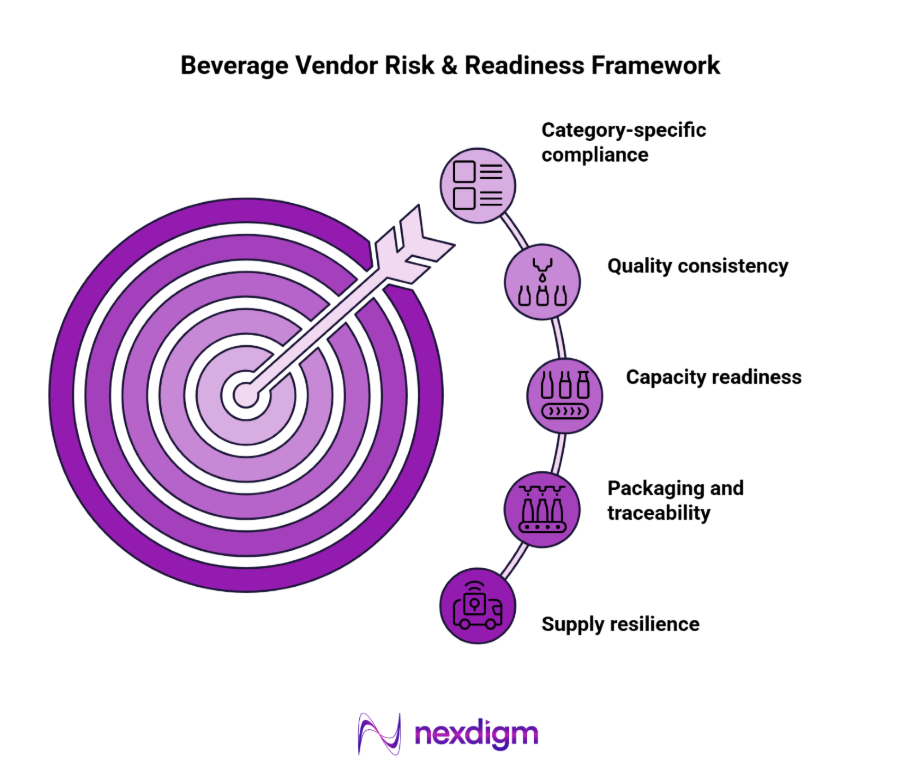
The risk profile also varies by beverage category. Packaged drinking water requires strict control over source water and treatment processes. Carbonated drinks depend on consistent ingredient specifications and packaging integrity. Fruit-based beverages may face seasonal raw-material availability, while dairy-based drinks require additional temperature and microbiological controls.
A supplier assessment must account for these differences rather than applying one compliance checklist across every category.
A Changing Regulatory Environment for Beverage Suppliers
India’s packaged food and beverage market is expanding alongside the wider food-processing sector. Processed food exports reached approximately US$10.1 billion in FY2024–25, while the sector’s gross value added increased to ₹2.24 lakh crore in FY2023–24.
At the same time, regulatory requirements continue to evolve. In December 2025, FSSAI issued a specific testing scheme for packaged drinking water and mineral water, effective from 1 January 2026. The change followed the removal of the mandatory BIS certification provision and established a separate testing framework for these products.
For manufacturers, this makes regulatory monitoring an important part of supplier evaluation. A vendor’s previous certification or compliance record may not fully establish whether it meets the requirements currently applicable to its product category.
Four Areas That Determine Beverage Vendor Reliability
- Product Quality and Safety
Quality assessment should begin with the characteristics of the supplied material. Water suppliers require evaluation of source quality, treatment systems and microbiological controls. Ingredient vendors need to demonstrate consistency in parameters such as concentration, purity, composition and shelf life.
Testing records should be checked against the product’s applicable specifications. Businesses should also examine sampling frequency, laboratory arrangements, rejected batches and the way deviations are investigated. - Manufacturing Capacity and Process Control
A supplier’s ability to meet current orders does not necessarily establish its ability to support future growth. Capacity assessment should examine installed production capacity, actual output, utilisation, equipment condition and availability of additional shifts.
For beverage manufacturers, production interruptions can affect filling and packaging schedules. Suppliers of caps, bottles, cartons and labels therefore need to be evaluated against the production requirements of the facilities they serve. - Packaging Integrity and Traceability
Packaging failures can result in leakage, contamination, product deterioration and consumer complaints. Vendors should be assessed on material specifications, food-contact suitability, batch identification, testing procedures and consistency between production lots.
Traceability is equally important. Manufacturers should be able to connect incoming packaging or ingredients to the finished product batches in which they were used. - Supply and Delivery Continuity
Supplier reliability depends on geographical location, transport availability, raw-material access and contingency arrangements. Seasonal concentrates, imported flavours and specialised packaging may have longer replenishment cycles than standard inputs.
Businesses should identify suppliers whose disruption could stop production or affect several product lines simultaneously.
What Food Safety Enforcement Data Tells Manufacturers
FSSAI analysed 170,535 food samples during FY2024–25, with 34,388 found non-conforming. In the dairy segment alone, 33,405 milk and milk product samples were analysed, of which 12,780 were found non-conforming.
The dairy figures are relevant to beverage manufacturers using milk-based ingredients, but they should not be treated as a failure rate for the wider beverage industry. They demonstrate why category-specific testing and supplier controls matter.
Nexdigm’s market assessment and industry research capabilities can help beverage businesses evaluate supplier landscapes, production capacity, regional supply conditions and regulatory developments. This supports decisions on supplier selection, market expansion and supply-network diversification.
Nexdigm’s Case Study
A beverage manufacturer operating 3 production facilities assessed 36 suppliers across ingredients, packaging and water treatment. The review identified 8 vendors with significant capacity or compliance gaps. The client qualified 6 alternate suppliers, improved documented compliance coverage from 72% to 94% and reduced average replenishment lead times by 18%.
To take the next step, simply visit our Request a Consultation page and share your requirements with us.
Harsh Mittal
+91-8422857704