

Financial institutions increasingly depend on external technology providers, outsourcing partners, consulting firms, and infrastructure vendors. Their sustainability commitments therefore extend beyond internal operations to the environmental, social, and governance practices of their suppliers. According to EcoVadis’ 2026 Sustainable Procurement Barometer, 98% of surveyed companies have started integrating ESG data into procurement, yet only 48% have visibility into ESG practices across most Tier 1 suppliers.
Additionally, 30% of suppliers do not report emissions data. The OECD’s 2026 Responsible Business Outlook indicates that fewer than 20% of large listed companies report evaluating supplier risks using environmental or social criteria. These gaps make structured BFSI ESG vendor evaluation research increasingly important for responsible supplier selection.
Why ESG Vendor Evaluation Matters in BFSI
Banks, insurers, and financial services companies work with suppliers whose practices can influence regulatory exposure, operational continuity, reputation, and sustainability performance. Weak governance, limited emissions transparency, or inadequate labour safeguards can create risks beyond the immediate supplier relationship. Evaluating ESG performance helps institutions understand these dependencies and make sourcing decisions aligned with responsible business expectations.
What Should Financial Institutions Examine Vendor ESG Assessments?
Financial institutions should assess vendors across three core dimensions: environmental and social performance, transparency of sustainability disclosures, and governance accountability. This includes reviewing emissions management, labour practices, ESG reporting, ethical conduct, compliance frameworks, and risk-management processes. Examining these areas helps institutions distinguish measurable sustainability practices from broad commitments and make more informed supplier comparisons.
Nexdigm’s Expert-led Initiative in Evaluating Vendor ESG Practices
Nexdigm helps financial institutions build a structured understanding of supplier sustainability through research, ESG profiling, and comparative assessments. Our approach focuses on examining key aspects of:
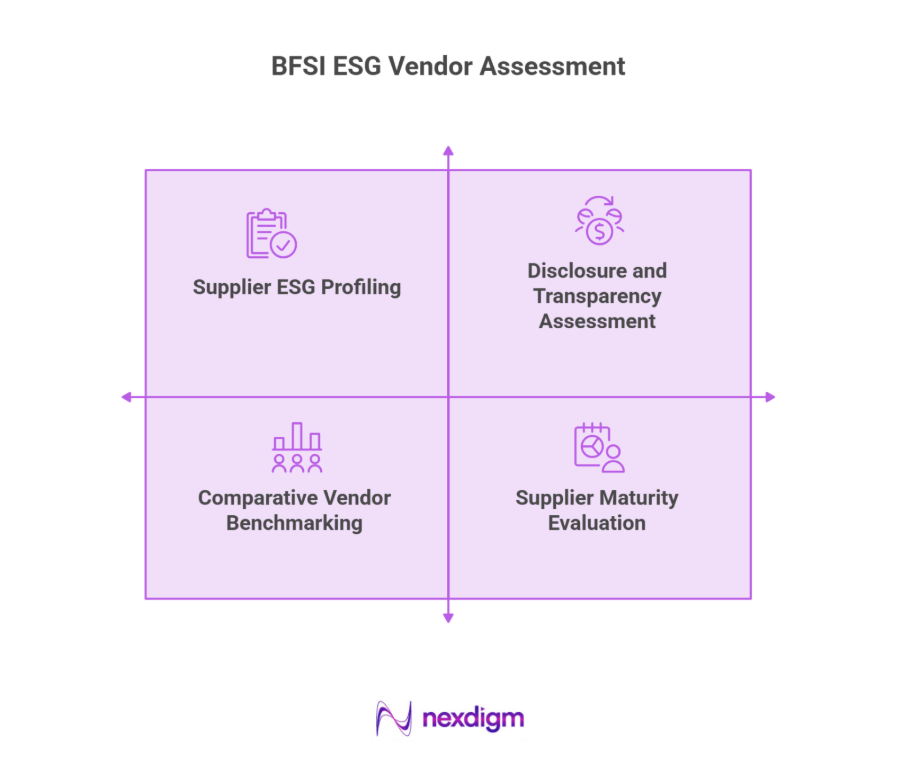
- Supplier ESG Profiling: Research vendors’ environmental policies, emissions disclosures, labour practices, sustainability initiatives, and governance commitments to understand their ESG positioning.
- Disclosure and Transparency Assessment: Examine the availability, consistency, and credibility of supplier disclosures to identify information gaps and areas requiring further validation.
- Comparative Vendor Benchmarking: Compare suppliers across ESG practices, governance standards, business capabilities, and market positioning to understand their relative strengths and limitations.
- Supplier Maturity Evaluation: Assess the extent to which sustainability commitments are supported by defined policies, measurable targets, reporting practices, and accountability mechanisms.
Through this research-led approach, Nexdigm helps procurement teams move beyond broad sustainability claims, develop clearer supplier comparisons, and incorporate ESG considerations into vendor selection and ongoing management.
Understanding Emerging Vendor ESG Trends With Nexdigm
Beyond individual supplier assessments, financial institutions need visibility into how sustainability practices are evolving across the broader vendor market. Through BFSI ESG vendor evaluation research, Nexdigm provides market intelligence and competitive insights focused on:
- Emerging ESG Expectations: Track changing sustainability priorities, disclosure practices, and governance expectations across financial technology and service providers.
- Vendor Sustainability Positioning: Understand how providers communicate their ESG commitments, sustainability initiatives, and environmental and social performance.
- Market-Level Benchmarking: Compare sustainability approaches across vendor categories to identify common practices, differentiated capabilities, and areas where market transparency remains limited.
- Changing Market Requirements: Examine how regulatory developments, customer expectations, and responsible business practices may influence vendor sustainability priorities.
These insights give financial institutions a broader view of the market and help them place individual supplier findings within the evolving ESG landscape.
How Nexdigm’s ESG Intelligence Supports Financial Institutions and Investors
Nexdigm combines company research, market intelligence, and competitive benchmarking to help financial institutions and investors interpret ESG developments across the BFSI vendor ecosystem. Our research capabilities support several strategic priorities:
- Assessing Market Readiness: Examine how vendors are responding to evolving ESG expectations and incorporating sustainability into their business strategies.
- Understanding Competitive Positioning: Evaluate how providers differentiate themselves through environmental initiatives, social responsibility practices, and governance standards.
- Identifying Emerging Business Risks: Highlight potential concerns arising from limited ESG disclosures, governance weaknesses, or gaps in sustainability commitments.
- Evaluating Long-Term Business Potential: Understand how sustainability practices, regulatory developments, and market expectations may influence vendor relevance and business positioning over time.
These insights help financial institutions and investors connect ESG considerations with market developments, competitive dynamics, and longer-term business priorities.
Nexdigm’s Case
A financial institution engaged Nexdigm to assess ESG practices across its vendor ecosystem. The research found that 29% of reviewed vendors demonstrated strong alignment with evaluation criteria, while 14% offered differentiated sustainability practices and 15% required further disclosure validation. These insights supported structured vendor comparisons and procurement decisions.
To take the next step, simply visit our Request a Consultation page and share your requirements with us.
Harsh Mittal
+91-8422857704