

In competitive financial markets, product adoption depends on how effectively firms understand customer needs, position offerings, select channels, and build trust. A strong BFSI go to market strategy helps banks, fintechs, insurers, payment providers, and investment platforms translate market entry strategy into practical execution. It connects product design, pricing, partnerships, distribution, compliance, and customer engagement into a focused launch plan.
As financial products become more digital and competitive, firms need clear messaging, localized outreach, and efficient onboarding to convert interest into adoption. Effective go-to-market planning supports faster entry, stronger differentiation, and sustainable customer growth across BFSI markets.
The global fintech market was valued at USD 394.88 billion in 2025 and is projected to reach USD 1,760.18 billion by 2034, growing at 18.20% CAGR. Digital payments are also expanding, with the market projected to grow from USD 164.8 billion in 2026 to USD 682.8 billion by 2033. These trends highlight the need for a focused BFSI go to market strategy.
Role of Go-to-Market Strategy in Improving Financial Product Adoption
Role of Go-to-Market Strategy in Improving Financial Product Adoption explains how customer targeting, product positioning, pricing, distribution, education, and onboarding help financial firms improve awareness, trust, conversion, and sustained usage:
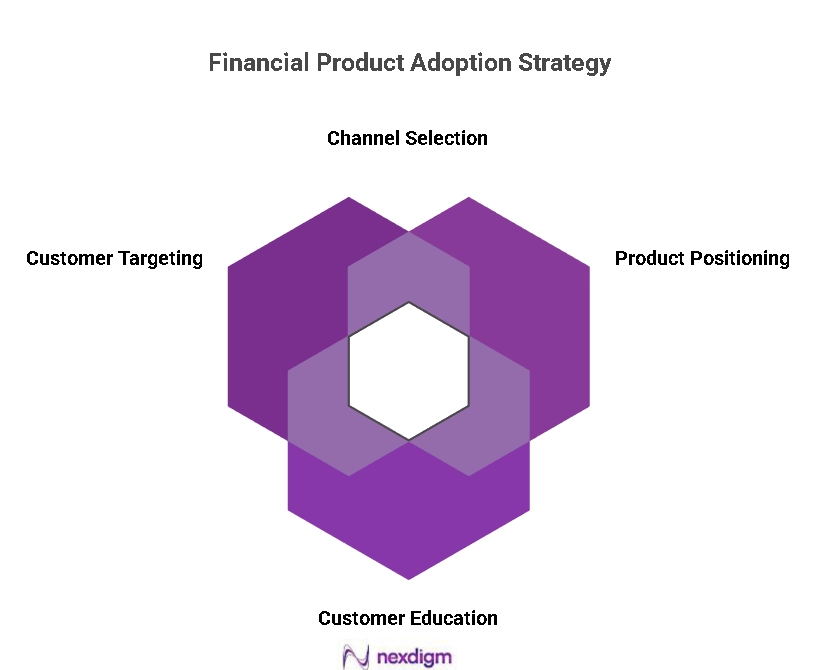
- Customer Targeting: Identifies priority customer groups based on financial needs, behavior, income, digital readiness, and product adoption potential.
- Product Positioning: Communicates product value clearly by linking benefits, features, pricing, and use cases to customer priorities.
- Channel Selection: Chooses suitable digital, branch, partner, distributor, and direct sales channels to reach target customers effectively.
- Customer Education: Helps users understand product benefits, risks, usage steps, pricing, and long-term financial value before adoption.
Nexdigm’s Competitive Benchmarking for BFSI Product Launch Strategies
Nexdigm’s Competitive Benchmarking for BFSI Product Launch Strategies helps firms compare competitor offerings, pricing, distribution channels, customer experience, digital onboarding, product positioning, and promotional approaches. These insights support stronger differentiation, better launch planning, improved customer targeting, and a more effective BFSI go to market strategy across competitive financial markets.
How Can Nexdigm Support Pricing Strategy for Financial Product Adoption?
Nexdigm helps assess competitor pricing, customer affordability, fee structures, incentives, revenue models, and perceived value to improve adoption and profitability.
- Incentive Model Design: Nexdigm helps assess cashback, introductory offers, loyalty benefits, referral rewards, and partner incentives to attract customers.
- Revenue Model Assessment: Nexdigm evaluates transaction-based income, subscription models, asset-based fees, cross-sell income, and long-term profitability potential.
- Value Perception Mapping: Nexdigm studies whether customers view pricing as fair based on product benefits, convenience, trust, and service quality.
- Pricing Optimization Roadmap: Nexdigm converts pricing insights into actionable recommendations for launch pricing, promotional offers, profitability, and adoption growth.
Nexdigm’s case:
Recently, Nexdigm helped a BFSI company refine its pricing strategy before launching a new financial product in a competitive market. Nexdigm benchmarked 14 competitor pricing models, analyzed 6 customer segments, reviewed 9 fee structures, and assessed customer affordability across 3 target markets.
The support helped the company improve pricing clarity, reduce launch rework by 28%, increase expected customer conversion by 22%, and build a more adoption-focused BFSI go to market strategy.
To take the next step, simply visit our Request a Consultation page and share your requirements with us.
Harsh Mittal
+91-8422857704