

Demand data is only the starting point for entering banking, financial services, and insurance markets. A large addressable market does not necessarily translate into profitable demand once regulation, capital requirements, competitive intensity, distribution costs, and operating infrastructure are considered.
For financial institutions, market entry is ultimately an investment decision. The assessment needs to establish not only where demand exists, but whether an entrant can build a viable business around it, how much capital will be required, and which entry model can achieve sustainable returns.
Regulation Defines the Commercial Perimeter
Financial services operate within regulatory boundaries that determine what an institution can offer, how it can distribute products, and how much capital it must maintain.
An entry assessment should examine:
- Licensing and permissible activities
- Capital adequacy and statutory requirements
- Ownership and FDI restrictions
- Regulatory obligations for lending, deposits, insurance, or investment products
- Data, governance, and compliance requirements
- Potential regulatory changes that could alter the business model
This distinction matters because theoretical market demand can become commercially inaccessible when the required licence, capital structure, or regulatory obligations make the proposed model uneconomic.
Competition Reveals the Cost of Winning Customers
Market size does not indicate how expensive it will be to capture market share. Established banks, insurers, and NBFCs may have lower funding costs, extensive distribution networks, established customer relationships, and the ability to withstand prolonged pricing pressure.
Competitive analysis should therefore examine:
- Incumbent market share and balance-sheet strength
- Product pricing and margin structures
- Branch and distributor coverage
- Customer acquisition costs
- Distributor commissions and incentives
- Customer retention and switching behaviour
The objective is to identify where competitive intensity leaves genuine commercial white space rather than assuming that an underserved segment is automatically profitable.
Operating Infrastructure Can Determine Time to Market
The ability to enter a market also depends on whether the required infrastructure can be established efficiently.
Technology assessment should cover core banking, policy administration, lending systems, API middleware, fraud monitoring, and integration with financial infrastructure such as payment and identity networks.
The availability of underwriting, compliance, treasury, technology, and relationship-management talent can affect both launch timing and operating costs. Operational feasibility is equally important.
For lending businesses, legal and physical infrastructure also matters. Collateral documentation, asset registration, enforcement processes, and recovery timelines can materially influence portfolio economics.
The Entry Model Changes the Investment Requirement
An advisory assessment should compare alternative routes into the market rather than assuming that a greenfield operation is the default.
- Greenfield entry provides control over technology and operating design but requires significant upfront investment.
- Brownfield acquisition can accelerate access to customers and infrastructure while introducing legacy asset-quality, technology, and integration risks.
- Partnership-led entry can reduce capital requirements and accelerate distribution but creates dependence on external platforms and limits control over customer relationships and economics.
The right choice depends on the institution’s capital availability, strategic objectives, regulatory position, risk appetite, and required speed to market.
A Market Entry Strategy Should End With a Financial Decision
The final assessment needs to translate market intelligence into a five-year investment case. This should connect market opportunity with:
- Target customer and product segments
- Required regulatory structure
- Capital deployment and staging
- Distribution and technology investment
- Balance-sheet or premium growth
- Margin and fee-income assumptions
- Cost-to-income trajectory
- Asset-quality or claims scenarios
- Break-even and return expectations
This allows boards and investment committees to determine whether to enter, which vehicle to use, how much capital to commit, and which milestones should trigger subsequent investment.
Nexdigm’s BFSI Market Entry Advisory Framework
Nexdigm’s bfsi industry market entry advisory services integrate five areas of analysis:
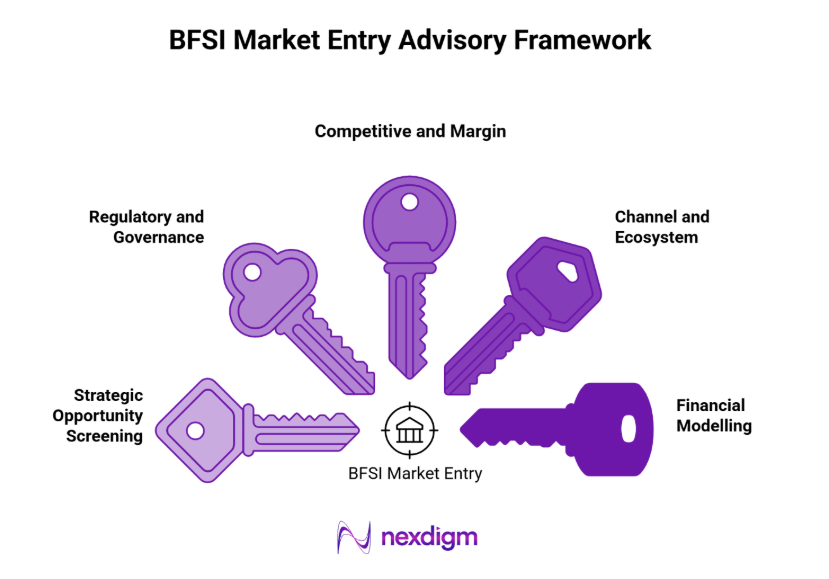
- Strategic Opportunity Screening: Identify and size commercially addressable customer segments using market, transaction, demographic, and financial-flow data.
- Regulatory and Governance Structuring: Determine the appropriate regulatory perimeter, corporate structure, licensing requirements, and governance framework.
- Competitive and Margin Benchmarking: Assess incumbent economics, pricing, funding costs, distribution structures, and customer retention to identify defensible white space.
- Channel and Ecosystem Design: Evaluate branch, digital, intermediary, and partnership models based on acquisition economics, customer access, and implementation requirements.
- Financial Modelling and Execution Roadmap: Build five-year financial scenarios, capital-staging plans, stress tests, and phased implementation milestones.
The resulting assessment connects market attractiveness, regulatory feasibility, operating requirements, capital needs, and expected returns into a single entry decision.
How Nexdigm Converts Market Intelligence Into an Entry Decision
A diversified industrial conglomerate evaluating a ₹3,200 crore financial-services investment compared an NBFC, housing finance company, and universal-bank entry. Nexdigm found the greenfield banking route required disproportionate capital and a 6.4-year break-even, while housing finance faced margin pressure. A phased Upper-Layer NBFC strategy projected ₹16,500 crore portfolio value by Year 5, with 15.8% ROE and 2.3% ROA, providing the basis for board approval.
To take the next step, simply visit our Request a Consultation page and share your requirements with us.
Harsh Mittal
+91-8422857704