

Building a financial services franchise organically can take years. An acquisition can compress that timeline by providing an existing customer base, operating infrastructure, distribution network, experienced teams, and, depending on the target, an established regulatory position.
But speed alone does not make an acquisition attractive. A target can accelerate market entry while simultaneously importing weak asset quality, expensive legacy technology, regulatory liabilities, or an incompatible business model. The investment case therefore has to compare the value of acquiring an existing position with the cost and risk of building the same position organically.
What Is the Acquirer Actually Buying?
The strategic value of a BFSI target rarely sits in its physical assets alone. It can reside in the relationships, capabilities, and infrastructure accumulated over years.
For different target types, the source of value can vary:
- Banks: Low-cost CASA deposits, customer relationships, branch networks, transaction histories, and regulatory positioning.
- NBFCs: Specialized underwriting capabilities, collection infrastructure, local market knowledge, and secured lending portfolios.
- Insurers: Distribution relationships, agency and broker networks, policyholder relationships, and product capabilities.
- Asset managers: AUM, investment track record, distributor relationships, and recurring fee income.
The first screening question should therefore be: which capabilities would take the longest or cost the most to reproduce organically?
The Cheapest Target Can Be the Most Expensive Acquisition
Financial services targets require diligence well beyond headline profitability: loan growth can mask borrower concentration or lax underwriting, premium surges can hide rising claims, and large AUM often conceals institutional reliance.
Due diligence should examine:
- Loan or policy vintage performance
- Asset-quality and provisioning adequacy
- Capital and solvency position
- Asset-liability maturity mismatches
- Regulatory and compliance history
- Customer and distributor concentration
- Technology architecture and migration requirements
- Governance and key-person dependencies
The purpose is to determine the adjusted economic value of the franchise, rather than relying on reported book value.
Strategic Fit Determines Whether the Target Creates Value
Market share alone cannot justify an acquisition; the target must reinforce the acquirer’s strategic focus. For example, a wholesale corporate portfolio adds little value to a lender targeting secured MSME expansion, just as metropolitan branches create a mismatch for an institution prioritizing secondary-market distribution.
A useful acquisition screen should compare the target against the acquirer’s intended operating model across:
Customer fit → Product fit → Geographic fit → Distribution fit → Risk fit → Technology fit → Synergy potential
This also determines whether the target should be integrated, operated independently, or used as a platform for subsequent expansion.
Valuation Needs a Build-versus-Buy Benchmark
Traditional corporate valuation metrics are insufficient for balance-sheet financial institutions. The acquisition price needs to reflect the value of the regulatory position, customer franchise, future earnings, and assets after adjusting for hidden risks.
Depending on the target, relevant measures can include:
- Price-to-Book and Price-to-Adjusted Book Value for banks and NBFCs
- Price-to-Embedded Value for life insurers
- AUM-based valuation for asset managers
- ROE and earnings multiples alongside balance-sheet measures
A substantial acquisition premium is economically justified only if time-to-market advantages and capital savings outweigh the organic build cost, but that rationale collapses if integration expenses erase those gains.
Regulatory and Integration Risk Can Reverse the Thesis
BFSI M&A carries distinct risks rarely seen in standard deals, particularly regulatory bottlenecks and hidden post-acquisition vulnerabilities across compliance, provisioning, and underwriting. Technology migration requires rigorous scrutiny; an attractive distribution network quickly loses value if legacy architecture cannot seamlessly integrate.
Consequently, financial models must stress-test downside scenarios, accounting for delayed approvals, elevated integration costs, higher provisioning, customer attrition, and slower synergy realization.
Key Scrutiny Areas
- Regulatory & Approvals: Lengthy change-of-control clearances and supervisory findings that alter valuation or deal terms.
- Technology & Operations: Incompatible legacy platforms that inflate migration costs and erode distribution value.
- Balance Sheet Integrity: Latent provisioning shortfalls and gaps in underwriting or compliance.
- Financial Modelling: Mandatory downside sensitivity for attrition, extended timelines, and delayed synergies.
Nexdigm’s BFSI Acquisition Target Assessment Framework
Nexdigm’s bfsi mergers and acquisitions market entry consulting approach evaluates acquisition-led expansion through five stages:
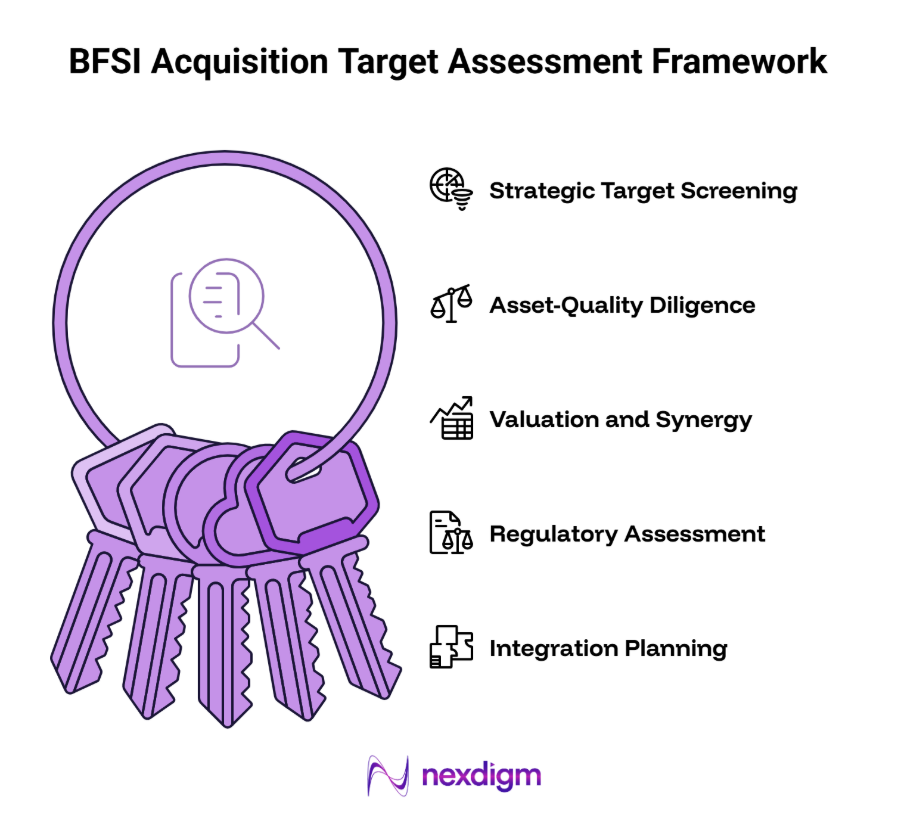
- Strategic Target Screening: Define acquisition objectives and screen the target universe by product, geography, customer base, scale, regulatory position, and strategic fit.
- Balance-Sheet and Asset-Quality Diligence: Examine loan vintages, claims, provisions, collateral, liabilities, capital adequacy, and regulatory history to establish adjusted economic value.
- Valuation and Synergy Modelling: Compare acquisition pricing with adjusted book value, embedded value, earnings, expected synergies, integration costs, and the cost of an organic build.
- Regulatory and Transaction Assessment: Identify change-of-control requirements, approval timelines, competition considerations, and transaction conditions.
- Post-Merger Integration Planning: Develop technology migration, branch rationalization, governance, risk-management, talent-retention, and customer-transition plans.
This creates a transaction thesis that answers three questions: Is this the right target? Is the price justified? And does acquisition create a better market-entry outcome than building organically?
How Nexdigm Identifies Acquisition Targets That Can Accelerate Market Entry
An international banking institution seeking entry into Indian retail and micro-enterprise lending screened 32 NBFCs and SFBs for a target with a ₹5,000–₹10,000 crore loan book and established secondary-market distribution.
Nexdigm shortlisted eight and conducted deeper diligence on three, identifying material liabilities in two. The recommended ₹6,800 crore secured-lending NBFC, valued at 1.90x Price-to-Adjusted Book Value, accelerated entry by four years and created ₹340 crore of projected operating savings over 36 months.
To take the next step, simply visit our Request a Consultation page and share your requirements with us.
Harsh Mittal
+91-8422857704