

Launching new financial products requires pricing decisions that balance customer expectations, competitive dynamics and long-term profitability. BFSI pricing feasibility study consulting enables financial institutions to validate pricing strategies through comprehensive Pricing Analysis, competitor benchmarking, customer willingness-to-pay assessments, demand forecasting, and financial modelling.
By evaluating market acceptance and commercial viability before launch, organizations can optimize pricing structures, minimize revenue risks, strengthen product positioning, and improve the likelihood of successful adoption in increasingly competitive financial markets.
Strategic Pricing Analysis can improve new product revenue realization by 8–15%, while robust pricing feasibility assessments may increase customer adoption by 20–30%. Data-driven pricing decisions also help reduce commercialization risks, enhance competitive positioning, and support sustainable profitability across evolving BFSI markets.
BFSI Pricing Analysis for Demand Validation, Revenue, and Risk Assessment
BFSI pricing analysis helps financial institutions validate market demand, forecast revenue, and identify commercial risks before introducing new products across highly competitive financial markets successfully. Core benefits of the same are:
- Segment Opportunity Analysis: Identifies customer groups offering the strongest demand and revenue potential. Major benefits revolve around focusing on targeting, efficient resource allocation, and improved conversion opportunities.
- Willingness-to-Pay Testing: Measures how much customers are prepared to pay for different product benefits. Major benefits include accurate pricing, stronger uptake, and reduced discount dependence.
- Adoption Barrier Identification: Highlights pricing concerns that may restrict customer acquisition or usage. It usually focuses on lower resistance, improved onboarding, and faster product adoption.
- Decision Support Framework: Combines demand, revenue, cost, and risk insights into actionable recommendations. It focuses on faster approvals, evidence-based decisions, and greater launch confidence.
Nexdigm’s Pricing Analysis Support for Commercially Viable BFSI Products
Nexdigm supports financial institutions in developing commercially viable BFSI products through structured pricing analysis, market feasibility assessment, competitor pricing benchmarking, and customer willingness-to-pay research. Its pricing strategy consulting evaluates demand, price elasticity, cost structures, revenue potential, and commercial risk, helping organizations optimize product pricing, strengthen market positioning, improve profitability, and make informed, evidence-based launch decisions across competitive financial markets.
Nexdigm’s Commercial Pricing Roadmap for BFSI Product Development
Nexdigm’s commercial pricing roadmap helps BFSI organizations develop market-ready products by aligning customer value, competitive positioning, revenue objectives, risk controls, and launch priorities effectively. Strategic steps of the roadmap are:
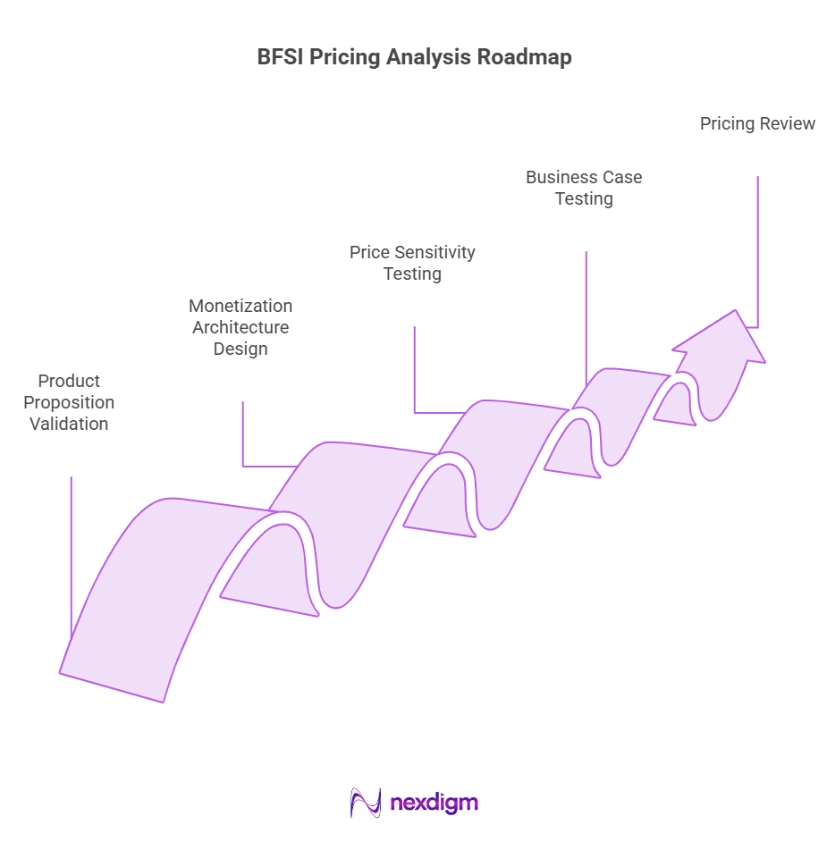
- Product Proposition Validation: Clarify the product’s target audience, core benefits, use cases, and market relevance before pricing assumptions are developed or tested.
- Monetization Architecture Design: Define how the product will generate revenue through fees, subscriptions, commissions, bundles, transaction charges, or relationship-based pricing structures.
- Price Sensitivity and Adoption Testing: Examine customer responses to different price points, product configurations, and benefit combinations to estimate adoption and identify acceptable pricing thresholds.
- Business Case Testing: Test revenue, cost, volume, and profitability assumptions under alternative market conditions to assess resilience and identify potential financial vulnerabilities.
- Pricing Review: Establish approval of responsibilities, monitoring standards, review cycles, and adjustment protocols to maintain pricing consistency, transparency, and long-term commercial effectiveness.
Nexdigm’s Case
Nexdigm supported a financial institution in validating the pricing of a new digital lending product through customer research, competitor benchmarking, and scenario analysis. The revised pricing model improved projected product adoption by 23%, increased expected fee revenue by 12%, reduced break-even time by 18%, and strengthened launch confidence.
To take the next step, simply visit our Request a Consultation page and share your requirements with us.
Harsh Mittal
+91-8422857704