

Procurement benchmarking is becoming increasingly important for financial institutions seeking to improve cost efficiency, supplier performance, and operational productivity. A 2026 banking-sector study found that cost savings and optimization were the primary value delivered by procurement for 36% of surveyed executives, followed by risk management at 15% and digitalization at 14%.
Another 2026 procurement survey found that 58% of respondents had discovered supplier overpayments against contractual terms within the previous year, while 72% identified supplier underperformance only after it had affected business operations.
These findings highlight the need for BFSI procurement benchmarking services to compare category-level costs, vendor performance, and operating models, helping financial institutions identify performance gaps and strengthen procurement decisions.
Understanding the Differences in BFSI Procurement Performance
Procurement performance varies across banks, insurers, and financial services organizations due to differences in operating scale, regulatory requirements, purchasing priorities, and supplier ecosystems. While some institutions prioritize cost efficiency, others focus on service continuity, risk management, and supplier quality. Comparing these factors provides a broader understanding of procurement effectiveness beyond expenditure alone.
Key Parameters That Shape Procurement Comparisons
A meaningful benchmarking exercise considers multiple performance indicators rather than relying on cost comparisons alone:
- Category-Level Efficiency: Compare expenditure, contract value, savings, and purchasing patterns across technology, operations, facilities, and outsourced services.
- Vendor Performance: Evaluate supplier pricing, service quality, delivery consistency, contractual compliance, and responsiveness to changing requirements.
- Operating-Model Effectiveness: Examine procurement structures, approval processes, governance, cycle times, and coordination across business functions.
Together, these parameters help institutions identify performance differences and understand the operational factors influencing procurement outcomes.
Nexdigm’s Expert-led View on Connecting Procurement Performance
Nexdigm approaches procurement benchmarking as a way to connect institutional performance with the wider supplier and market environment. Instead of viewing procurement metrics in isolation, its research can examine how commercial arrangements, supplier capabilities, sourcing practices, and operating structures influence outcomes. This perspective helps financial institutions understand not only how their procurement functions perform but also where meaningful improvement opportunities may exist.
Nexdigm’s Research Framework for Comparative Procurement Assessment
Nexdigm can support BFSI organizations through a combination of market research, supplier intelligence, and comparative analysis across procurement functions.
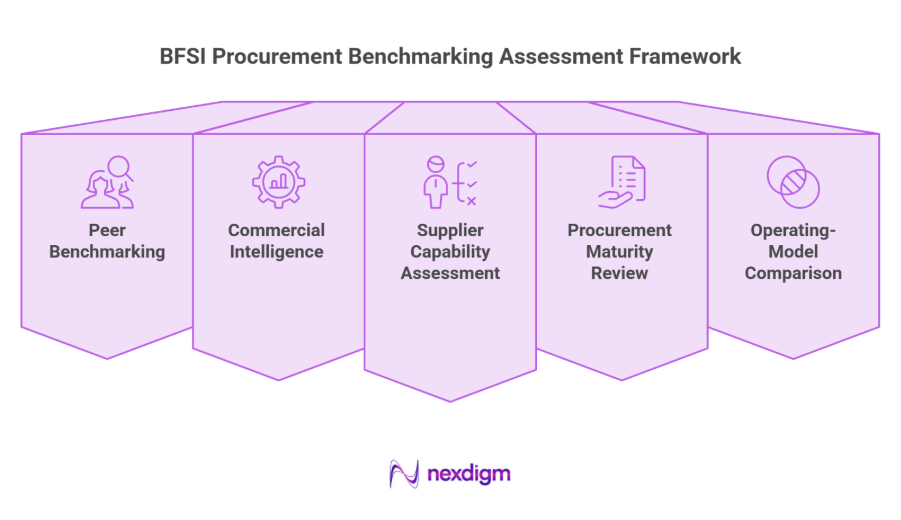
- Peer Benchmarking: Compare procurement practices and performance indicators across relevant institutions and market segments.
- Commercial Intelligence: Examine pricing structures, contract terms, and purchasing arrangements to understand variations in supplier value.
- Supplier Capability Assessment: Evaluate provider service offerings, operational capabilities, and market positioning across selected categories.
- Procurement Maturity Review: Assess sourcing processes, governance structures, and procurement capabilities to identify areas requiring development.
- Operating-Model Comparison: Study centralized, decentralized, and hybrid structures to understand their implications for efficiency and control.
By combining these assessment areas, Nexdigm helps financial institutions build a more comprehensive view of procurement performance. The findings provide a basis for understanding competitive positioning, identifying capability gaps, and prioritising areas for further evaluation.
Translating Nexdigm’s Benchmarking Insights Into Business Priorities
The findings from comparative research can help procurement leaders move from identifying performance gaps to evaluating specific improvement opportunities.
- Strategic Contract Reviews: Identify agreements that may benefit from renegotiation or revised commercial terms.
- Procurement Process Optimisation: Highlight workflow inefficiencies and opportunities to improve purchasing and approval processes.
- Supplier Relationship Improvements: Assess how supplier engagement and performance management can better support institutional requirements.
- Cost and Resource Prioritisation: Identify categories where additional procurement attention may deliver greater commercial value.
- Sourcing Model Refinement: Evaluate whether existing procurement structures remain appropriate as business requirements evolve.
Building on these comparative findings, Nexdigm helps organizations examine how identified performance gaps can translate into actionable business priorities.
How Nexdigm’s Collaborative Approach Improves Procurement Performance
Through collaborative research engagements, Nexdigm works with financial institutions to understand procurement challenges, evaluate performance gaps, and identify relevant improvement opportunities. By combining market intelligence with structured benchmarking, Nexdigm supports more informed commercial and operational decisions. This partnership-led approach helps organizations translate procurement insights into practical initiatives aligned with their business priorities.
Nexdigm’s Case
A financial institution partnered with Nexdigm to benchmark suppliers across four procurement categories. The assessment identified 28% opportunities for commercial improvement, 22% supplier performance gaps, and 19% potential process efficiencies. These findings helped prioritize contract reviews, strengthen vendor oversight, and improve procurement planning.
To take the next step, simply visit our Request a Consultation page and share your requirements with us.
Harsh Mittal
+91-8422857704