

The largest procurement cost optimization opportunities in BFSI often sit in technology, outsourced services, infrastructure and recurring operational contracts. These categories combine substantial expenditure with complex pricing structures, multiple suppliers and long-term service dependencies. Savings are more likely to come from understanding how institutions consume these services and how supplier markets are structured than from applying uniform price reductions across all categories.
For banks, insurers and financial services companies, procurement analysis should identify where expenditure is concentrated, which costs are driven by actual usage and where supplier alternatives can create commercial leverage without weakening service quality.
Technology and Infrastructure Offer Significant Areas for Review
Technology expenditure is a major area of procurement attention because financial institutions depend on software, hardware, cloud services, cybersecurity, connectivity and managed infrastructure.
However, the opportunity varies by subcategory. Software licensing may contain unused capacity, overlapping applications or pricing arrangements that no longer reflect actual usage. Cloud expenditure may be influenced by storage, computing demand, data transfer and architecture choices. Hardware costs may be affected by replacement cycles, support contracts and supplier concentration.
A useful review separates fixed commitments from consumption-based expenditure. It also examines whether different business units purchase similar services independently, creating fragmented demand and inconsistent commercial terms.
Data centre, network and infrastructure contracts deserve particular attention where institutions maintain multiple locations or rely on several service providers for connected workloads.
Outsourced Services Require a Volume and Productivity Perspective
Business process outsourcing, customer service, document processing, transaction support and technology maintenance can account for substantial recurring expenditure.
The opportunity is not always to move work to a lower-cost supplier. It may involve understanding whether the institution is paying for unused capacity, duplicated activities or service levels that do not reflect actual business requirements.
For example, contact centre expenditure should be assessed against interaction volumes, channel mix, staffing assumptions and resolution quality. Document processing costs should be examined alongside the number of cases, complexity, manual intervention and exception rates.
Comparing providers on a common service specification can reveal differences in pricing models and delivery structures. It can also show whether a category has enough supplier competition to support a new sourcing process.
Fragmented Spend Can Conceal Commercial Leverage
Financial institutions often procure similar services through different departments, subsidiaries or business units. This can create fragmented supplier relationships and reduce visibility into total category expenditure.
Consolidating demand information may reveal overlapping contracts, inconsistent licence arrangements or multiple providers serving similar requirements. However, consolidation should be selective. A single supplier may offer scale advantages, but excessive dependence can increase concentration risk and reduce future negotiating options.
The RBI’s 2025 outsourcing directions specifically identify concentration and systemic risks as considerations in outsourcing arrangements. This reinforces the need to balance commercial efficiency with the resilience of the supplier base.
What the Financial Sector’s Cost Structure Reveals
The RBI’s data for FY2024-25 shows that scheduled commercial banks recorded operating expenses of approximately ₹6.30 lakh crore, an increase of 6.2% over the previous year. Within this, wage bills accounted for nearly ₹2.99 lakh crore.
These figures provide an important distinction for procurement analysis. Not every operating expense is addressable through external sourcing. Employee costs, regulatory provisions and internal operations should not be treated as supplier expenditure. The opportunity lies in identifying the portion of external spend that can be benchmarked, consolidated, restructured or competitively sourced.
This requires a clean separation of procurement expenditure from the wider operating cost base.
Where BFSI procurement cost analysis consulting Can Identify Opportunities
Nexdigm’s market and procurement research can support cost analysis by mapping supplier markets, comparing commercial models, benchmarking input costs and identifying alternative providers. The work can help institutions understand whether current expenditure reflects market conditions, category complexity or fragmented sourcing decisions.
BFSI procurement cost analysis consulting should distinguish between immediate sourcing opportunities and longer-term structural changes. A contract renewal may provide an opportunity for competitive benchmarking, while an application consolidation decision may require a broader assessment of technology requirements and business ownership.
BFSI Procurement Cost Optimization Framework
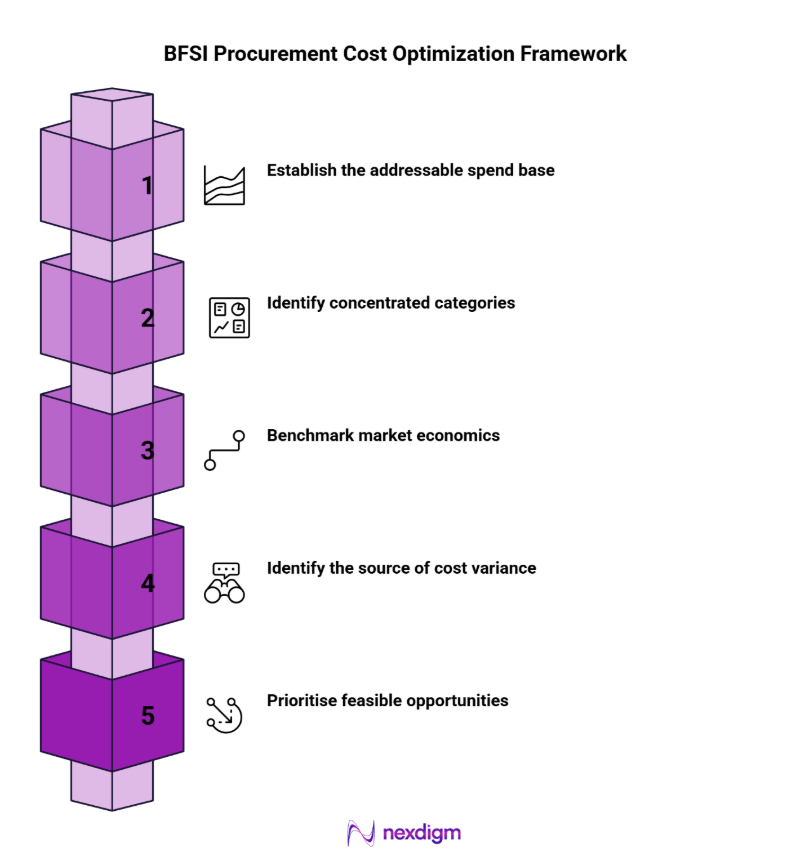
- Establish the addressable spend base: Separate external supplier expenditure from employee costs, provisions and other internal operating expenses.
- Identify concentrated categories: Rank expenditure by value, renewal timing, supplier concentration and business criticality.
- Benchmark market economics: Compare supplier pricing structures, service models, capacity and commercial conditions across relevant categories.
- Identify the source of cost variance: Examine usage, specification differences, overlapping contracts, service levels and fragmented purchasing.
- Prioritise feasible opportunities: Distinguish between competitive sourcing, contract restructuring, demand rationalisation and supplier diversification, while accounting for implementation and risk.
Nexdigm’s Case: BFSI Procurement Cost Analysis
A diversified financial services group reviewed ₹420 crore of external expenditure across technology, facilities and outsourced operations. Category benchmarking identified ₹31 crore of potential annual cost opportunities, concentrated in software licensing, managed services and fragmented support contracts, with priorities established for the next renewal cycle.
To take the next step, simply visit our Request a Consultation page and share your requirements with us.
Harsh Mittal
+91-8422857704