

BFSI procurement teams can reduce third-party risk without narrowing competition by making risk assessment proportionate to the service being sourced. Applying identical requirements to every supplier can exclude smaller technology companies and specialist providers that may offer valuable capabilities. At the same time, treating all vendors as interchangeable can expose financial institutions to operational, cybersecurity, concentration and continuity risks.
The more effective approach is to distinguish between suppliers according to the nature of the service, access to sensitive information, operational criticality and potential impact of failure. This allows procurement teams to maintain a broad supplier market while applying deeper scrutiny where the consequences of a disruption are significant.
Risk Should Be Determined by the Service, Not Just the Supplier’s Size
A large technology company is not automatically low risk, and a smaller fintech provider is not automatically high risk. The relevant question is what the supplier does, what systems or information it can access and how difficult it would be to replace its service.
A cloud infrastructure provider supporting critical banking applications presents a different risk profile from a supplier providing non-sensitive office software. Similarly, a customer onboarding platform handling identity information requires more scrutiny than a standard business productivity application.
Procurement teams should classify third parties using factors such as:
- Operational criticality: Whether the service supports essential financial or customer-facing activities.
- Information access: The sensitivity and volume of data handled by the supplier.
- System connectivity: The level of access to internal applications, networks and infrastructure.
- Subcontracting exposure: Reliance on external providers for hosting, processing or support.
- Replaceability: The availability of alternatives and the time required to transition.
This classification creates a risk-based sourcing process rather than a universal checklist that treats every purchase as equally sensitive.
Supplier Concentration Can Be as Important as Individual Vendor Risk
Financial institutions may appear to have multiple suppliers while relying on the same underlying infrastructure. Several fintech applications could use one cloud provider, one identity verification service or a shared payment processor.
This creates concentration risk that may not be visible when vendors are assessed individually. A disruption affecting a common infrastructure provider could interrupt several business services simultaneously.
Procurement research should therefore map important supplier relationships and identify common dependencies. It should examine whether alternative providers operate on independent infrastructure, whether data can be transferred and whether a service can be replaced without extensive redevelopment.
Competition also depends on understanding the actual market. A procurement team may assume that only two or three suppliers can meet its requirements because those are the providers it already knows. Broader supplier mapping can reveal specialist companies, regional providers and emerging alternatives that meet the required service specifications.
Build Risk Controls Into the Sourcing Process
Risk assessment should begin before a preferred supplier is selected. If security, data handling and continuity requirements are introduced only after commercial evaluation, procurement teams may discover that shortlisted vendors cannot meet essential conditions.
A proportionate process separates baseline eligibility requirements from enhanced due diligence. All suppliers can be assessed against relevant minimum standards, while vendors supporting critical services undergo more detailed review.
This may include financial and ownership checks, security documentation, business continuity arrangements, subcontractor disclosure, data-location information and incident management processes. The depth of review should reflect the service’s risk classification.
RBI’s 2025 outsourcing directions reinforce the importance of governance, due diligence, ongoing monitoring and oversight of outsourced activities for applicable regulated entities. These expectations make third-party risk a continuing responsibility rather than a one-time procurement approval.
Preserve Competition Through Clear and Proportionate Requirements
Overly restrictive tender specifications can reduce competition without materially improving security. Requirements that mandate a particular technology architecture, an unnecessarily long operating history or a large existing customer base may exclude capable providers.
Procurement teams should instead specify the required outcome and the evidence needed to demonstrate it. For example, a supplier may be required to meet defined recovery, access-control and data-protection standards without being forced to use one particular cloud platform or software architecture.
This approach allows different vendors to demonstrate capability through comparable evidence. It also makes it easier to identify where additional controls, contractual protections or technical safeguards may be necessary.
Using bfsi procurement risk mitigation strategies to Balance Control and Choice
Nexdigm’s market intelligence and supplier research can help BFSI organisations understand the available provider landscape before finalising restrictive sourcing criteria. Supplier mapping, capability profiling and market concentration analysis can reveal whether a category has genuine alternatives or depends on a small group of providers.
The scale of the Indian financial sector makes this increasingly relevant. As regulated entities expand digital services and outsource more specialised technology functions, their third-party networks become more interconnected. Risk assessments must account for those dependencies while leaving room for new suppliers to compete.
BFSI Third-Party Risk Mitigation Framework
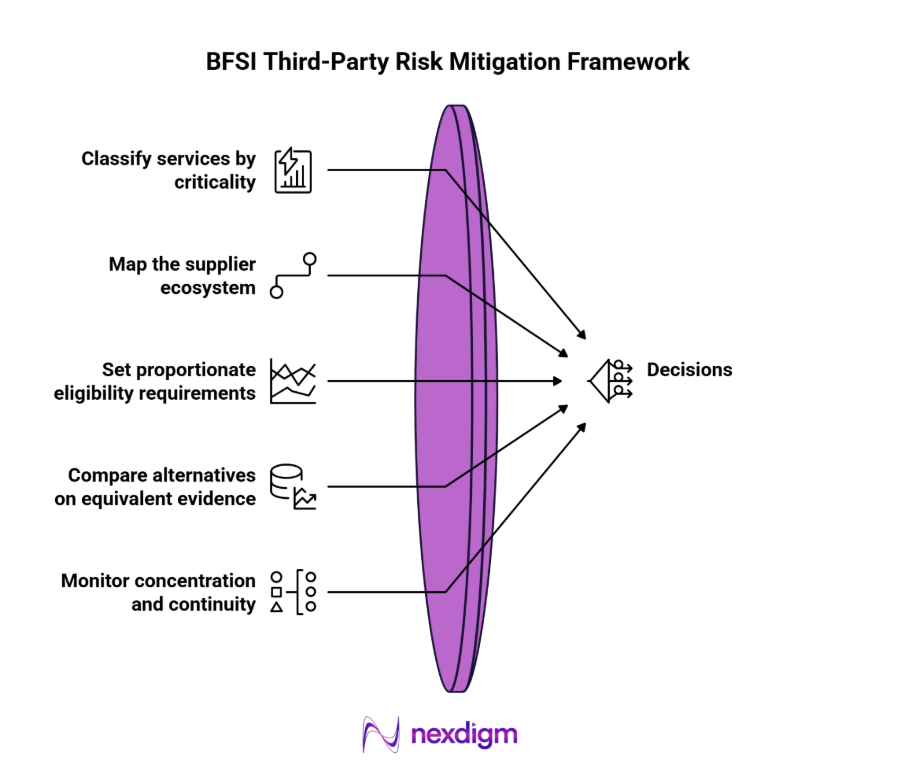
- Classify services by criticality: Identify which services affect essential operations, sensitive data and customer access.
- Map the supplier ecosystem: Identify direct vendors, subcontractors, infrastructure partners and common dependencies.
- Set proportionate eligibility requirements: Define minimum standards for all suppliers and enhanced checks for critical or sensitive services.
- Compare alternatives on equivalent evidence: Use consistent assessment criteria while allowing different technology models to demonstrate compliance.
- Monitor concentration and continuity: Review supplier performance, market changes, exit options and emerging dependencies throughout the relationship.
Nexdigm’s Case: Third-Party Risk and Supplier Competition
A financial services group reviewed 47 technology and operational suppliers across 11 categories. Dependency mapping identified six services with concentrated infrastructure exposure. Revised qualification criteria expanded the eligible supplier pool in four categories while directing enhanced due diligence towards critical providers.
To take the next step, simply visit our Request a Consultation page and share your requirements with us.
Harsh Mittal
+91-8422857704