

Expansion in financial services is ultimately a capital allocation decision. Entering a new geography, customer segment, or business model requires investment in distribution, technology, talent, compliance, and risk infrastructure, while returns may take several years to materialize.
Market size alone therefore provides an incomplete basis for expansion. A smaller commercial corridor with limited competition and strong credit demand can offer better economics than a larger metropolitan market where established banks compete aggressively on price.
Market Size Does Not Determine Market Attractiveness
Large metropolitan markets combine significant wealth and transaction volumes with high operating costs and intense competition. Secondary and tertiary commercial centres can present a different opportunity, particularly where local businesses remain underserved by large financial institutions.
Consider three markets with comparable economic output:
- Metropolitan commercial centres offer high transaction volumes but often face saturated branch networks, intense pricing competition, and compressed lending margins.
- Industrial and MSME hubs can combine strong working-capital demand with underserved business borrowers and opportunities for secured lending.
- Agricultural and logistics corridors may have surplus deposits but relatively low credit deployment, creating opportunities for deposit mobilisation and infrastructure financing.
The relevant question is therefore not how large a market is, but how much profitable financial activity remains addressable.
The Growth Opportunity Can Sit in Different Places
BFSI companies generally have three routes to expansion.
- Geographic expansion extends an existing proposition into new territories. This requires assessment of local demand, competitive intensity, distribution costs, talent availability, regulatory conditions, and recovery infrastructure.
- Customer-segment expansion moves into new cohorts within existing markets, such as an institution extending from corporate lending into secured MSME finance. This can leverage existing infrastructure but requires changes to underwriting, collections, and servicing models.
- Business-model expansion changes how products reach customers, including digital-first, embedded, or partnership-led distribution. This can reduce physical infrastructure requirements but increases dependence on technology integration and external platforms.
Each route carries a different capital requirement and execution risk.
Scale Works in Some Segments. Specialization Works in Others.
Standardized financial products typically reward institutions with scale, low funding costs, and efficient operations. Prime mortgages, basic savings products, and mass-market motor insurance are difficult markets for entrants to attack through price alone.
Specialized products can create more defensible opportunities. Equipment finance, trade finance, commercial property insurance, and private wealth services often depend more heavily on underwriting expertise, speed, flexibility, and sector knowledge.
The appropriate expansion model should therefore follow the economics of the target segment rather than the institution’s existing operating model.
Timing Can Change the Entry Case
A market that appears unattractive today can become viable when structural conditions change. Three catalysts deserve particular attention:
- Regulatory openings: Licensing changes, foreign investment reforms, or capital-rule revisions can alter competitive dynamics.
- Infrastructure readiness: Digital KYC, Account Aggregator infrastructure, electronic records, and payment rails can reduce the cost of serving previously expensive markets.
- Incumbent vulnerability: Portfolio stress, restructuring, management changes, or service disruptions can create openings for institutions with stronger distribution or underwriting capabilities.
Expansion decisions should consequently incorporate timing rather than treating market attractiveness as static.
Nexdigm’s BFSI Strategic Expansion Opportunity Framework
A BFSI strategic expansion opportunity assessment by Nexdigm evaluates markets through four analytical layers:
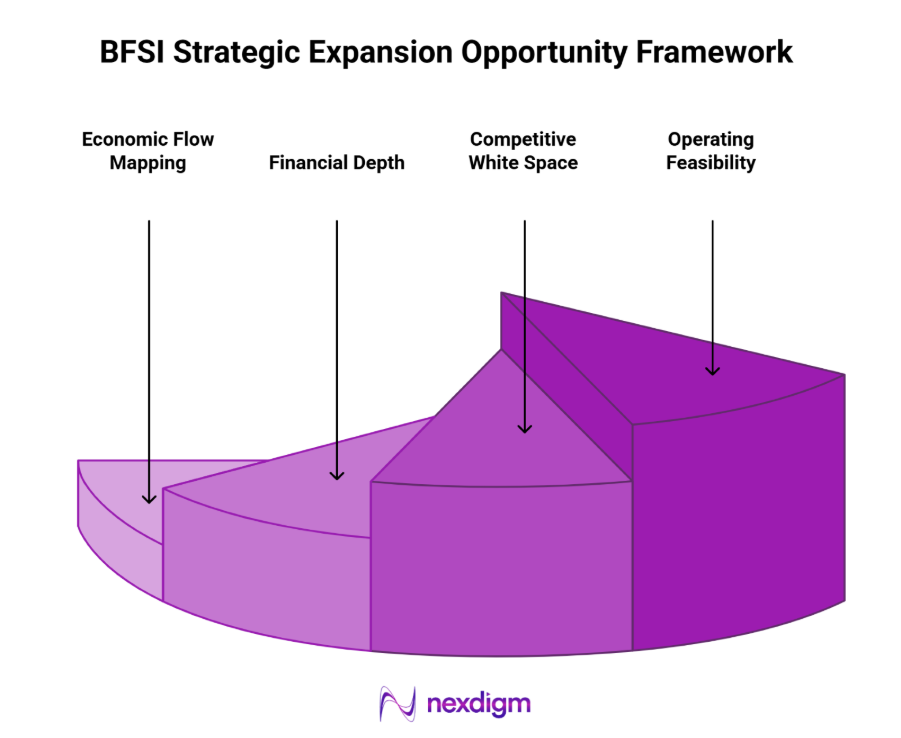
- Economic Flow Mapping: Assess district-level output, industrial activity, commercial vehicle registrations, GST activity, income growth, and other indicators that reveal where financial demand is actually being generated.
- Financial Depth and Credit Absorption: Compare deposits, credit disbursements, Credit-to-Deposit ratios, branch density, product penetration, and digital transaction activity to identify funding surpluses and credit gaps.
- Competitive White Space: Benchmark incumbent presence, NBFC coverage, pricing, product availability, branch productivity, and customer segments to determine where an entrant can achieve defensible economics.
- Operating Feasibility: Assess recovery timelines, legal enforceability, local talent, infrastructure, technology readiness, and distribution costs before translating market potential into an expansion plan.
The analysis ultimately ranks markets by addressable opportunity, expected economics, execution complexity, and risk, allowing management to determine where to enter first, which segments to prioritize, and what operating model to deploy.
How Nexdigm Prioritizes the Markets BFSI Companies Should Enter
A mid-tier NBFC targeting growth from ₹6,000 crore to ₹15,000 crore evaluated 18 markets across six lending segments. Nexdigm eliminated eight markets after identifying lender saturation, aggressive pricing, and prolonged recovery timelines. It prioritized five commercial corridors with ₹4,200 crore of addressable secured MSME and equipment credit, supporting ₹1,850 crore of deployment within 14 months while keeping gross NPAs below 1.4%.
To take the next step, simply visit our Request a Consultation page and share your requirements with us.
Harsh Mittal
+91-8422857704