

Financial institutions are managing increasingly complex third-party ecosystems spanning technology, cloud, cybersecurity, AI, operations, and specialized services. A 2026 survey found that 53% of financial institutions manage at least 300 vendors, while 63% have only one or two dedicated third-party risk professionals. The governance challenge is becoming more significant as technology dependence grows. A recent Bank of England study found that 39% of reported AI systems in financial services were implemented through third parties, rising to 53% for high-materiality AI systems.
Vendor evaluation therefore needs to extend beyond functionality or price. Security, compliance, service performance, resilience, scalability, and operational fit can all influence whether a provider is appropriate for a financial institution. BFSI vendor evaluation research can provide a structured basis for comparing these dimensions and identifying providers that can meet both immediate requirements and longer-term business needs.
Vendor Evaluation Is Becoming a Risk-and-Value Exercise
As financial institutions become more dependent on external providers, vendor evaluation increasingly needs to balance commercial value with operational and regulatory considerations. A provider may offer strong technology but have limited transparency, weak resilience arrangements, or insufficient banking experience. Conversely, a specialized vendor may offer differentiated capabilities but require closer scrutiny around scalability and third-party risk. This makes a multi-dimensional evaluation important for understanding whether a vendor can deliver sustainable value within a regulated financial-services environment.
Dimensions That Shape the Vendor Suitability
A structured evaluation can examine the following dimensions:
- Capability: Assess technology maturity, functional coverage, domain expertise, integration capabilities, and ability to meet defined business requirements.
- Security & Compliance: Examine security controls, certifications, governance, regulatory experience, data practices, and third-party risk management.
- Service Performance: Compare reliability, SLA adherence, responsiveness, issue resolution, support quality, and delivery consistency.
- Scalability & Resilience: Evaluate capacity, geographic reach, infrastructure, continuity arrangements, and ability to support changing requirements.
These dimensions help financial institutions distinguish between vendors that offer relevant capabilities and those that can reliably operate within a regulated BFSI environment.
Vendor Evaluation Priorities Vary by Service Category
The importance of each evaluation dimension can change depending on the vendor’s role within the financial institution. A cybersecurity provider may require greater emphasis on security and resilience, while a core technology provider may need deeper assessment of integration, scalability, and implementation capability. Nexdigm can help tailor evaluation criteria according to service category, business criticality, regulatory exposure, and operational dependency, creating a more relevant basis for comparing vendors.
Nexdigm’s Category-Specific Approach to Vendor Evidence
Building on category-specific criteria, Nexdigm’s experts can validate vendor capabilities through relevant evidence rather than relying solely on stated claims. As part of BFSI vendor evaluation research, this can include:
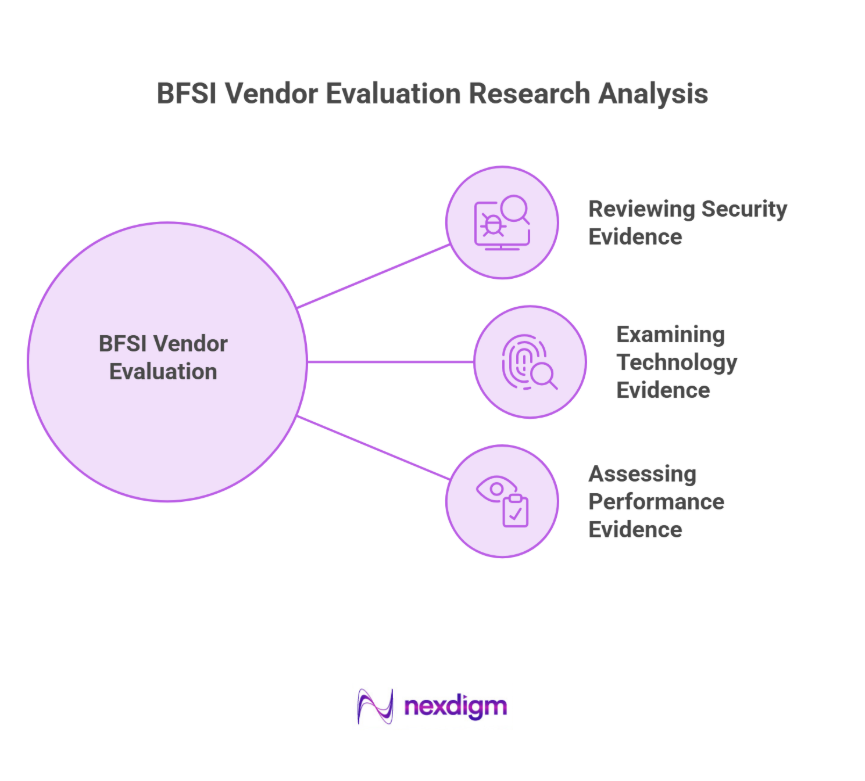
- Security Evidence: Review certifications, security credentials, resilience indicators, governance practices, and relevant controls to validate a provider’s risk-management capabilities.
- Technology Evidence: Examine implementation experience, integration capabilities, scalability, architecture, and service records to assess technology providers against actual banking requirements.
- Performance Evidence: Consider service metrics, delivery records, references, market positioning, and relevant commercial information to understand whether claimed capabilities translate into performance.
Using category-relevant evidence helps financial institutions develop a more grounded view of vendor suitability, supporting more informed evaluation and due-diligence decisions.
Nexdigm’s Comparative View of Vendor Performance
Validated evidence becomes more useful when vendors are assessed against a consistent reference point. Experts at Nexdigm can compare providers across capability, security, compliance, service performance, scalability, and commercial relevance, while weighting each factor according to category and business criticality. This helps financial institutions identify relative strengths, performance gaps, and areas requiring deeper due diligence before making sourcing, renewal, or vendor-management decisions.
The Advantage of Nexdigm’s Comparative Vendor View
Comparing vendors systematically can turn evaluation findings into clearer business actions. Our experts can help financial institutions interpret differences across providers and prioritize decisions based on performance, risk, and strategic relevance. This involves:
- Sharper Vendor Prioritization: Identify providers demonstrating stronger overall performance while directing deeper evaluation toward vendors with capability, compliance, security, or service concerns.
- More Focused Due Diligence: Use comparative findings to determine which vendors require additional validation, risk review, remediation, or commercial assessment before important sourcing decisions.
- Better Management Decisions: Translate vendor differences into practical actions across negotiations, renewals, supplier development, consolidation, replacement, or strategic relationship management.
A comparative approach therefore helps financial institutions move from vendor evaluation to targeted action, ensuring resources are focused on providers and issues with the greatest business relevance.
Nexdigm’s Case
Nexdigm evaluated 45 vendors across technology, cybersecurity, cloud, and managed services for a financial-services organization. The comparative assessment found that 31% of vendors required enhanced performance or risk review, while 13% showed overlapping capabilities with other providers and 11% demonstrated stronger strategic-fit potential. The findings helped the organization prioritize supplier reviews and focus deeper due diligence on strategically important vendors.
To take the next step, simply visit our Request a Consultation page and share your requirements with us.
Harsh Mittal
+91-8422857704