

Financial institutions increasingly depend on external vendors for technology, data processing, payments, customer operations, and critical infrastructure. This reliance creates interconnected risks that can affect business continuity, regulatory compliance, and customer trust. A 2026 ProcessUnity and Ponemon Institute study found that financial services organizations experienced an average of 12 third-party breaches annually.
Separately, the American Bankers Association reported that 53% of financial institutions manage at least 300 vendors, while 72% have only partial awareness of which vendors use AI. These findings highlight the challenges of maintaining oversight across complex supplier networks. BFSI vendor risk assessment consulting can help institutions evaluate exposure systematically, strengthen supplier oversight, and improve resilience across third-party relationships.
Why Vendor Risk Requires a Broader Assessment
Vendor risk extends beyond a supplier’s financial stability or contractual performance. A provider may introduce operational disruption, cybersecurity vulnerabilities, data privacy concerns, or regulatory exposure through its services and subcontractors. Financial institutions therefore need assessments that consider both individual supplier weaknesses and the wider impact of interconnected dependencies on critical business functions.
What Determines the Vendor Exposure
A comprehensive assessment should examine four interconnected areas:
- Financial Exposure: Review vendor financial health, liquidity, creditworthiness, revenue concentration, and business continuity capacity to identify potential instability.
- Operational Exposure: Evaluate service dependencies, delivery capabilities, incident management, recovery arrangements, and resource availability to assess disruption risks.
- Cybersecurity Exposure: Examine security controls, access management, data protection, vulnerability management, incident history, and subcontractor security practices.
Evaluating these dimensions together helps institutions understand the nature and potential consequences of vendor-related risks.
Nexdigm’s Approach to Building a Clearer Vendor Risk Picture
Nexdigm can help BFSI organizations develop a structured understanding of third-party exposure through research-led assessment and supplier intelligence. Its approach can consider vendor profiles, service criticality, financial indicators, operating models, and risk-related information to support more informed evaluations. This can help institutions distinguish between suppliers requiring routine oversight and those whose services or dependencies warrant closer scrutiny.
Why a Clear Vendor Risk Picture Matters
A consolidated vendor risk picture helps BFSI institutions understand how third-party relationships could affect business stability and regulatory obligations. Nexdigm can help organizations gain this visibility by focusing on three important aspects:
- Exposure Visibility: Identify financial weaknesses, operational vulnerabilities, cybersecurity threats, and compliance gaps across the vendor ecosystem.
- Risk Interdependencies: Understand how shared providers, subcontractors, and critical service dependencies can create interconnected risks.
- Business Impact Assessment: Evaluate how vendor failures, security incidents, or compliance breaches could affect service continuity, financial performance, and customer trust.
This enables institutions to develop a clearer understanding of their overall third-party exposure and prioritize areas requiring attention.
Nexdigm’s Framework for Comprehensive Vendor Risk Assessment
Nexdigm can help BFSI institutions evaluate third-party exposure through a structured assessment covering key areas of vendor risk:
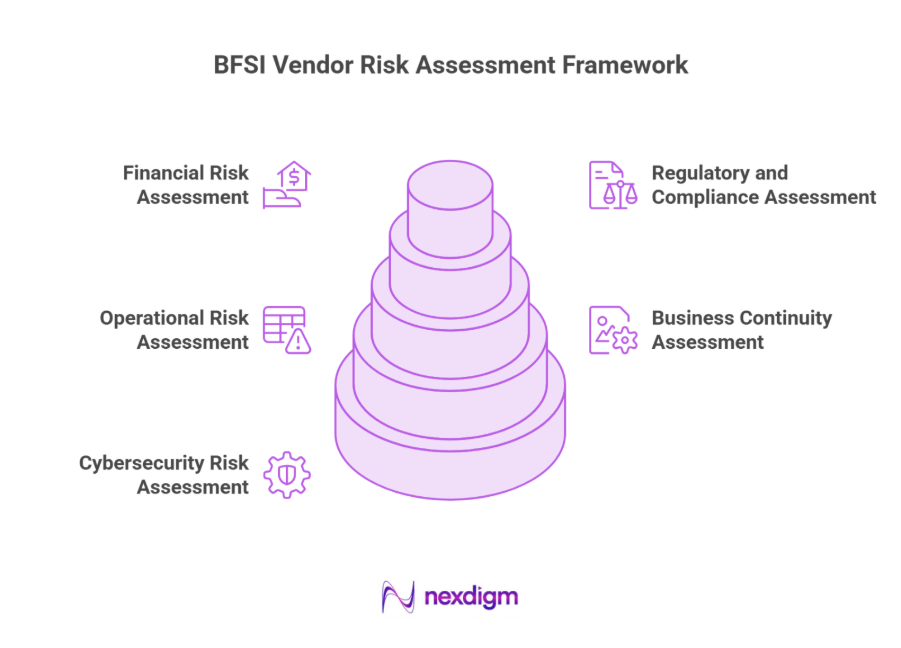
- Financial Risk Assessment: Examine financial stability, credit indicators, ownership structures, and business viability to identify potential supplier vulnerabilities.
- Operational Risk Assessment: Review service delivery capabilities, business continuity arrangements, operational dependencies, and incident management practices.
- Cybersecurity Risk Assessment: Evaluate information security controls, data protection practices, access management, vulnerability management, and potential cyber exposure.
- Regulatory and Compliance Assessment: Examine regulatory obligations, compliance frameworks, audit readiness, contractual requirements, and data privacy practices.
- Business Continuity Assessment: Review disaster recovery arrangements, contingency plans, recovery capabilities, and preparedness for service disruptions.
Through BFSI vendor risk assessment consulting, Nexdigm can help institutions identify supplier weaknesses, understand potential business implications, and establish priorities for stronger third-party risk management.
Strategic Impact Delivered Through Nexdigm’s Vendor Risk Assessment
Nexdigm’s assessment can help BFSI institutions translate vendor risk findings into practical business decisions. By providing clearer visibility into supplier vulnerabilities and their potential consequences, the assessment can support:
- Better Risk Prioritization: Identify high-risk vendors and critical dependencies that require enhanced oversight or timely intervention.
- Stronger Business Continuity: Highlight supplier-related vulnerabilities that could disrupt essential services, enabling institutions to strengthen contingency planning.
- Improved Governance: Support more informed vendor decisions through documented risk insights, clearer accountability, and better-informed oversight.
- Reduced Third-Party Exposure: Help institutions address identified weaknesses through targeted remediation, supplier engagement, and appropriate risk mitigation measures.
These outcomes can help institutions move beyond identifying vendor risks towards managing them more consistently and strengthening resilience across their third-party ecosystem.
Nexdigm’s Case
A financial institution partnered with Nexdigm to evaluate risks across its vendor network. The review highlighted 19% of suppliers with financial stability concerns, 16% with cybersecurity control gaps, and 13% with business continuity weaknesses. The findings helped strengthen due diligence, prioritize supplier interventions, and improve third-party risk oversight.
To take the next step, simply visit our Request a Consultation page and share your requirements with us.
Harsh Mittal
+91-8422857704