
Biological agricultural inputs are gaining importance as farmers and agribusinesses look for ways to improve nutrient management, strengthen crop resilience and reduce dependence on conventional chemical inputs.
Biofertilizers, biopesticides, microbial formulations and biostimulants are becoming part of a broader agricultural input portfolio.
For manufacturers, distributors and institutional buyers, this creates a growing supplier market, but also a difficult procurement environment.
The challenge is not simply finding companies that manufacture biological products. It is identifying vendors whose formulations are technically credible, consistently produced, properly registered and commercially viable at scale.
A supplier with an innovative product may still be unable to meet seasonal demand. Another may have strong distribution but limited evidence supporting its product claims.
A Growing Market with Uneven Supplier Maturity
India’s biological input market is expanding, but suppliers operate at different levels of technological and operational maturity.
The market includes established agricultural input companies, specialist biotechnology firms, microbial formulation manufacturers, research-led start-ups and smaller regional producers.
The India Bioeconomy Report 2026 estimated that India’s BioAgri segment grew from $13.5 billion in 2024 to $14.6 billion in 2025.
Within crop protection and nutrition, biofertilizers were estimated at $1.61 billion and biopesticides at $1.10 billion in 2025.
These figures indicate commercial expansion, but market growth does not automatically establish supplier reliability or product performance.
Product Innovation Does Not Guarantee Field Performance
Biological inputs depend on living organisms, biological activity or naturally derived compounds. Their performance can be affected by formulation quality, storage conditions, environmental factors, application methods and compatibility with other agricultural inputs.
A microbial product may demonstrate promising results under controlled conditions but produce inconsistent outcomes when exposed to different soil types, temperatures or application practices. Inadequate formulation stability can also reduce viability before the product reaches the end user.
For buyers, this creates a gap between technical claims and operational performance. Product brochures may describe broad applications, but procurement decisions require evidence from relevant crops, geographies and field conditions.
Certification and Quality Assurance Remain Critical
The biological input category includes products subject to different regulatory and quality requirements. Biofertilizers, biopesticides and biostimulants should not be treated as one regulatory category. Applicable registration, manufacturing, labelling and quality requirements depend on the product and its intended use.
This creates a due diligence burden. Buyers may encounter suppliers using similar terminology for products with different regulatory status, compositions or performance evidence. Certification claims also need to be checked for scope, validity and relevance to the product being purchased.
Quality assurance should extend beyond a one-time certificate. Batch consistency, microbial count or viable cell concentration where applicable, contamination controls, shelf life and storage conditions can all influence product usability.
Supply Capacity Can Become a Seasonal Constraint
Biological input manufacturers may depend on specialised fermentation facilities, culture maintenance, controlled production environments, specific raw materials and temperature-sensitive distribution. These requirements can make capacity expansion more complex than simply increasing conventional blending or packaging volumes.
A vendor may meet a pilot order but struggle when demand rises before a major sowing season. Procurement teams that qualify suppliers only on current catalogue availability risk discovering production or distribution constraints when replacement options are limited.
What Buyers Should Do Before Selecting a Biological Input Vendor
A robust bio based input supplier benchmarking exercise should compare vendors at the product and company levels. Buyers should first define the biological input category, intended application, crop coverage and required volume. Suppliers can then be assessed against technical evidence, regulatory readiness, manufacturing capacity, quality controls and commercial terms.
The assessment should include product-level documentation, field trial evidence, batch testing procedures, production infrastructure and distribution arrangements. Where possible, buyers should conduct technical discussions with the supplier’s research, quality and manufacturing teams rather than relying entirely on sales presentations.
Commercial evaluation should consider cost per application, shelf life, storage requirements, packaging, delivery reliability and the need for technical support. A lower purchase price may not represent better value if product viability declines during storage or if repeated applications increase the total cost.
Nexdigm supports organisations through supplier intelligence, market mapping, product benchmarking and commercial research. This can help buyers identify credible manufacturers, compare supplier capabilities and understand where the biological input market offers viable sourcing alternatives.
Biological Input Vendor Benchmarking Framework
A detailed assessment should examine six dimensions:
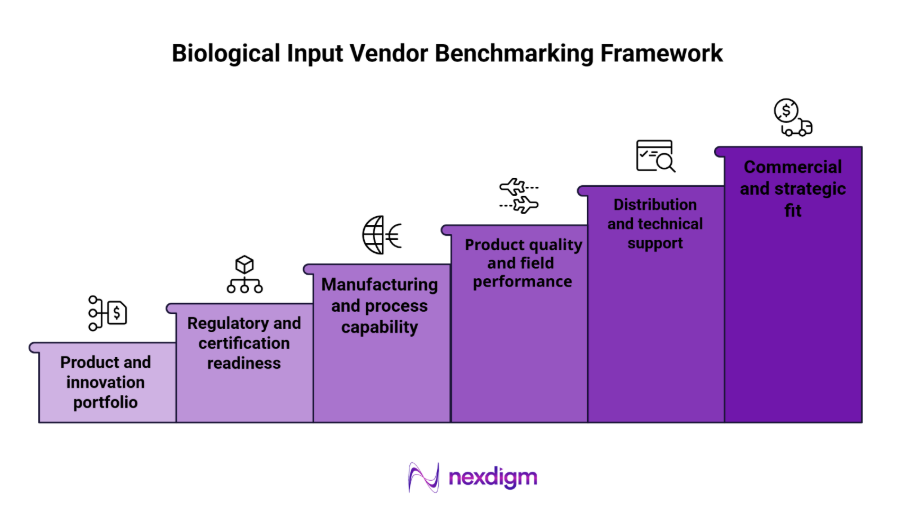
- Product and innovation portfolio: Identify the biological categories offered, active ingredients or organisms, target applications, formulation formats and product development pipeline. Assess whether innovation is supported by technical documentation and relevant field evidence.
- Regulatory and certification readiness: Verify applicable registrations, manufacturing permissions, product labels, quality certifications and validity periods. Check whether certificates apply to the specific facility and product under consideration.
- Manufacturing and process capability: Review production facilities, fermentation or extraction infrastructure, quality-control laboratories, installed capacity, utilisation and ability to scale during seasonal demand peaks.
- Product quality and field performance: Compare batch consistency, concentration or viability specifications, contamination controls, shelf life, storage requirements and performance across relevant crops and geographies.
- Distribution and technical support: Assess dealer coverage, warehousing, temperature-control arrangements where required, delivery lead times, application guidance and post-sale support.
- Commercial and strategic fit: Compare total application cost, minimum order quantities, payment terms, supply flexibility, product differentiation and the supplier’s ability to support long-term procurement requirements.
Nexdigm’s Case Study: Evaluating Biological Input Manufacturers
Nexdigm assessed 34 biological input vendors across 6 product categories, comparing product portfolios, registrations, manufacturing infrastructure and commercial capabilities. The study shortlisted 9 suppliers for further technical assessment and identified gaps in capacity and regional distribution.
To take the next step, simply visit our Request a Consultation page and share your requirements with us.
Harsh Mittal
+91-8422857704