
The expansion of biologics and biosimilars is creating demand for specialised manufacturing partners with capabilities that conventional pharmaceutical facilities cannot necessarily provide. Cell culture, fermentation, purification and sterile fill-and-finish require dedicated infrastructure, process expertise and rigorous quality controls. For pharmaceutical companies evaluating external partners, the central sourcing question is whether a manufacturer has the right technology platform, relevant production experience, and capacity for the intended product.
This makes biologics supplier research fundamentally different from compiling a list of pharmaceutical manufacturers. A company’s presence in the biotechnology sector does not automatically establish its ability to manufacture a particular biological product at commercial scale.
Manufacturing Technology Determines Which Suppliers Can Participate
Biologics cover several product categories, and their production requirements vary significantly. Monoclonal antibodies, recombinant proteins, vaccines and other biological products may use different host systems, production methods and purification processes.
The main manufacturing capabilities to distinguish include:
- Mammalian cell culture: Used for many complex therapeutic proteins and monoclonal antibodies, requiring specialised bioreactor and purification infrastructure.
- Microbial fermentation: Used for selected recombinant proteins and other biological products, with different process and downstream requirements.
- Vaccine manufacturing: Can involve bacterial, viral, recombinant or other production platforms, depending on the vaccine technology.
- Biosimilar development and production: Requires process development, analytical characterisation and comparability work alongside commercial manufacturing.
- Fill-and-finish operations: Convert bulk biological products into finished presentations such as vials, prefilled syringes or other sterile formats.
These capabilities should be assessed separately. A manufacturer experienced in microbial fermentation may not have the infrastructure for mammalian cell culture. Similarly, a company with fill-and-finish capacity may depend on an external partner for upstream production.
Capacity Must Be Evaluated Across the Complete Manufacturing Process
A large bioreactor does not, by itself, demonstrate that a supplier can deliver a finished biological product at the required scale. Manufacturing capacity depends on the entire process, from upstream production to purification, formulation, filling, and testing.
For procurement research, the distinction between development and commercial capacity is particularly important. A facility may be well suited to early-stage development or clinical batches but have limited capacity for sustained commercial supply. Another may have large-scale infrastructure but offer less flexibility for smaller or technically complex programmes.
Supplier profiles should therefore examine the type and scale of bioreactors, single-use or stainless-steel systems, downstream purification equipment, analytical laboratories, and sterile filling infrastructure. Technology transfer experience and the ability to scale processes are also relevant when evaluating a potential manufacturing partner.
India’s Biopharma SHAKTI initiative, announced in the Union Budget 2026–27, proposes investment of ₹10,000 crore over five years to strengthen the country’s biologics and biosimilars ecosystem. The initiative is intended to support research, clinical-trial infrastructure, and domestic manufacturing capabilities. Its significance lies in the direction of investment, although the availability of commercial manufacturing capacity still needs to be verified at the facility level.
Regulatory and Quality Capabilities Shape Market Access
Biological products can be sensitive to variations in raw materials, cell lines, process conditions, and purification methods. This makes process consistency and analytical control particularly important. A manufacturing partner must be able to demonstrate that its processes are suitably controlled, and that product quality can be maintained across batches.
The assessment should consider GMP credentials, process validation, contamination control, analytical characterisation, data integrity, and documentation systems. For biosimilars, comparability requirements and evidence supporting similarity to the reference product are also central to the development and regulatory pathway.
Regulatory readiness depends on the intended market. A facility’s experience supplying domestic customers does not automatically establish its readiness to manufacture for the United States or European Union. Buyers should examine the relevant facility, product category, and inspection history rather than relying on the manufacturer’s overall corporate profile.
India’s Biologics Ecosystem Offers Different Types of Manufacturing Partners
India’s biologics industry includes vaccine manufacturers, biosimilar developers, biotechnology companies and specialised development and manufacturing service providers. Companies such as Biocon Biologics, Serum Institute of India, Biological E, Bharat Biotech, Zydus Lifesciences and Syngene International operate across different segments of this ecosystem.
Their capabilities should not be treated as interchangeable. Some have established vaccine production platforms, while others focus on biosimilars, recombinant products or contract development services. Their manufacturing locations, technology portfolios and commercial models also differ.
The expanding market makes supplier mapping more important. A structured biologics supplier intelligence exercise helps identify manufacturers by technology platform, product category, facility footprint and market presence. It also helps distinguish companies with commercial manufacturing experience from those primarily engaged in research or development.
Nexdigm’s procurement research can support supplier identification, facility mapping, capacity and technology profiling, and regional market comparisons. This provides a market-level view before technical qualification, process validation and regulatory approval.
Biologics Manufacturing Partner Assessment Framework
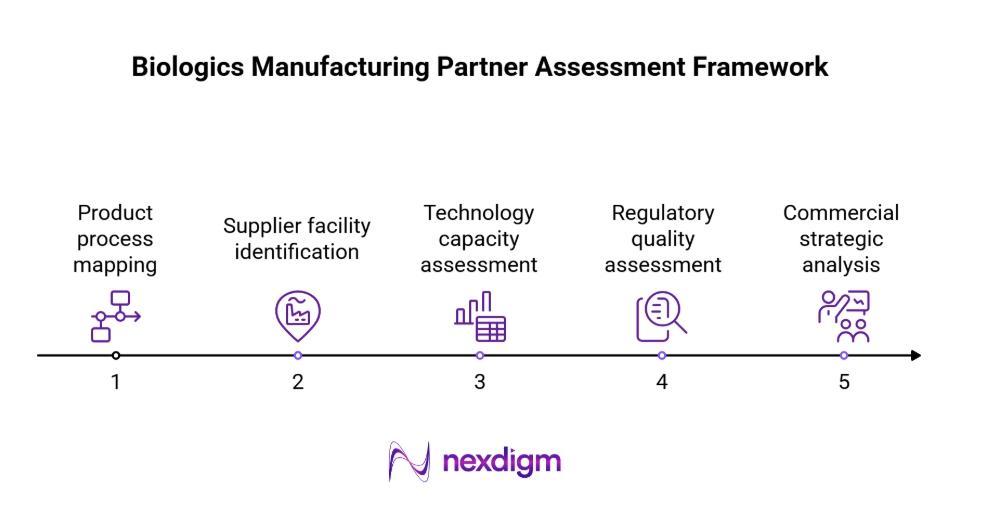
- Biological product and process mapping: Define the modality, production stage, process technology, batch requirements and intended market.
- Supplier and facility identification: Map manufacturers and service providers by product category, technology platform, facility location and manufacturing model.
- Technology and capacity assessment: Compare bioreactor infrastructure, upstream and downstream capabilities, fill-and-finish facilities and scale-up experience.
- Regulatory and quality-profile assessment: Examine relevant GMP credentials, inspection history, analytical capabilities, validation experience, and regulatory market exposure.
- Commercial and strategic-fit analysis: Evaluate production flexibility, capacity availability, geographic concentration, service scope, and alternative manufacturing partners.
Case Study: Mapping Biologics Manufacturing Partners
A biotechnology company evaluating external manufacturing options for a therapeutic protein needed visibility into regional production capabilities. Nexdigm’s research mapped 17 manufacturers across four markets, compared technology platforms and facility footprints, and identified five potential partners for further technical and regulatory assessment.
To take the next step, simply visit our Request a Consultation page and share your requirements with us.
Harsh Mittal
+91-8422857704