

Crop protection is becoming a more complicated commercial equation. Farmers still depend heavily on synthetic chemistries for speed and residual control, but exporters and high-value growers are facing tighter residue requirements, resistance concerns, and pressure to reduce chemical load. This is creating room for biological products, although the opportunity is not evenly distributed across crops or regions.
India’s biopesticide market is estimated at about $242 million in 2025, with growth estimates of roughly 9.2% to 9.5% annually toward 2031. Yet biologicals remain a relatively small part of the broader crop protection market. The more important commercial question is therefore not whether the market will grow, but where biopesticides can move from an occasional complement to a repeat-use component of crop protection programmes.
Adoption Is Being Pulled by the Crop, Not Just the Product
The strongest adoption corridors are associated with crops where residue compliance, resistance, or product quality has a direct commercial consequence. Table grapes, pomegranates, basmati rice, and tea provide examples of this shift.
In Nashik, Solapur, and Sangli, commercial spray programmes increasingly integrate biological products during pre-harvest periods. In basmati production, tighter scrutiny of residues such as tricyclazole has encouraged biological seed treatments and botanical alternatives. Tea-growing regions face similar pressure where residue requirements influence crop protection decisions.
This changes the way the market needs to be segmented. Instead of treating farmers as a single addressable customer base, suppliers need to identify crop systems where the economic cost of conventional protection, residue exposure, or resistance is already high enough to justify an alternative.
The Farmer’s Calculation Is About the Whole Season
A biological product can appear inexpensive at the application level and still lose its economic advantage if it requires repeated spraying. Microbial products such as Bt or Beauveria may cost around ₹450–₹650 per acre per spray, compared with approximately ₹1,400–₹1,800 for a synthetic diamide application. However, biological products can require two or three applications because of shorter field persistence and UV sensitivity.
Farmers therefore need to evaluate:
- Total seasonal protection cost rather than the price of one application.
- Yield protection and quality outcomes under actual field conditions.
- Labour requirements and application frequency.
- Compatibility with existing crop protection programmes.
- Product shelf life and storage conditions.
- Dealer availability and credit terms.
Shelf life is particularly important in rural distribution. Liquid biological formulations can experience significant viability losses when stored above 30°C for prolonged periods. A formulation that performs well under controlled conditions can therefore lose commercial value before reaching the field.
Three Forces Could Push Biologicals Further into the Mainstream
The next phase of adoption is likely to be shaped by the interaction of agronomy, regulation, and economics.
First, crops facing strict MRL requirements create a stronger reason to reduce dependence on certain synthetic chemistries. Second, resistance to conventional products can make alternative modes of action more valuable. Third, high-value crops provide sufficient margins for growers to absorb the additional application complexity associated with biological products.
The distribution channel also matters. Biological formulations can offer dealers gross margins of roughly 18% to 26%, compared with around 7% to 11% for branded synthetic chemistries. That creates an incentive for channel push, but dealer enthusiasm alone does not establish sustained farmer demand. Repeat adoption ultimately depends on visible field performance and economics.
Where Nexdigm Can Separate Market Growth from Commercial Opportunity
A structured Biopesticide market potential study can distinguish between headline market growth and commercially addressable demand. Nexdigm can assess crop and pest vulnerability, regional adoption, farmer economics, regulatory exposure, formulation readiness, competitive intensity, and distribution conditions to identify where biological products have a credible path to scale.
The assessment can examine:
- Crop-pest combinations where resistance to conventional products is increasing.
- Export markets where MRL requirements affect product selection.
- Per-acre economics across the complete crop cycle.
- Dealer margins, inventory turns, and credit structures.
- Formulation and shelf-life requirements across target geographies.
- Product positioning and market-entry priorities.
The objective is not simply to estimate how large the biologicals market could become. It is to identify where the economics, agronomy, and market conditions already support repeat adoption.
Nexdigm’s Framework for Biological Crop Protection
Nexdigm can build the opportunity assessment around five connected layers.
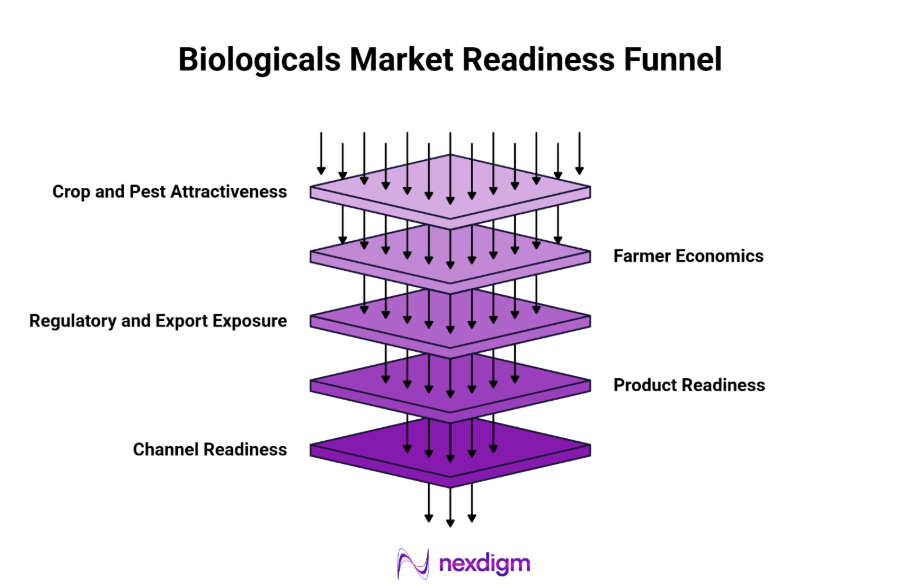
- Crop and Pest Attractiveness: Identifies specific crop-pest segments where biological solutions solve a meaningful agronomic issue.
- Farmer Economics: Evaluates the full seasonal program cost between biological and conventional regimes rather than focusing on unit pack prices.
- Regulatory and Export Exposure: Analyzes MRL thresholds, shipment rejection risks, and crop-specific compliance mandates across destination markets.
- Product Readiness: Measures field efficacy, formulation stability, shelf life under variable storage conditions, and compatibility with standard spray equipment.
- Channel Readiness: Assesses distributor incentives, credit terms, stock turnover, agronomist influence, and field demonstration needs to ensure successful scale-up through retail networks.
Together, these layers allow manufacturers to distinguish between markets where biologicals remain complementary, markets where substitution is becoming commercially viable, and markets where technical or economic barriers still limit adoption.
Nexdigm Case Study: Turning Farmer Intelligence into Commercial Decisions
Nexdigm conducted a Farmer Intelligence & Input Adoption Study for a Fortune 500 agriscience leader, covering 348 micro-district audits across high-value cropping zones. The study examined farmer brand-switching behaviour, dealer influence, and willingness to pay.
The approach provides a practical model for biological commercialisation because it connects farmer behaviour with channel economics and willingness to adopt. For biological manufacturers, similar analysis can identify the points where agronomic need, farmer economics, and regulatory pressure converge before distribution and marketing investment is scaled.
To take the next step, simply visit our Request a Consultation page and share your requirements with us.
Harsh Mittal
+91-8422857704