

Agribusinesses are under increasing pressure to manage pests while meeting tighter expectations around residue levels, environmental impact and responsible input use. Biopesticides have become an important part of this shift. Derived from microorganisms, plant extracts and other biological sources, they can support integrated pest management programmes and help reduce dependence on conventional chemical treatments.
However, selecting a biopesticide supplier requires more than identifying vendors with a broad product catalogue. Product efficacy, formulation stability, regulatory compliance, field performance and distribution reliability all influence whether a biological crop protection programme will deliver consistent results.
Why Biopesticide Procurement Requires a Different Assessment
Biopesticides can be sensitive to storage conditions, application timing, environmental factors and target pest characteristics. A product that performs well in one crop or climatic zone may produce different results elsewhere. Procurement teams must therefore assess suppliers in relation to the crops, pest pressures and operating conditions they are expected to serve.
The supplier landscape also includes manufacturers specialising in microbial products, botanical formulations, pheromone-based solutions and integrated pest management inputs. Their capabilities are not interchangeable. A vendor focused on fungal biofungicides, for example, may not have the same expertise or distribution reach as a manufacturer specialising in neem-based insecticides.
India’s biopesticide landscape includes products based on bacterial, fungal and viral agents, alongside botanical and other biological approaches. This diversity makes product-level evaluation essential. A supplier’s overall reputation cannot substitute for evidence about the specific formulation being purchased.
What Agribusinesses Should Evaluate in a Biopesticide Vendor
A structured assessment should begin with the supplier’s technical portfolio. Buyers need to understand the active biological agent, target pest, recommended crop applications, formulation type and compatibility with existing crop protection programmes. Registration status and label claims should be checked against the applicable regulatory requirements rather than accepted solely on the basis of vendor documentation.
Field performance is equally important. Trial data should reflect relevant crops, geographies and pest conditions. Buyers should examine application rates, response consistency, residual performance, shelf life and the conditions under which results were recorded. Independent field validation can help distinguish a product with repeatable performance from one supported mainly by promotional claims.
How Supplier Intelligence Improves Product and Commercial Decisions
A comprehensive biopesticide supplier intelligence exercise can help agribusinesses identify manufacturers with the right combination of product capability, regulatory standing and market access. It should map suppliers by biological category, target application, production capacity, geographic presence and distribution model.
The assessment should also consider operational risks that may not be visible in a product brochure. These include dependence on a limited number of fermentation facilities, inconsistent raw material sourcing, inadequate cold-chain or temperature-controlled storage, and weak technical support for distributors and farmers.
Commercial evaluation should extend beyond the quoted purchase price. Buyers should compare cost per treated hectare, application frequency, storage requirements, expected wastage and the need for complementary crop protection products. A lower-priced formulation may prove more expensive if it requires repeated applications or has a shorter usable shelf life.
Questions to Ask Before Appointing a Supplier
Procurement and technical teams should establish a common evaluation checklist. Key questions include:
- Does the supplier hold the required registrations for the product and intended application?
- Is the product supported by relevant field trials and clear technical documentation?
- Can the vendor maintain consistent formulation quality across production batches?
- Are storage, transportation and shelf-life requirements compatible with the distribution network?
- Does the supplier provide application guidance, training and post-sale technical support?
- Can the vendor meet seasonal demand without compromising quality or delivery timelines?
These questions help buyers assess whether a supplier can support an entire crop protection programme rather than simply fulfil an individual purchase order.
Building a More Reliable Biopesticide Sourcing Strategy
Agribusinesses should avoid concentrating procurement decisions around a single product or vendor wherever practical alternatives exist. A qualified supplier base can include primary manufacturers, regional distributors and specialised biological-input companies. However, supplier diversification should not come at the expense of technical consistency.
Nexdigm supports agribusinesses through supplier intelligence, market mapping, product benchmarking and commercial research. Its research can help procurement teams understand the competitive landscape, assess vendor capabilities, compare product portfolios and identify supply-side risks before entering sourcing or partnership discussions.
Biopesticide Supplier Evaluation Framework
A practical evaluation can be organised around five dimensions:
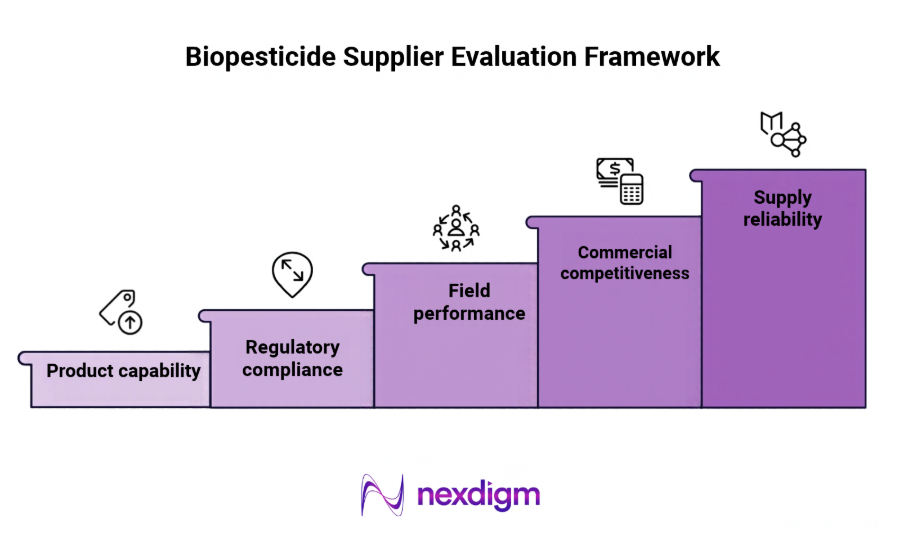
- Product capability: Biological category, target pests, crop suitability and formulation range.
- Regulatory compliance: Registration status, labelling, documentation and quality controls.
- Field performance: Trial evidence, application requirements and consistency across growing conditions.
- Supply reliability: Manufacturing capacity, storage infrastructure, distribution reach and seasonal availability.
- Commercial competitiveness: Cost per application, technical support, contract terms and scalability.
Nexdigm’s Case Study: Mapping Biological Crop Protection Suppliers
Nexdigm mapped 42 biopesticide vendors across 6 product categories and 8 agricultural markets, assessing registrations, manufacturing capabilities, distribution reach and commercial positioning. The research shortlisted 11 suppliers for further technical and procurement evaluation.
To take the next step, simply visit our Request a Consultation page and share your requirements with us.
Harsh Mittal
+91-8422857704