

Biopharmaceutical manufacturing is expanding while supply chains remain dependent on specialized materials, limited manufacturing capacity, and globally distributed suppliers. The global biopharmaceutical contract manufacturing market was valued at $44.7 billion in 2025 and is projected to reach $100.8 billion by 2033, growing at a 10.5% CAGR. Biologics represented 78.1% of the market by drug type in 2025, highlighting the increasing importance of complex biologic production.
Yet growth does not eliminate procurement constraints. The OECD’s 2026 analysis identifies limited global manufacturing capacity, limited API sources, and environmental or regulatory constraints among important supply-chain vulnerabilities. In one assessment of medical countermeasure supply chains, limited manufacturing capacity accounted for 27% of cited vulnerability factors, while limited API sources represented 18%.
For biotech companies, procurement therefore needs to look beyond unit prices. Biotech material procurement intelligence can help identify supply constraints, supplier concentration, alternative sources, geographic exposure, capacity limitations, and cost drivers before they affect manufacturing continuity.
Procurement Risk Is Increasingly Linked to Upstream Visibility
Biotech materials can move through multiple tiers involving specialized manufacturers, distributors, raw-material producers, and logistics providers. Limited visibility into these upstream relationships can make it difficult to anticipate shortages or identify alternatives quickly. The OECD notes that persistent gaps in visibility across essential medical supply chains can limit the ability to detect emerging disruptions and strengthen supply security. For biotech companies, procurement intelligence can therefore provide an early view of where supply may tighten, which inputs have limited alternatives, and where cost or continuity risks could emerge.
Procurement Exposure Requires a Multi-Factor View
Supply concentration, alternative availability, and cost exposure rarely operate independently. A material may have multiple suppliers but remain vulnerable because capacity is concentrated geographically, while a low-cost source may carry longer lead times or qualification barriers. A combined view helps biotech companies understand where individual risks intersect, which materials warrant closer attention, and where procurement decisions could strengthen both cost efficiency and supply continuity.
Criticality, Substitutability, and the Cost of Switching Sources
Not every supply constraint creates the same level of procurement risk. Nexdigm can help biotech organizations assess areas to understand which inputs require greater procurement attention. These are:
- Material Criticality: Determine how strongly a material’s availability affects manufacturing continuity, development timelines, or product quality.
- Substitutability: Assess whether alternative materials or suppliers exist and what technical, quality, or regulatory requirements may limit substitution.
- Switching Cost: Consider qualification timelines, validation requirements, inventory implications, logistics, and commercial costs associated with changing sources.
This helps Nexdigm distinguish between materials that are simply expensive or constrained and those where switching limitations could create meaningful business exposure.
How Nexdigm’s Experts Translate Material Risk Into Procurement Priorities
Nexdigm can bring together life sciences expertise, biotech material procurement intelligence, supplier intelligence and market research to interpret material-level risks in the context of broader manufacturing requirements. Our experts can help organizations:
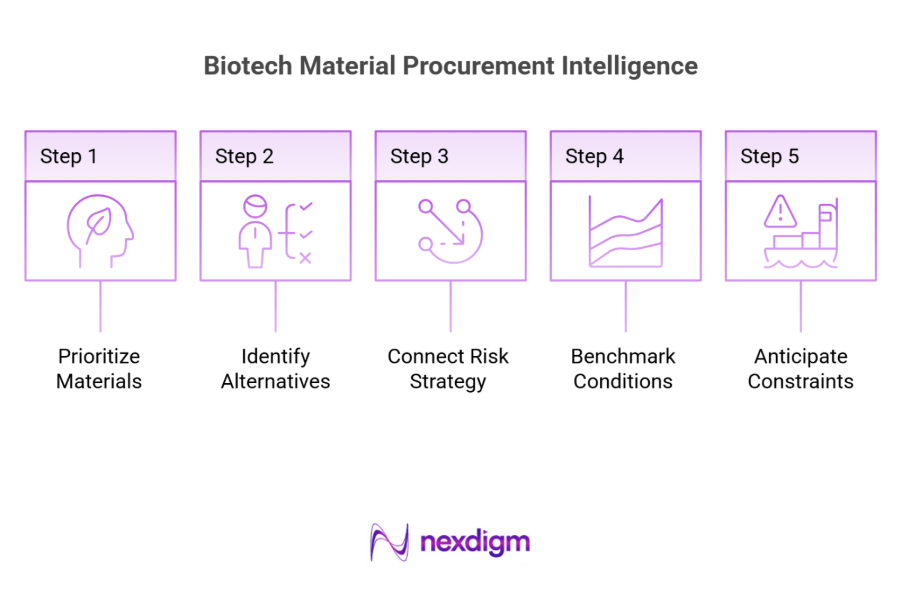
- Prioritize High-Impact Materials: Identify inputs where supply disruption, limited substitutes, or long qualification cycles could have greater operational consequences.
- Identify Actionable Alternatives: Assess suppliers and sourcing markets based on technical suitability, qualification feasibility, capacity, and commercial practicality.
- Connect Risk With Procurement Strategy: Translate findings into sourcing priorities that can support diversification, supplier engagement, negotiation, and continuity planning.
- Benchmark Supplier and Market Conditions: Compare supplier capabilities, capacity, pricing dynamics, geographic exposure, and market conditions to identify relative strengths and potential procurement risks.
- Anticipate Emerging Supply Constraints: Monitor changes in supplier availability, capacity, sourcing markets, logistics, and cost drivers to identify risks that could affect future procurement requirements.
This enables Nexdigm to move beyond identifying procurement risks and help organizations understand which risks require action, what options exist, and where procurement intervention can create the greatest value.
Nexdigm’s Biotech Material Procurement Intelligence Supporting Sourcing Decisions
Nexdigm can use biotech material procurement intelligence to connect supplier, market, cost, and supply-risk insights with the decisions procurement teams need to make in the following areas. Such as:
- Strengthening Supplier Selection: Comparing suppliers across capability, capacity, quality, geographic exposure, commercial positioning, and long-term sourcing potential.
- Identifying Cost and Risk Trade-Offs: Evaluate whether lower-cost sourcing options introduce additional logistics, qualification, concentration, or continuity risks.
- Support Sourcing Diversification: Identify viable alternate suppliers and markets based on material criticality, substitutability, qualification requirements, and supply availability.
By combining these perspectives, Nexdigm can help biotech organizations turn procurement intelligence into more informed sourcing priorities, stronger supplier strategies, and greater supply-chain resilience.
Nexdigm’s Case
Nexdigm supported a biotech company in assessing 32 critical material categories across supplier availability, sourcing markets, cost drivers, and qualification requirements. The analysis identified 20% with elevated cost exposure, 14% with limited alternative sources, and 11 categories suitable for diversification, helping the company prioritize supplier engagement, alternate-source evaluation, and procurement-risk mitigation.
To take the next step, simply visit our Request a Consultation page and share your requirements with us.
Harsh Mittal
+91-8422857704