

Blockchain adoption in financial systems is reshaping how institutions manage payments, settlements, trade finance, compliance, and data verification. By creating secure, shared, and transparent transaction records, blockchain helps reduce reconciliation delays, manual errors, and processing costs while improving trust across financial networks.
Using competitive intelligence, firms need to track how banks, fintechs, payment providers, and exchanges are adopting blockchain to enhance speed and transparency. Blockchain in finance benchmarking helps compare competitor use cases, technology partnerships, efficiency gains, regulatory readiness, and market positioning to identify innovation gaps and strategic opportunities.
The blockchain in banking and financial services market was valued at about $6.98 billion and is projected to reach nearly $59.12 billion by 2029, growing at 53.3% CAGR. Another estimate expects the market to grow from $10.65 billion in 2025 to $16.27 billion in 2026. These trends make Blockchain in finance benchmarking essential for tracking transparency, speed, and adoption gaps.
Competitive Intelligence on using Blockchain Payment Solutions
Competitive Intelligence on Using Blockchain Payment Solutions analyzes how banks, fintechs, and payment providers use blockchain to improve transaction speed, transparency, security, settlement efficiency, and cross-border payment competitiveness.
-
Competitor Adoption Tracking
Monitors banks, fintechs, and payment providers using blockchain for faster, transparent, and secure payment processing.
-
Cross-Border Payment Benchmarking
Compares blockchain-based international payment solutions on speed, cost, transparency, settlement time, and user convenience.
-
Technology Platform Analysis
Reviews blockchain networks, protocols, and vendors used by competitors to improve payment infrastructure and scalability.
-
Transaction Speed Assessment
Evaluates how blockchain reduces settlement delays, manual reconciliation, and transaction processing time across payment systems.
-
Transparency and Traceability
Analyzes how blockchain improves real-time tracking, auditability, and trust across financial payment networks.
Nexdigm Operational Efficiency Analysis for Blockchain Adoption
Nexdigm Operational Efficiency Analysis for Blockchain Adoption helps financial institutions assess how blockchain can reduce reconciliation delays, manual processing, settlement time, and transaction costs. It evaluates current workflows, competitor practices, technology platforms, and efficiency gaps. Through benchmarking and data-led insights, Nexdigm supports banks, fintechs, and payment providers in improving transparency, speed, compliance, and operational performance.
Nexdigm Competitive Intelligence for Blockchain Adoption in Finance
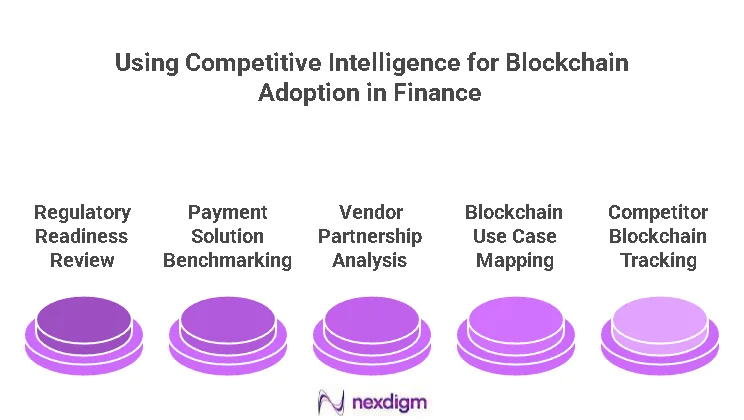
Nexdigm Competitive Intelligence for Blockchain Adoption in Finance helps firms track competitor blockchain use, payment innovation, vendor partnerships, regulatory readiness, transparency improvements, and speed-driven efficiency gains across financial systems:
-
Competitor Blockchain Tracking
Nexdigm monitors banks and fintechs adopting blockchain for payments, settlements, transparency, compliance, and faster transaction processing.
-
Blockchain Use Case Mapping
Nexdigm identifies blockchain applications across payments, trade finance, smart contracts, digital assets, and transaction verification.
-
Vendor Partnership Analysis
Nexdigm tracks blockchain technology providers, platform partnerships, fintech collaborations, and ecosystem alliances shaping financial innovation.
-
Payment Solution Benchmarking
Nexdigm compares blockchain payment models on speed, cost, transparency, security, scalability, and cross-border efficiency.
-
Regulatory Readiness Review
Nexdigm evaluates compliance, data privacy, reporting standards, and regulatory alignment for blockchain adoption in finance.
Nexdigm’s case:
Nexdigm helped a leading global digital trade finance platform using blockchain technology to strengthen cybersecurity and operational resilience. The client used blockchain to manage global liquidity for supply chain and trade assets but lacked a dedicated CISO and cybersecurity team.
Nexdigm acted as a Virtual CISO, improving governance, incident response, API security, compliance, and monitoring. The engagement delivered 70% annual cost savings compared with a full-time CISO while strengthening risk controls and business continuity.
To take the next step, simply visit our Request a Consultation page and share your requirements with us.
Harsh Mittal
+91-8422857704