

Blockchain has been associated with logistics for years, particularly around trade documentation, shipment visibility, and supply chain traceability. Yet adoption has been uneven. The 2022 closure of TradeLens, the blockchain-based maritime platform developed by Maersk and IBM, showed that technical feasibility does not automatically translate into commercial viability.
The more relevant question for logistics providers is where distributed ledgers create value that conventional databases, EDI systems, or API integrations cannot deliver as effectively. The answer is generally found in transactions involving multiple independent parties, limited trust, high fraud exposure, or stringent audit requirements.
The Strongest Case Is Where Provenance Matters
Traceability is among the more compelling logistics applications because the cost of an unreliable chain of custody can be substantial.
Pharmaceutical and biologic supply chains require detailed records across manufacturers, wholesalers, logistics providers, and dispensers. Food companies need to trace contaminated lots quickly during recalls. Aerospace manufacturers need verifiable records covering component origins, certifications, maintenance, and operating history.
In these environments, a shared and tamper-resistant record can reduce disputes over custody and make transaction histories easier to verify across organizations that do not operate from the same database.
Trade Documentation Can Create Another Use Case
International trade involves multiple documents moving between exporters, importers, carriers, banks, and customs authorities. Bills of lading, certificates of origin, letters of credit, and inspection documents can create delays when physical copies or fragmented systems are involved.
Electronic bills of lading and smart contracts can reduce some of this friction. A verified digital transaction can allow ownership documentation to move between parties more quickly, while predefined conditions can link proof of delivery or customs release to payment.
The commercial value becomes particularly relevant when documentation delays result in cargo sitting at destination ports and accumulating demurrage.
An Immutable Ledger Does Not Mean Accurate Data
Blockchain can preserve a record, but it cannot establish whether the information entering that record is correct.
Temperature sensors, GPS devices, barcode scans, and other external systems provide much of the underlying logistics data. If a sensor is incorrectly calibrated or manipulated, the blockchain can permanently record the wrong information.
There are other practical vulnerabilities:
- Barcode and RFID duplication: Legitimate identifiers can be copied onto unauthorized products.
- Sensor reliability: Calibration failures or manipulation can compromise environmental readings.
- Consortium governance: Competing logistics participants may be unwilling to share sensitive operational data on a common platform.
This makes data capture, device security, and governance as important as the ledger itself.
The Economics Should Come Before the Technology
Blockchain also has to compete against simpler technology architectures. The research compares centralized cloud databases capable of handling 10,000+ transactions per second with distributed-ledger environments operating at roughly 100–1,000 transactions per second. Blockchain implementations can also require higher integration, node infrastructure, and governance costs.
For supply chains where participants already have established contractual relationships, a centralized database connected through APIs may provide the required visibility at substantially lower complexity.
The stronger opportunity exists where fraud reduction, auditability, and faster settlement create enough value to justify the additional architecture.
This is why a Blockchain logistics market assessment needs to evaluate the use case before recommending the technology.
Which Logistics Problems Justify Blockchain?
Nexdigm evaluates proposed applications across operational need, trust requirements, data integrity, regulatory obligations, and economics.
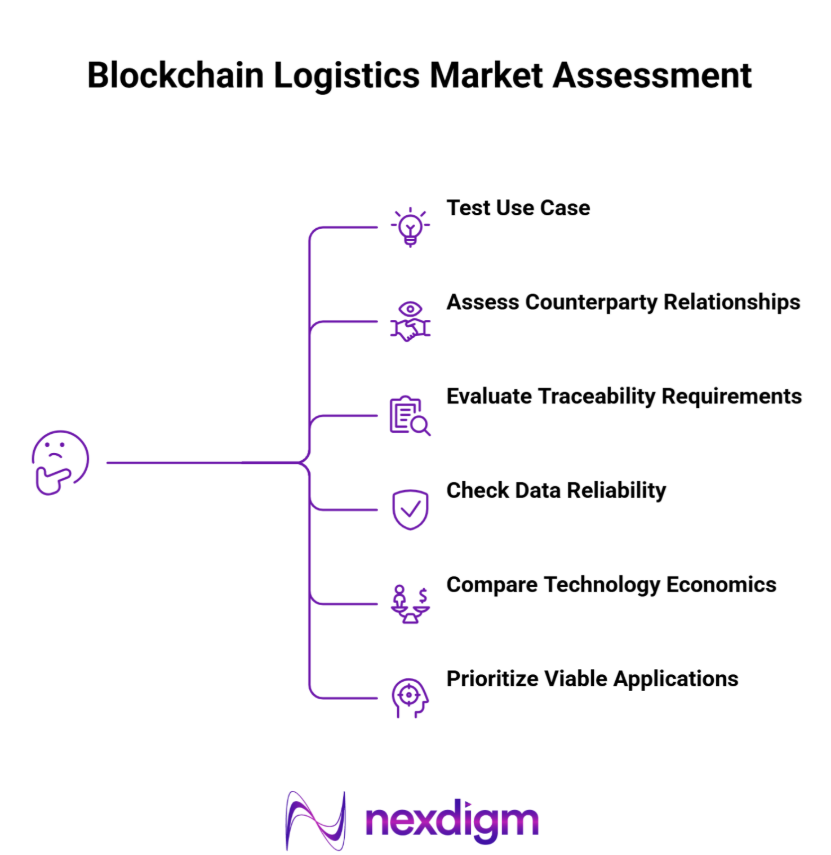
- Test the use case: Determine whether the underlying problem actually requires a distributed ledger.
- Assess counterparty relationships: Identify where multiple parties need a shared record without relying on a single system owner.
- Evaluate traceability requirements: Examine the financial, regulatory, or safety consequences of incomplete provenance.
- Check data reliability: Assess sensors, scanning systems, IoT devices, and other sources feeding the ledger.
- Compare technology economics: Model integration, node infrastructure, smart-contract, and governance costs against expected savings.
- Prioritize viable applications: Identify the use cases, where fraud reduction, faster settlement, or lower audit costs can generate a defensible return.
How Nexdigm Identified a Viable Cold-Chain Application
A pharmaceutical logistics provider across 12 countries was spending ₹18 crore ($2.2 million) annually on reconciliation, audits, and temperature disputes.
Nexdigm assessed three blockchain use cases and prioritized cold-chain traceability, using tamper-resistant sensors with 15-minute readings. The deployment cut reconciliation from 42 days to under four hours, reduced carrier disputes by 78%, and saved ₹12.5 crore ($1.5 million) annually.
To take the next step, simply visit our Request a Consultation page and share your requirements with us.
Harsh Mittal
+91-8422857704