
Business intelligence (BI) software helps enterprises turn operational and customer data into reports, dashboards, and insights that guide business decisions. Yet adoption and value depend on selecting suppliers whose products fit organizational needs. Eurostat reported that 16.28% of EU enterprises used BI software in 2025, while adoption among large enterprises reached 69.24%.
Another Consulting’s 2026 ERP Report found that 55.3% of respondents had significantly deployed business intelligence as a digital initiative. These findings reflect both the growing relevance of BI and the importance of evaluating solutions carefully.
Through business intelligence software supplier comparison, enterprises can examine dashboard functionality, reporting capabilities, integration options, usability, and vendor suitability before committing to a platform across increasingly complex and interconnected enterprise technology environments today.
Why BI Supplier Selection Involves More Than Feature Comparison
BI suppliers often offer overlapping features, but differences in dashboard flexibility, reporting accuracy, integration architecture, and user experience can influence adoption and performance. A platform with extensive functionality may still create challenges if it requires complex administration or cannot connect effectively with existing systems. Enterprises must therefore assess how each solution fits their data environment, reporting needs, and users’ ability to interpret insights consistently.
Tests for Evaluating Business Intelligence Software Suppliers
Comparing BI software suppliers requires examining how well their solutions support enterprise reporting and data accessibility. Organizations should consider dashboard flexibility, reporting accuracy, integration with existing applications, and ease of use across different employee groups. Evaluating these factors together helps decision-makers distinguish between platforms with extensive features and those offering practical functionality, reliable performance, and suitability for everyday business requirements.
Common Challenges in Comparing Business Intelligence Software Suppliers
Comparing BI software suppliers can be challenging because vendors present similar capabilities through different product structures, pricing models, and technical specifications. Experts at Nexdigm can help enterprises examine these differences through focusing on three areas:
- Feature and Functionality Differences: Compare dashboard capabilities, reporting tools, analytical features, and customization options to identify meaningful differences between suppliers.
- Integration and Compatibility Limitations: Assess connectivity with ERP, CRM, databases, and existing enterprise applications to identify potential integration constraints.
- Usability and Adoption Challenges: Examine interface design, implementation complexity, training requirements, and self-service capabilities to understand factors that may influence employee adoption.
This assessment can help organizations identify potential limitations, establish clearer evaluation criteria, and shortlist BI suppliers aligned with their technology environments and business requirements.
Mapping Business Intelligence Software Supplier Landscape by Nexdigm’s Experts
Nexdigm helps enterprises gain a clearer understanding of the BI software market through business intelligence software supplier comparison, examining established providers, specialized technology vendors, and emerging competitors. Our research covers four distinct areas:
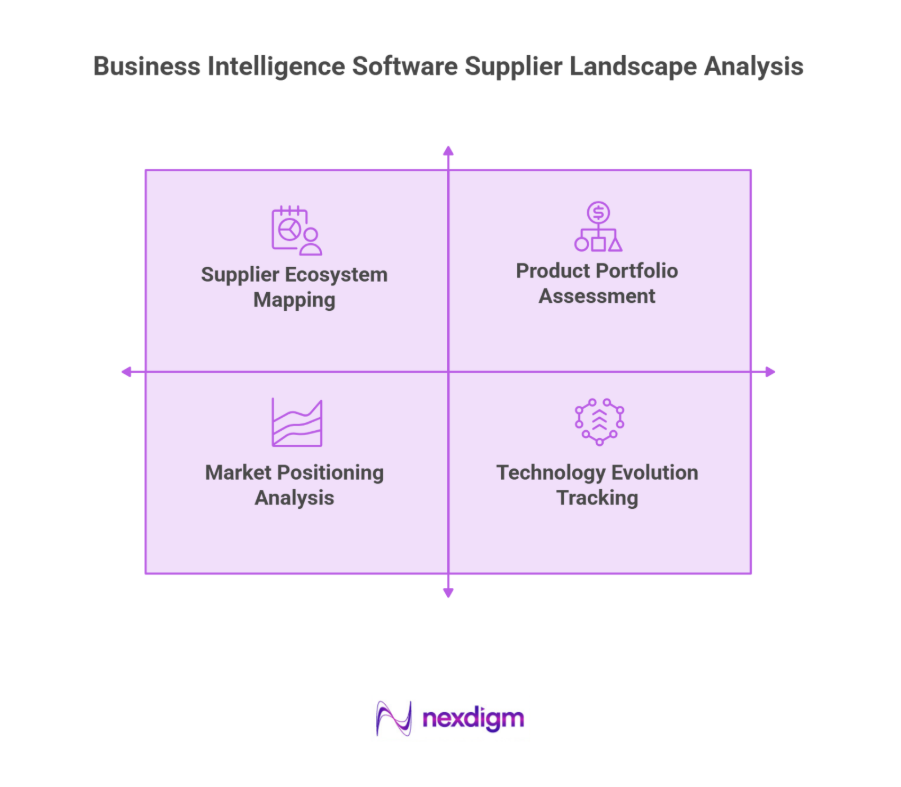
- Supplier Ecosystem Mapping: Identify established vendors, niche providers, and emerging competitors based on product portfolios, target industries, and deployment models.
- Product Portfolio Assessment: Examine dashboard tools, reporting functionality, predictive analytics, data integration, and other capabilities across supplier offerings.
- Market Positioning Analysis: Evaluate vendor presence, customer segments, strategic partnerships, and competitive differentiation to understand their relative market positions.
- Technology Evolution Tracking: Monitor developments in AI-enabled analytics, cloud-based BI, self-service reporting, and data visualization to identify changing supplier priorities.
This market perspective can help enterprises identify relevant providers, explore alternatives, and establish a focused shortlist for further evaluation.
A Glimpse Into Nexdigm’s Business Intelligence Software Supplier Comparison Services
Our business intelligence software supplier comparison services help enterprises move from market exploration to structured vendor evaluation. Our research can support supplier profiling, comparative capability assessments, technology gap identification, and vendor shortlisting. By examining suppliers against defined business and technical requirements, Nexdigm can help decision-makers understand available options, evaluate relevant trade-offs, and establish a more informed basis for software selection.
Nexdigm’s Case
A large enterprise sought to identify a BI software provider capable of supporting its reporting, data integration, and analytics requirements across multiple business functions. Here Nexdigm supported them by evaluating 12 software suppliers, comparing their dashboard functionality, reporting capabilities, integration options, and usability, and identifying capability gaps across 5 vendors. The assessment helped the enterprise shortlist 4 suppliers for detailed evaluation, providing a clearer basis for its software selection process.
To take the next step, simply visit our Request a Consultation page and share your requirements with us.
Harsh Mittal
+91-8422857704