

A business market entry framework helps companies evaluate new markets with a structured view of demand, competition, and regulatory risks. Instead of entering a market based only on growth potential, businesses need to assess customer needs, pricing expectations, competitor strength, compliance requirements, distribution channels, and operational readiness.
This supports a stronger market entry strategy by connecting market opportunity with execution planning. It helps companies choose the right entry mode, avoid costly delays, and reduce uncertainty before launch. By using a clear business market entry framework, organizations can make informed decisions and build a scalable path for long-term expansion.
The need for a business market entry framework is clear, as nearly 70% of cross-border expansions face execution challenges linked to planning, regulation, and local market complexity. Market research also shows that weak pre-entry assessment often leads companies to misjudge customer demand, underestimate competition, or delay approvals.
With regulatory compliance, pricing pressure, and distribution barriers affecting launch timelines, a structured market entry strategy helps businesses reduce risk and improve execution success.
Assessing Demand and Competition Before Finalizing Market Entry Strategy
Assessing Demand and Competition Before Finalizing Market Entry Strategy means analyzing customer needs, market size, pricing expectations, competitor strength, and growth potential to choose the right entry approach and reduce expansion risks.
-
Customer Demand Assessment
Analyze customer needs, buying behavior, affordability, and product relevance to confirm whether the market has real demand.
-
Market Size Evaluation
Estimate total market potential, growth rate, customer segments, and revenue opportunities before committing resources to expansion.
-
Competitor Benchmarking
Study key competitors, pricing models, product offerings, strengths, and weaknesses to identify market gaps and positioning opportunities.
-
Pricing and Value Analysis
Review customer price sensitivity, competitor pricing, and perceived value to build a practical and competitive pricing strategy.
-
Target Segment Identification
Define priority customer groups based on demographics, purchasing power, industry needs, and adoption potential in the new market.
Nexdigm’s End-to-End Market Entry Advisory for Turning Research into Execution
Nexdigm’s Market Entry Advisory for Turning Research into Execution helps companies convert market research into a practical expansion plan. Nexdigm supports demand assessment, competitor analysis, regulatory review, entry mode selection, partner identification, business setup, tax planning, and go-to-market execution. This helps businesses move from insight to action while reducing delays, compliance risks, and operational uncertainty.
Nexdigm’s Demand Assessment Support for Validating New Market Opportunities
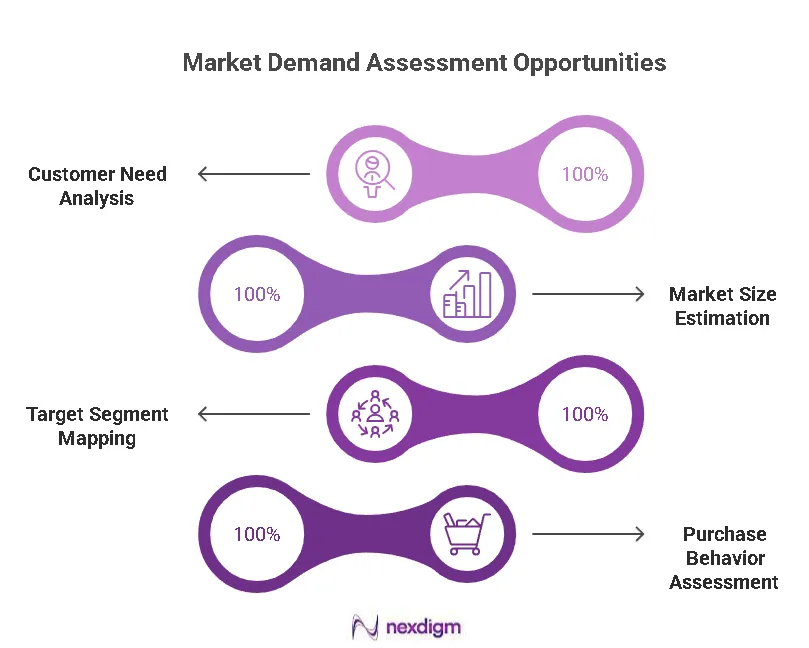
Nexdigm’s Demand Assessment Support for Validating New Market Opportunities helps companies evaluate customer needs, market size, purchasing behavior, pricing potential, and growth trends before committing resources to a new market:
-
Customer Need Analysis
Nexdigm identifies customer pain points, preferences, and expectations to confirm whether the product or service fits market demand.
-
Market Size Estimation
Nexdigm evaluates addressable market size, growth potential, and revenue opportunity to support confident expansion decisions.
-
Target Segment Mapping
Nexdigm defines priority customer groups based on demographics, industry requirements, purchasing power, and adoption potential.
-
Purchase Behavior Assessment
Nexdigm studies buying triggers, decision-making patterns, price sensitivity, and adoption barriers within the target market.
Nexdigm’s case:
Nexdigm helped a Japan-based chemicals and materials company assessed India’s demand for Engineering Plastic and Polypropylene compound goods before setting up operations. Nexdigm supported the client with market sizing, segmentation, demand analysis, value-chain mapping, competitor assessment, and stakeholder discussions.
The study found that compound demand in India was projected to grow at an 8.5% CAGR from 2020 to 2025, with major organized players accounting for nearly 70%–80% of demand. Nexdigm also conducted 25+ stakeholder interviews to support informed market entry decisions.
To take the next step, simply visit our Request a Consultation page and share your requirements with us.
Harsh Mittal
+91-8422857704