

Growth opportunities are everywhere, but not every opportunity deserves investment. Whether expanding into new markets, launching innovative products, entering adjacent business segments, or pursuing strategic partnerships, organizations must carefully evaluate potential returns against associated risks. This is where comprehensive business opportunity assessment services become important.
In a competitive landscape, business leaders need more than just assumptions to make strategic decisions. They require a structured framework that helps determine which opportunities align with organizational capabilities, market realities, and long-term growth objectives.
At Nexdigm, business opportunity evaluations are designed to transform uncertainty into actionable insights, enabling organizations to focus resources on ventures with the highest likelihood of commercial success.
The Need for a Structured Opportunity Assessment
A structured assessment framework is a strategic measure which helps organizations avoid costly missteps and focus on opportunities that offer sustainable growth. Effective business opportunity assessment services help organizations:
- Identify attractive growth avenues
- Validate market potential
- Assess strategic fit
- Quantify risks and rewards
- Prioritize investment decisions
- Develop actionable business strategies
- Improve return on investment
Organizations like Nexdigm supports businesses by providing fact-based evaluations that enable smarter and more confident decision-making, through a series of structured steps.
Step 1: Identifying and Screening Opportunities
The first challenge is determining which opportunities are worth investigating further. With limited resources and multiple growth possibilities available, businesses need a structured approach to filter opportunities based on their strategic relevance, market potential, and likelihood of success before committing significant time and investment.
This opportunity assessment involves assessing latest trends, competitive landscape, current performance, etc. Nexdigm helps businesses systematically evaluate these opportunities through a strategic process that eliminates low-potential options early. This process evaluates factors such as:
- Business goals and growth ambitions
- Core competencies
- Resource availability
- Operational readiness
- Brand positioning
- Long-term strategic priorities
This process ensures that only the most relevant opportunities move forward for deeper analysis.
Step 2: Evaluating Market Attractiveness
Before committing resources, businesses need to understand whether a market can deliver meaningful growth and profitability. This is usually done by Market Size and Growth Analysis. It’s a key component of business opportunity assessment which helps in determining the overall potential of the targeted market. Nexdigm in this analytical process examines:
- Current market size
- Forecasted market growth
- Demand drivers
- Customer adoption trends
- Industry outlook
- Macroeconomic influences
This analysis provides a clear understanding of whether the opportunity offers enough scale to justify investment.
Step 3: Assessing Competitive Positioning
Even attractive markets may present challenges if the competitive landscape is highly saturated. Nexdigm’s Competitor Landscape Mapping helps business with opportunity assessment and competitive evaluations that examine:
- Existing market participants
- Market share concentration
- Product differentiation
- Pricing strategies
- Distribution capabilities
- Customer loyalty factors
This helps organizations identify both competitive threats and untapped opportunities.
Step 4: Commercial and Financial Evaluation
An opportunity’s attractiveness must be supported by strong financial fundamentals. This is carried down by Revenue Potential Analysis to help determine current and future financial performance statistics. Nexdigm develops realistic revenue projections by considering:
- Target customer segments
- Market penetration expectations
- Pricing assumptions
- Sales channel effectiveness
- Growth timelines
This provides decision-makers with practical expectations rather than overly optimistic forecasts.
Step 5: Risk and Feasibility Assessment
Every opportunity involves some level of uncertainty. Successful organizations understand those risks before making investment decisions. This is an essential step which helps businesses to allocate resources accordingly without any loss. Nexdigm evaluates such potential barriers like:
- Regulatory challenges
- Market volatility
- Competitive responses
- Supply chain constraints
- Technology risks
- Execution complexities
Step 6: Opportunity Prioritization and Decision-Making
Organizations often face multiple opportunities simultaneously. The challenge lies in identifying which initiatives should receive immediate attention and best suit the business goals. With Opportunity Scoring Framework, Nexdigm helps clients prioritize opportunities using key evaluation criteria such as:
- Market attractiveness
- Strategic alignment
- Revenue potential
- Profitability outlook
- Risk exposure
- Resource requirements
- Time-to-market
This objective framework enables executives to compare opportunities on a consistent basis.
Executive Decision Support
By combining market intelligence, financial analysis, and strategic insights, organizations like Nexdigm provide leadership teams with a complete decision-making framework designed to support confident investments and promote long-term growth.
Why Choose Nexdigm for Business Opportunity Assessment?
Nexdigm combines deep market expertise, analytical capabilities, and industry knowledge to help businesses identify opportunities that create tangible value. Nexdigm’s business opportunity assessment services enable organizations to:
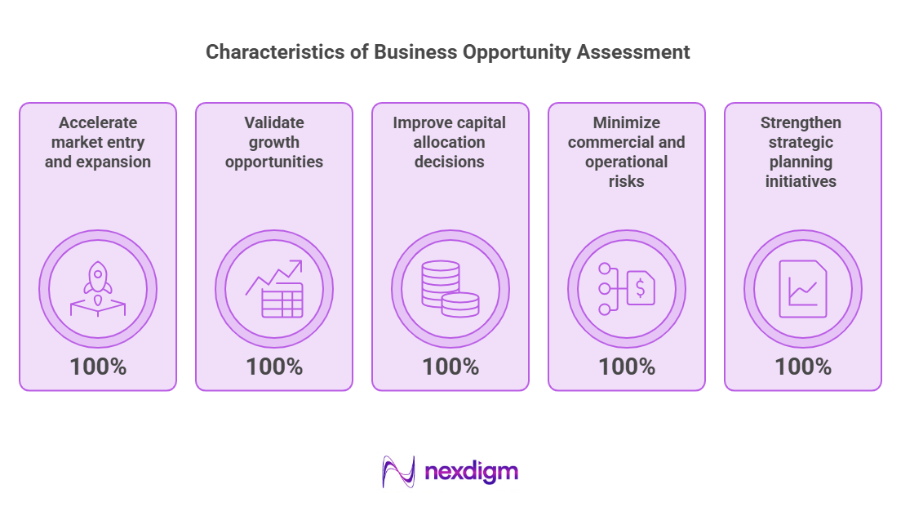
- Validate growth opportunities before investment: Assess market demand, competitive dynamics, and commercial potential to ensure opportunities are worth pursuing before resources are committed.
- Minimize commercial and operational risks: Identify potential market, financial, regulatory, and execution challenges early to support informed decision-making and risk mitigation.
- Improve capital allocation decisions: Prioritize investments based on opportunity attractiveness, expected returns, and strategic alignment to maximize business value creation.
- Strengthen strategic planning initiatives: Provide data-driven insights that support business planning, growth strategies, market expansion, and long-term organizational objectives.
- Accelerate market entry and expansion: Develop actionable market entry strategies that help businesses capitalize on opportunities and achieve sustainable growth faster.
The result is a more disciplined and structured approach to growth that balances ambition with commercial reality.
Nexdigm’s Case
In a recent engagement, Nexdigm helped a client identify high-potential opportunities through a structured business opportunity assessment framework. Real-time market insights prioritized investments, reduced evaluation timelines by 40%, improved decision confidence by 30%, and delivered 18% growth in opportunity conversion.
To take the next step, simply visit our Request a Consultation page and share your requirements with us.
Harsh Mittal
+91-8422857704