

Enterprise software is entering a consolidation cycle. After years of departmental buying, organizations are reassessing application portfolios that have accumulated through individual SaaS purchases, acquisitions, and functional experimentation. Gartner estimates the enterprise SaaS market reached $218.5 billion in 2024, up 16.7%, with CRM accounting for 51.4% of revenue. At the same time, enterprises are increasingly examining whether every application still justifies its cost, integration burden, and security exposure.
The shift is not simply about reducing the number of vendors. It reflects a broader change in how technology leaders evaluate software: whether applications share data, automate workflows across functions, support AI initiatives, and produce measurable business outcomes.
The SaaS Stack Has Become an Architecture Problem
A typical enterprise application environment can span ERP, CRM, HCM, ITSM, collaboration, procurement, analytics, contract management, customer support, and dozens of specialized tools.
Each additional application can introduce another subscription, integration, identity configuration, data store, security review, and renewal cycle. Over time, the cost of maintaining connections between systems can become material even when individual software licenses appear inexpensive.
The consequence is often fragmented data. Sales information sits in CRM, employee information in HCM, operational data in ERP, and service records in separate platforms. AI initiatives then have to reconcile those systems before they can produce reliable cross-functional insights.
This is one reason platform strategies are gaining traction. A shared data model and common workflow layer can reduce integration requirements while giving organizations greater control over identity, governance, and automation.
Where Consolidation Makes Economic Sense
Consolidation tends to be strongest where business processes are relatively standardized.
CRM, finance, HR, service management, and collaboration are increasingly served by broader suites. A company may therefore replace several adjacent applications with capabilities already included within its strategic platform.
But consolidation has limits. Specialized software can remain difficult to replace where it contains proprietary algorithms, industry-specific workflows, regulatory logic, or highly differentiated operational capabilities.
Advanced engineering, clinical research, sophisticated logistics optimization, and specialized financial applications can therefore retain a defensible position even when enterprises rationalize their broader software estate.
The relevant decision is consequently application-specific. Eliminating a tool because it is technically duplicative can destroy functionality that the core platform cannot reproduce at comparable depth.
AI Is Changing the Meaning of a Software Platform
The platform debate is also being reshaped by agentic AI.
Gartner estimates that up to $234 billion of enterprise application software spending could be exposed to agentic AI arbitrage between now and 2030, representing roughly 20% of enterprise application SaaS spending by that point. AI agents can increasingly complete tasks across multiple systems without requiring users to interact with every underlying application interface.
That changes the value equation for software vendors. Buyers may increasingly evaluate whether an application provides unique data, workflows, decision logic, or business outcomes rather than simply counting screens and features.
It also makes integration quality more important. A platform that cannot exchange trusted data with surrounding systems may become a bottleneck for automation, regardless of how extensive its individual feature set appears.
Four Tests for Software Portfolio Rationalization
A useful enterprise software review can begin with four questions:
- Is the capability differentiated? Determine whether the application provides functionality that a strategic platform cannot reproduce without significant customization.
- What is the integration burden? Measure APIs, middleware, maintenance effort, data duplication, and failure points created by the application.
- Where does the data live? Assess whether the application contributes to a unified data architecture or creates another isolated information repository.
- Does the economics justify retention? Compare licensing, implementation, administration, security, integration, and switching costs against measurable business value.
Nexdigm Enterprise Software Demand Assessment Framework
Nexdigm can evaluate software portfolios using a structured assessment tailored to the organization’s architecture and operating model:
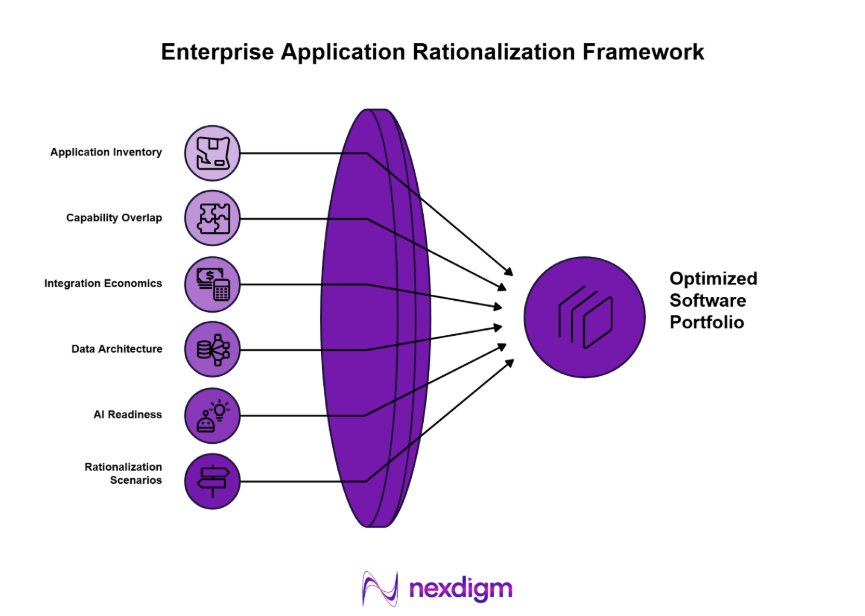
- Application inventory: Map applications by function, users, contracts, spend, deployment model, and business criticality.
- Capability overlap: Identify duplicated functionality across enterprise suites and point solutions.
- Integration economics: Quantify API maintenance, middleware, data reconciliation, and support requirements.
- Data architecture: Assess whether applications contribute to or fragment the enterprise’s core data environment.
- AI readiness: Evaluate API accessibility, data quality, workflow automation, and suitability for agentic processes.
- Rationalization scenarios: Model retain, consolidate, replace, or retire options using five-year TCO and operational impact.
Nexdigm Case: Technology Portfolio and Growth Strategy
Nexdigm supported a technology firm evaluating emerging-market demand, buyer segments, product positioning, and a scalable growth roadmap. The engagement improved customer-segment accuracy by 34%, reduced entry-planning gaps by 29%, and increased qualified adoption opportunities by 41%, demonstrating how structured technology assessment can sharpen investment and commercialization decisions.
To take the next step, simply visit our Request a Consultation page and share your requirements with us.
Harsh Mittal
+91-8422857704