

Business software companies win market share through effective go-to-market execution by translating product capabilities into clear customer value, targeted messaging, and scalable sales motions. In competitive software markets, success depends on identifying priority segments, aligning pricing with buyer expectations, building strong acquisition channels, and supporting adoption after purchase.
Market entry strategy helps providers reduce sales friction, differentiate offerings, and focus resources on customers with the highest conversion potential. An effective Business software go to market strategy enables companies to improve visibility, accelerate customer acquisition, strengthen retention, and capture growth from enterprises investing in digital transformation.
Business software demand is strengthening as the global software market was valued at USD 730.70 billion in 2024 and is projected to reach USD 1,397.31 billion by 2030, growing at a CAGR of 11.3%. The business software market was valued at USD 0.66 trillion in 2025 and is expected to reach USD 1.28 trillion by 2031, reflecting continued enterprise investment in digital tools and go-to-market execution.
Go-to-Market Roadmap for Winning Market Share in Business Software Markets
A go-to-market roadmap for winning market share in business software markets defines target segments, positioning, sales channels, pricing actions, adoption support, and growth milestones for scalable execution:
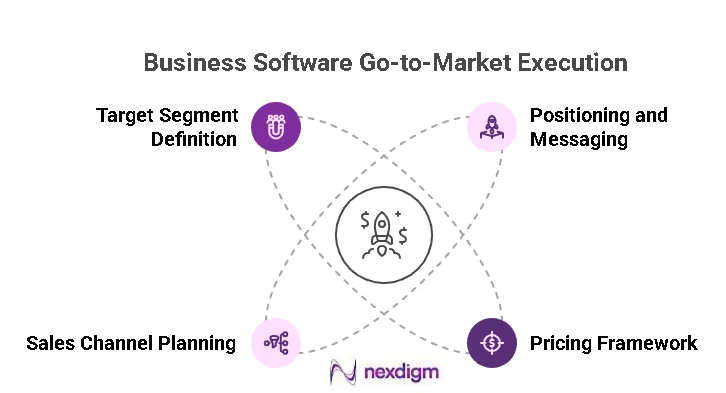
- Target Segment Definition: Identify priority industries, company sizes, buyer roles, and functional teams with strong business software adoption potential.
- Positioning and Messaging: Define clear value messages around productivity, workflow efficiency, integration, cost savings, and measurable business outcomes.
- Sales Channel Planning: Select direct sales, partner-led, marketplace, referral, and digital channels to reach target customers efficiently.
- Pricing Action Framework: Develop pricing tiers, packaging options, subscription models, discounts, and renewal structures aligned with buyer expectations.
Nexdigm’s support for Business Software Market Positioning
Nexdigm’s support for business software market positioning helps providers assess competitor offerings, customer expectations, differentiation gaps, pricing approaches, and adoption drivers. This enables companies to define clearer value propositions, strengthen messaging, improve buyer relevance, and position their software effectively to win market share in competitive business software markets.
Nexdigm’s Segment Prioritization for Business Software Market Share Growth
Nexdigm’s Segment Prioritization for Business Software Market Share Growth helps identify high-potential customer groups based on adoption readiness, business needs, budget capacity, buyer influence, and competitive opportunity.
- Adoption Readiness Assessment: Evaluate customer maturity, technology usage, process digitization, and willingness to adopt new business software solutions.
- Business Need Mapping: Identify operational pain points, workflow gaps, automation needs, and productivity challenges across target customer segments.
- Budget Capacity Review: Assess spending potential, software investment priorities, subscription affordability, and procurement readiness among customer groups.
- Buyer Influence Analysis: Map decision-makers, influencers, users, and procurement stakeholders involved in business software purchase decisions.
Nexdigm’s case:
Nexdigm assisted a business software company prioritize customer segments for market share growth. The assessment reviewed 8 target segments, analyzed 14 adoption and budget indicators, and identified 5 high-potential buyer groups. Nexdigm’s support helped the company improve targeting accuracy by 27%, reduce go-to-market planning time by 30%, and create a focused roadmap to strengthen business software adoption.
To take the next step, simply visit our Request a Consultation page and share your requirements with us.
Harsh Mittal
+91-8422857704