

Business software has become the operating layer connecting an organisation’s departments, processes and information. Finance teams rely on systems for accounting and reporting, HR functions manage employee data and payroll, procurement teams coordinate supplier relationships, and sales teams use customer platforms to manage revenue pipelines.
Despite the importance of these applications, software procurement is often fragmented. Individual departments may select products independently, creating overlapping subscriptions, inconsistent data and integration challenges. A business software market assessment helps organisations understand which suppliers serve different enterprise functions and where their products fit within the broader technology environment.
A structured business software vendor landscape research exercise gives procurement teams a clearer view of the market, supplier positioning and potential sourcing options across core business operations.
The Enterprise Software Market Is Built Around Functional Needs
Business software is not a single product category. It includes platforms designed to manage specific functions as well as integrated suites that connect multiple departments.
The most relevant supplier groups generally include:
- Finance and accounting software: Supports general ledger management, accounts payable and receivable, budgeting, financial reporting and reconciliation. Enterprise buyers should examine reporting flexibility, audit trails, regulatory requirements and integration with procurement and operational systems.
- Enterprise resource planning platforms: Connect finance, procurement, inventory, manufacturing, order management and other operational processes. Their value often lies in providing a shared view of business activity across departments.
- Human resource management software: Covers recruitment, payroll, workforce planning, employee records, performance management and learning. Buyers should consider employee experience, local payroll requirements and integration with finance systems.
- Customer relationship management software: Supports sales management, customer information, marketing activities and service operations. Platform comparisons should focus on pipeline visibility, workflow automation, customer data and reporting.
- Procurement and supply chain applications: Help organisations manage sourcing, purchase approvals, supplier information, contracts, inventory and logistics. Their suitability depends on the complexity of the supplier base and the level of process control required.
- Business intelligence platforms: Consolidate information from multiple systems to support reporting, analytics and operational decision-making.
What Market Data Says About Enterprise Software Adoption
Official adoption data provides useful context for understanding which business functions are investing in digital platforms.
Ireland’s Central Statistics Office reported that in 2025, 34.7% of enterprises used ERP software, 28.4% used CRM software and 26.5% used business intelligence software. Adoption was substantially higher among large enterprises: 78.7% used ERP, 66.0% used CRM and 75.5% used BI.
The difference across enterprise sizes highlights an important market consideration. Software vendors serve businesses with very different requirements, budgets and internal technology capabilities. A platform designed for a multinational enterprise may offer more functionality than a smaller organisation needs, while a simpler product may lack the controls required by a complex operating environment.
How to Identify the Vendors That Matter
A supplier landscape should begin with market segmentation rather than a broad list of software brands.
Procurement teams should identify vendors according to:
- Functional category and industry specialisation.
- Target customer size and geographic presence.
- Deployment model, including cloud and on-premises options.
- Product breadth and integration capabilities.
- Implementation partners and support ecosystem.
- Pricing structure and commercial positioning.
This segmentation helps distinguish integrated enterprise software providers from specialist vendors. It also reveals where the market is concentrated and where organisations have access to a wider selection of alternatives.
A vendor’s market presence should not be confused with suitability. A recognised supplier may have strong enterprise adoption but offer a product that is too complex or commercially unsuitable for a particular buyer.
The Importance of Integration Across Business Functions
The value of business software increases when information can move reliably between departments.
For example, procurement software should connect with finance systems to support purchase approvals, supplier payments and expenditure reporting. CRM platforms may need to integrate with ERP systems to provide visibility into order status, inventory and customer transactions.
Fragmented applications can create duplicated data entry, inconsistent reporting and manual reconciliation. These problems may increase operating costs even when individual software subscriptions appear affordable.
Supplier comparisons should therefore examine APIs, integration tools, data migration, identity management and compatibility with existing applications.
Organisations should also consider whether they need an integrated suite or a portfolio of specialist products. The former may simplify administration, while the latter can offer greater functional depth in specific departments.
Commercial Considerations Across the Software Landscape
Business software pricing varies according to user numbers, functionality, transaction volumes, modules and deployment models. Implementation and support can account for a substantial part of the overall investment.
Procurement teams should compare subscription or licence fees alongside configuration, data migration, integration, training, maintenance and renewal costs.
They should also examine the cost of adding new business units, expanding to additional markets or changing software providers. These factors are particularly relevant when the platform is expected to support long-term operational growth.
Business Software Vendor Landscape Assessment Framework
A market assessment should give decision-makers a view of both supplier availability and commercial suitability:
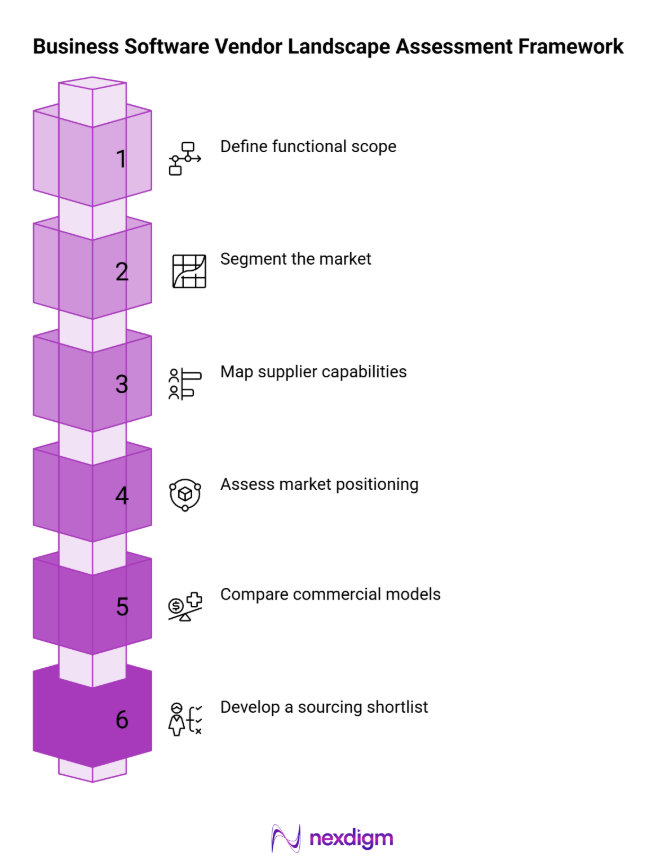
- Define functional scope: Identify the business functions, processes and software categories requiring evaluation.
- Segment the market: Group vendors by product specialisation, target customer, deployment model and geographic reach.
- Map supplier capabilities: Compare functional coverage, integration, scalability, implementation and support.
- Assess market positioning: Examine product maturity, customer segments, partner ecosystems and competitive differentiation.
- Compare commercial models: Evaluate licensing, subscriptions, implementation, maintenance and expansion costs.
- Develop a sourcing shortlist: Match vendor capabilities to organisational priorities and identify gaps requiring further assessment.
Nexdigm can support businesses through enterprise software market mapping, vendor intelligence, competitive benchmarking and procurement research. This helps organisations understand supplier positioning, identify relevant alternatives and evaluate software sourcing opportunities across core business functions.
Nexdigm’s Case Study: Mapping Business Software Suppliers
Nexdigm mapped 18 business software vendors across 6 enterprise functions, comparing product coverage, integration, deployment and pricing. The research identified 5 supplier segments, shortlisted 6 relevant vendors and established 9 criteria for enterprise software evaluation.
To take the next step, simply visit our Request a Consultation page and share your requirements with us.
Harsh Mittal
+91-8422857704