

Buy Now, Pay Later (BNPL) has moved well beyond its early association with small online purchases and younger digital consumers. Installment payment options are now appearing across categories such as consumer electronics, healthcare, travel, and home improvement.
BNPL can reduce upfront payment friction and encourage larger purchases for merchants. However, for providers, sustained growth depends on a more difficult balance between customer adoption, merchant value, credit performance, and regulatory requirements. The central question is whether the model can continue growing while remaining economically viable for both merchants and lenders.
BNPL Has Moved Beyond Its Original Customer Base
Early BNPL adoption was concentrated among digitally active younger consumers, particularly in fashion and discretionary retail. The customer base has since broadened.
Two distinct demand patterns are becoming important. Some prime-credit consumers use installment payments as a budgeting tool despite having access to credit cards. Others use BNPL because traditional revolving credit is less accessible to them.
That distinction matters because the same transaction volume can carry very different credit implications. A provider serving financially resilient customers may experience very different repayment behavior from one increasingly dependent on credit-constrained borrowers.
The expansion into higher-value categories also changes the opportunity. Healthcare, electronics, travel, and home improvement can generate larger transactions, creating greater potential value for merchants and providers.
Merchants Need a Reason to Keep Offering It
Merchant adoption hinges on whether BNPL delivers enough commercial value to justify the merchant discount rate.
By breaking up large upfront costs into smaller installments, BNPL reduces customer friction at checkout, directly lifting conversion rates and expanding average order values.
The value proposition is stronger where:
- Purchases are relatively high-value
- Consumers benefit from spreading payments
- Gross margins can accommodate merchant fees
- The product helps reduce checkout abandonment
- BNPL attracts customers the merchant may otherwise struggle to convert
For low-margin businesses where processing fees already squeeze profitability, the economics fall apart. This forces BNPL providers to segment carefully: prioritize categories where incremental sales and higher basket sizes easily outweigh the integration cost.
Credit Quality Is Becoming Harder to Ignore
Volume growth does not guarantee sustainable lending. BNPL providers face real exposure to defaults, rising cost of capital, and shifting consumer credit health.
Product duration dictates that risk.
Pay-in-4 structures allow fast capital recycling and real-time risk adjustments,
whereas longer-term financing increases vulnerability to macroeconomic downturns and household budget strain.
Sustainable scale depends on monitoring key borrower indicators:
- repeat usage frequency
- discretionary versus essential spending
- segment-level default rates
- merchant category loss performance
A expanding user base creates value only when portfolio repayment remains resilient.
Regulation Is Changing the Product
BNPL is also moving toward greater regulatory scrutiny. Requirements around consumer disclosures, credit reporting, affordability, disputes, and underwriting can change both customer acquisition and operating costs.
Greater oversight can reduce some of the practices that helped BNPL platforms scale rapidly, particularly frictionless borrowing without a complete view of a consumer’s existing obligations.
For providers, this creates a more demanding operating environment. Stronger underwriting and compliance may reduce some short-term conversion, but they can also create a healthier lending portfolio and greater consumer confidence.
Regulation is therefore becoming part of the market structure rather than a separate compliance issue.
The Next BNPL Opportunities May Look Different
The most attractive opportunities may increasingly sit outside the original fashion-focused Pay-in-4 model.
Healthcare and elective medical expenses, home improvement, education, and other higher-value purchases can provide clearer reasons for consumers to spread payments. B2B applications are another emerging area, particularly where financing can support transactions between SMEs and distributors.
Bank-fintech partnerships may also provide an alternative growth model by combining BNPL-style installment functionality with regulated lending infrastructure.
The common factor is a stronger underlying economic need. The opportunity is less about adding another payment button and more about identifying situations where installment financing solves a meaningful affordability or purchasing problem.
Nexdigm’s BNPL Sustainability Assessment
Nexdigm assess the market through four connected dimensions:
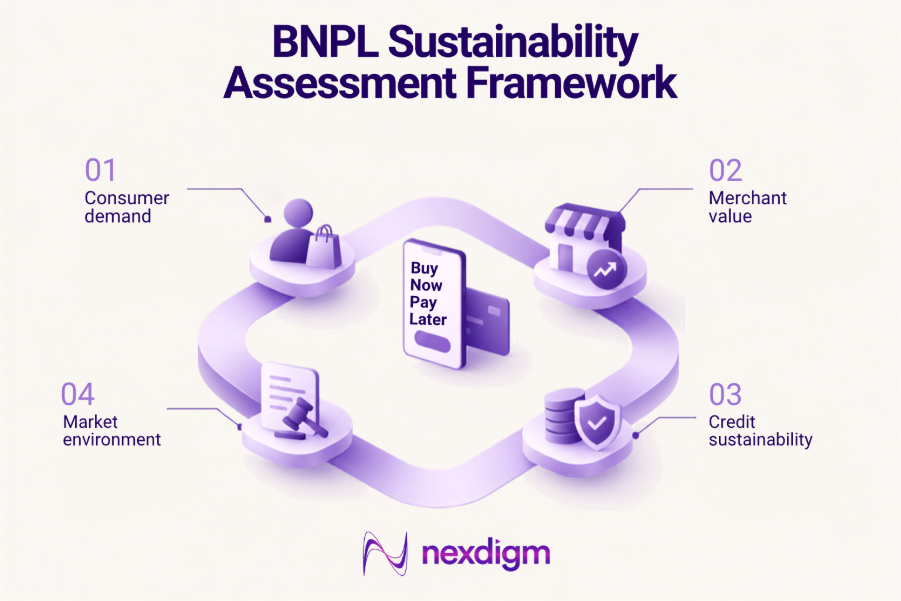
- Consumer demand: Segment users by demographics, credit profile, purchase category, repeat behavior, and underlying reason for borrowing.
- Merchant value: Assess conversion potential, basket-size effects, merchant margins, category economics, and willingness to pay for BNPL.
- Credit sustainability: Evaluate repayment behavior, delinquency trends, funding requirements, and risk across borrower and merchant cohorts.
- Market environment: Assess regulatory requirements, competitive positioning, distribution models, and barriers to scaling.
A Buy now pay later market analysis should examine demand and economics together. The result can identify which customer segments, merchant categories, and lending models offer the strongest balance between growth and risk.
How Nexdigm Separates Durable BNPL Markets From Short-Term Growth
A BNPL provider assessed expansion across higher-value consumer categories after finding that BNPL merchant fees can reach 3.5%–5.0%, while higher-value categories such as healthcare and home improvement can support larger financed purchases. Nexdigm used merchant economics and borrower-risk indicators to prioritize segments with stronger sustainability potential
BNPL can continue expanding, but its next phase is likely to be more selective. Merchant acceptance will depend on measurable commercial value, while providers will need stronger control over credit risk and compliance.
To take the next step, simply visit our Request a Consultation page and share your requirements with us.
Harsh Mittal
+91-8422857704
[email protected]