
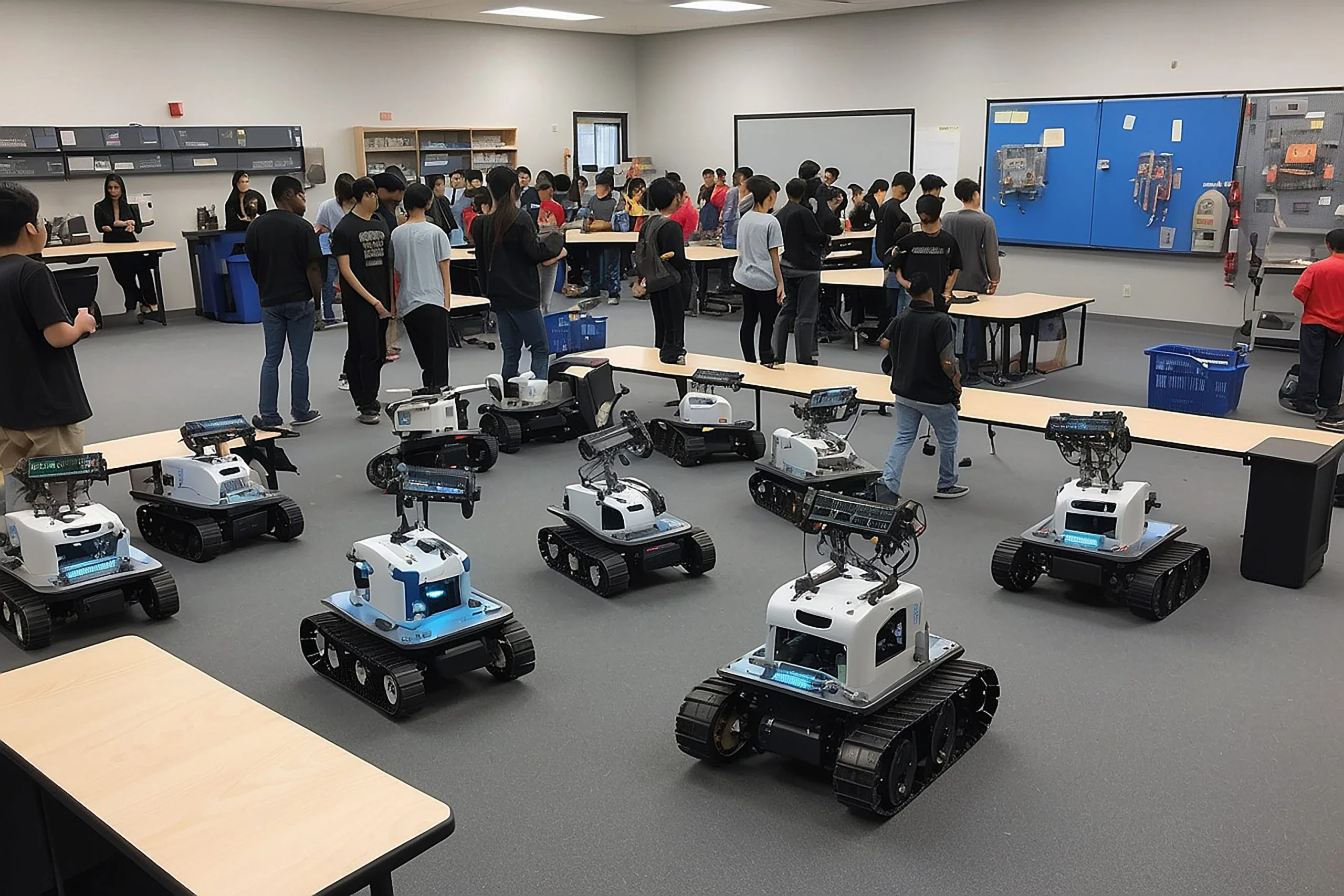
Canada’s robotics market is moving from selective factory automation toward broader adoption across manufacturing, logistics, healthcare, agriculture, mining, and public-sector operations. Industrial robotics remains the core segment, supported by automotive production, electronics, metal fabrication, and food processing. The Canada industrial robotics market was estimated at about USD 592 million in 2024 and is projected by one market study to reach roughly USD 1.30 billion by 2030, implying a 13.1% CAGR from 2025 to 2030.
Key Market Drivers Accelerating Robotics Adoption in Canada
Manufacturing Automation and Productivity Pressure
Canada’s manufacturing sector is under pressure to improve productivity, reduce downtime, and remain competitive against the U.S., Mexico, Europe, and Asia. Robotics adoption is especially relevant because Canada’s labour productivity has been relatively weak; one 2025 report noted that Canadian labour productivity in 2024 was only 0.8% above its 2019 level. This creates a stronger business case for automation in repetitive, hazardous, or precision-based tasks such as welding, painting, palletizing, inspection, and machine tending.
Automotive and EV Manufacturing Demand
Automotive manufacturing remains one of the strongest robotics demand centers in Canada. The International Federation of Robotics reported that robot installations in Canada rose 37% to 4,311 units in 2023, with the automotive industry accounting for 58% of installations. As Canadian automakers and suppliers transition toward electric vehicles, battery components, lightweight materials, and flexible production lines, demand for advanced robotic systems is expected to increase.
AI, Cloud Robotics, and Smart Operations
The next growth phase will be less about standalone robots and more about connected, intelligent systems. AI-enabled vision, predictive maintenance, autonomous navigation, and cloud-based fleet management are expanding robotics use cases. One forecast estimates Canada’s cloud robotics market could grow from USD 415.23 million in 2025 to USD 5.54 billion by 2035, at a 29.5% CAGR.
Policy Support and Investment Incentives for Robotics Adoption
Canada’s robotics outlook is supported by public investment in AI, advanced manufacturing, and industrial modernization. The federal government has launched initiatives around sovereign AI computing capacity, while organizations such as NGen continue to fund AI and advanced manufacturing projects. In 2026, NGen announced CAD 79.5 million for 20 AI projects, including robotics-related companies. These programs can help firms adopt automation, develop domestic capabilities, and commercialize robotics solutions.
Competitive Landscape of Leading Robotics Companies in Canada
The Canadian robotics market includes global industrial automation leaders such as ABB, FANUC, Yaskawa, KUKA, Mitsubishi Electric, and Universal Robots, alongside domestic and specialized players in autonomous systems, drones, inspection robotics, AI software, and systems integration. Competition is shifting from hardware sales alone to full automation ecosystems: robot arms, vision systems, grippers, sensors, safety software, cloud monitoring, maintenance, and integration services.
Key Challenges Limiting Robotics Adoption in Canada
High Upfront Cost and Integration Complexity
Robotics adoption can be expensive for small and mid-sized manufacturers. Hardware, software, safety systems, training, maintenance, and process redesign all add to implementation cost. Many firms also lack internal automation expertise, making integration timelines longer and return-on-investment calculations more difficult.
Skills Gap and Uneven Adoption
Canada’s robotics adoption is still concentrated in sectors such as automotive manufacturing. Statistics Canada has noted that robotics adoption in manufacturing is mainly driven by the automotive sector and that Canada has historically trailed several peer economies in robot density and installations. Broader market growth will require more robotics technicians, automation engineers, AI specialists, and operator training.
Future Outlook
By 2035, Canada’s robotics market is expected to become more diversified, software-driven, and service-oriented. Industrial robots will remain central, but faster growth is likely in collaborative robots, autonomous mobile robots, warehouse automation, agricultural robotics, healthcare assistance, inspection drones, and AI-enabled cloud robotics. North America’s manufacturing robot density reached 204 robots per 10,000 employees in 2024, showing that automation intensity is rising across the region. For Canada, the main opportunity is to move robotics beyond automotive plants into smaller factories, logistics networks, resource industries, hospitals, and public infrastructure.
Consultants at Nexdigm, in their latest publication “Canada Robotics Market Outlook to 2035,” analyze the sector by System Type (Industrial Robots, Service Robots, Collaborative Robots, Robotic Arms), By Platform Type (Land-based Robots, Aerial Robots, Underwater Robots), and By Fitment Type (On-premise Solutions, Cloud-based Solutions, Hybrid Solutions). Nexdigm suggests that businesses should invest in scalable robotics and automation strategies aligned with Canada’s evolving industrial priorities, including advanced manufacturing, AI-enabled operations, supply chain resilience, and workforce productivity improvement.
To take the next step, simply visit our Request a Consultation page and share your requirements with us.
Harsh Mittal
+91-8422857704