

Global trade increasingly depends on fast, dependable, and cost-effective freight movement, placing cargo airlines under pressure to balance network reach, capacity utilization, transit time, and service reliability. This cargo airline pricing competitiveness study examines how carriers structure rates across routes while responding to demand volatility, fuel costs, operational constraints, and competitor offerings.
Through pricing analysis, it evaluates the influence of speed, available capacity, shipment priority, and delivery consistency on customer choice, revenue performance, and market positioning across domestic, regional, and international cargo networks under changing economic and supply chain conditions.
Air cargo carries roughly one-third of global trade by value despite representing less than 1% by weight. Global cargo demand reached record levels in 2024, rising 11.3%, highlighting strong opportunities for competitive pricing, optimized capacity, and reliable network performance.
Cargo Airline Pricing Analysis Across Global Freight Networks
Cargo airline pricing analysis evaluates route economics, capacity, demand, speed, and reliability to develop competitive freight rates that strengthen profitability, customer value, network performance, and market responsiveness across regions. Core benefits of airline pricing analysis can be:
- Fuel Cost Recovery: Pricing analysis helps carriers incorporate fuel volatility, surcharges, route distance, and aircraft efficiency into rates while protecting margins and maintaining customer transparency.
- Shipment Priority Optimization: Differentiating rates for standard, express, perishable, pharmaceutical, and high-value cargo enables airlines to match service intensity with customer willingness to pay.
- Digital Pricing Agility: Automated pricing tools enable faster rate updates based on capacity, demand, competition, and disruptions, improving quotation speed and customer conversion rates.
- Disruption-Responsive Pricing: Incorporating congestion, weather, route closures, and operational delays into pricing decisions helps airlines manage risk while preserving service continuity and commercial value.
- Network Balance Improvement: Pricing incentives can redirect shipments toward alternative hubs, routes, or departure times, reducing bottlenecks and supporting more balanced network capacity utilization.
Nexdigm’s Strategic Support for Cargo Pricing, Capacity, and Demand Analysis
Nexdigm supports cargo airlines with data-driven pricing analysis, demand forecasting, capacity optimization, and route profitability assessment to strengthen commercial performance across global freight networks. Its expertise combines competitive pricing analysis, cargo yield management, market benchmarking, and network optimization to help airlines align pricing strategies with shipment demand, operational reliability, and long-term revenue growth objectives.
Nexdigm’s Commercial Strategy Framework for Cargo Airlines Pricing Analysis
Nexdigm’s commercial strategy framework helps cargo airlines align pricing, capacity, demand, route economics, and customer priorities to strengthen network profitability, market responsiveness, service differentiation, and sustainable revenue growth globally. Some major strategies of the framework model are:
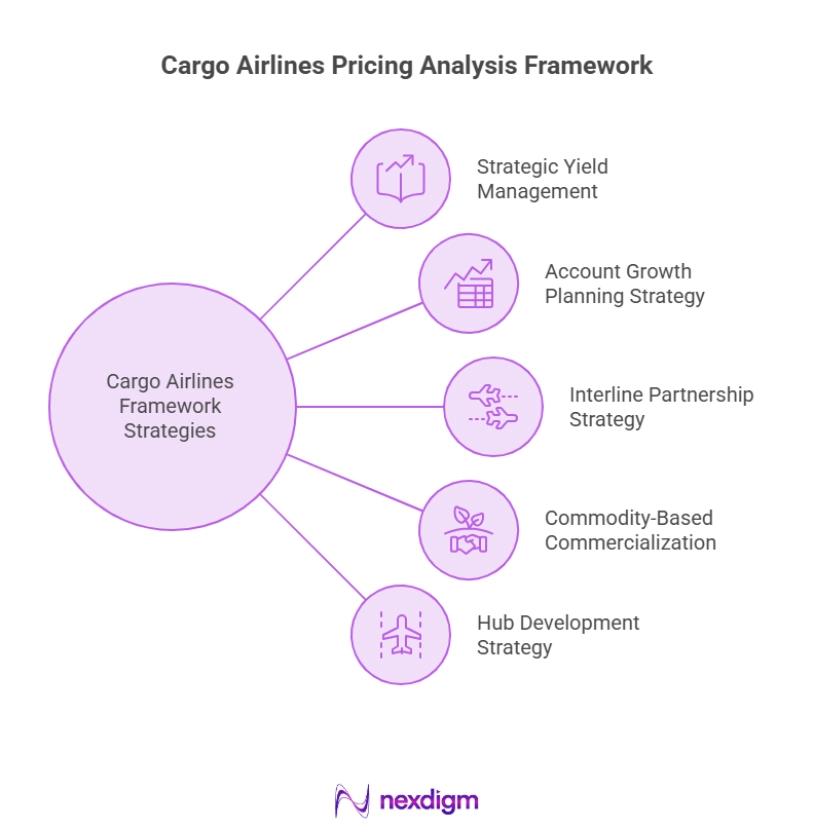
- Strategic Yield Management: Set shipment-level pricing thresholds by weight, density, urgency, commodity, and lane economics to improve revenue quality and minimize low-margin bookings.
- Account Growth Planning Strategy: Develop customized pricing, service commitments, and volume incentives for priority customers to increase wallet share, retention, and long-term commercial value.
- Interline Partnership Strategy: Collaborate with partner carriers to extend network coverage, improve shipment connectivity, reduce service gaps, and create more competitive end-to-end cargo solutions.
- Commodity-Based Commercialization: Build specialized pricing and service strategies for pharmaceuticals, perishables, electronics, automotive parts, e-commerce, and other high-value or time-sensitive commodities.
- Hub Development Strategy: Strengthen selected cargo hubs through coordinated schedules, feeder networks, handling capabilities, and customer incentives to improve consolidation and route economics.
Nexdigm’s Case
In a cargo airline engagement, Nexdigm applied route profitability analysis, demand forecasting, and dynamic pricing to reshape commercial decisions. Within nine months, the airline increased yield per kilogram by 12%, improved load factors by 9%, reduced low-margin bookings and strengthened revenue performance across priority international freight corridors.
To take the next step, simply visit our Request a Consultation page and share your requirements with us.
Harsh Mittal
+91-8422857704