

Cargo handling equipment supports the movement of goods across ports, airports, warehouses, manufacturing facilities and industrial terminals. Cranes, forklifts, reach stackers, loading systems and specialised lifting equipment help operators manage cargo volumes while maintaining operational efficiency and safety.
Selecting an equipment supplier requires more than comparing machinery specifications. Businesses must understand equipment suitability, handling capacity, operating reliability, maintenance requirements and the supplier’s ability to provide long-term technical support.
The Cargo Handling Equipment Supplier Landscape
Cargo handling requirements vary according to cargo type, facility design and operating environment. A container terminal, for example, requires different equipment from an industrial warehouse handling bulk materials or oversized components.
The supplier landscape generally includes several equipment categories.
Container handling equipment includes ship-to-shore cranes, rubber-tyred gantry cranes, rail-mounted gantry cranes and reach stackers. These systems support container movement between vessels, storage yards and transportation vehicles.
Material handling equipment includes forklifts, pallet trucks, conveyors and stackers used across warehouses and distribution centres.
Bulk cargo handling equipment includes hoppers, grabs, bucket elevators, belt conveyors and specialised loading systems used for commodities such as coal, minerals and agricultural products.
Procurement teams should first identify the equipment category that matches the facility’s operating requirements. Comparing suppliers across unrelated equipment categories without standardising technical specifications can produce misleading results.
Assessing Equipment Capability and Operating Performance
Equipment capacity should be assessed against the facility’s expected cargo volume, operating hours and handling conditions.
For cranes, relevant parameters include rated lifting capacity, outreach, lifting height and cycle time. For forklifts and reach stackers, load capacity, lifting height, manoeuvrability and operating surface requirements are important.
Throughput is another important indicator. A supplier should provide realistic performance specifications based on operating conditions rather than relying exclusively on maximum theoretical capacity.
Reliability should be evaluated through equipment availability, breakdown frequency, mean time between failures and maintenance turnaround time.
For equipment operating in ports and industrial environments, exposure to dust, moisture, vibration and heavy operating loads can influence component life and maintenance frequency.
Maintenance, Safety and Supplier Support
After-sales service has a direct effect on equipment availability. A machine that remains unavailable while waiting for replacement parts or specialised technicians can disrupt cargo operations and increase operating costs.
Supplier evaluation should therefore examine preventive maintenance programmes, spare parts availability, technician coverage and emergency service response.
Safety documentation is equally important. Equipment should comply with applicable machinery safety requirements, lifting standards and local occupational safety regulations. Suppliers should also provide operator training, inspection documentation and maintenance procedures.
The contractual assessment should cover warranty periods, service-level agreements, equipment commissioning, software updates where applicable and responsibilities for technical failures.
Commercial Assessment and Long-Term Equipment Value
Initial acquisition costs represent only part of the investment. Fuel or electricity consumption, maintenance, operator training, replacement parts and downtime all contribute to equipment lifecycle costs.
Procurement teams should compare equipment using consistent operating assumptions, including annual operating hours, cargo throughput and expected service life.
Leasing and equipment-as-a-service arrangements may also be relevant where organisations want to reduce upfront capital expenditure or maintain flexibility in response to changing cargo volumes.
Cargo Handling Equipment Supplier Evaluation Framework
A structured cargo handling equipment supplier analysis should include:
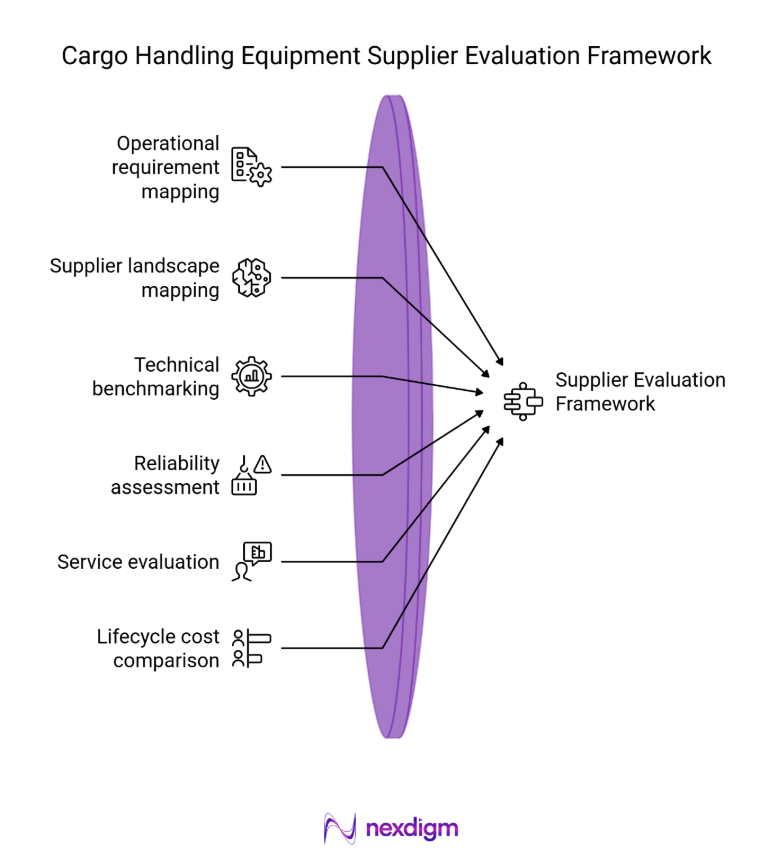
- Operational requirement mapping: Identify cargo types, throughput, load characteristics and facility conditions.
- Supplier landscape mapping: Identify manufacturers, authorised dealers and equipment service providers.
- Technical benchmarking: Compare lifting capacity, handling speed, energy consumption and equipment specifications.
- Reliability assessment: Evaluate equipment availability, breakdown records and maintenance requirements.
- Service evaluation: Review spare parts networks, technician availability, warranty and emergency support.
- Lifecycle cost comparison: Assess acquisition, installation, energy, maintenance and downtime expenses.
Nexdigm can support organisations through cargo handling equipment market research, supplier benchmarking, manufacturer comparisons and commercial due diligence. This helps procurement teams assess equipment suitability and identify suppliers capable of supporting operational requirements over the equipment lifecycle.
Nexdigm’s Case Study: Improving Cargo Handling Equipment Selection
Nexdigm benchmarked 11 cargo handling equipment suppliers across 4 equipment categories. The assessment shortlisted 3 providers, identified a 14% variation in lifecycle costs and established 7 performance criteria covering capacity, equipment availability, maintenance and technical support.
To take the next step, simply visit our Request a Consultation page and share your requirements with us.
Harsh Mittal
+91-8422857704