

A cash crop can generate a strong farm-gate price and still produce mediocre economics for the businesses buying, processing, or exporting it. The difference is usually created after the crop leaves the farm.
Processing yields, quality grades, byproduct revenues, logistics, export specifications, and intermediary costs can all change the value of the same tonne of agricultural output. For agribusinesses, understanding demand therefore means following the crop through the value chain rather than stopping at production volumes or mandi prices.
Four Markets Can Create Four Different Values for the Same Crop
Domestic consumption is often the largest demand pool, but it is not necessarily the most valuable one. Processing can increase the value of agricultural commodities by converting them into ingredients, industrial inputs, or specialised products. Exports can create premiums for compliant, traceable, or higher-grade output. Industrial buyers can provide predictable volumes where consistent quality matters more than consumer branding.
These markets also impose different requirements.
A domestic commodity buyer may prioritise price and availability. A food processor may require specific moisture, grade, or processing characteristics. An exporter may need traceability, certification, and compliance with destination-country MRL requirements. An industrial buyer may focus on consistency and long-term supply.
The commercial opportunity therefore depends on matching the crop with the demand pool where its characteristics can generate the strongest realisation.
What Happens After the Farm Gate Changes the Economics
Cotton shows how downstream conversion can reshape commodity economics. Raw kapas typically produces around 34% to 35% lint and 60% to 62% cottonseed, with the balance associated with trash and moisture. Lint remains the principal output, but cottonseed can be processed into oil and de-oiled cake, creating additional revenue streams for ginners and processors.
Chilli offers a different example. Standard dried chilli sold through commercial markets may generate gross trader margins of around 8% to 12%. Higher-colour or high-capsaicin varieties processed into oleoresins and paprika extracts can support significantly higher processing margins because the product enters specialised food and pharmaceutical applications.
Sugarcane presents an allocation decision rather than simply a processing decision. Integrated facilities can direct cane-derived products towards sugar, ethanol, or cogeneration depending on relative economics. Soybean similarly generates value through both oil and meal, meaning processor profitability depends on the combined value of its outputs.
The implication is straightforward: demand should be measured at the level of the final product, not only at the level of the raw crop.
Follow the Margin, Not Just the Volume
A large consumption market does not automatically create an attractive commercial opportunity. The more useful exercise is to identify where value accumulates and what prevents businesses from capturing it.
Several points in the chain can affect realised value:
- Procurement: Fragmented sourcing can increase transaction costs and make quality consistency difficult.
- Market access: Mandi fees, commissions, and handling can collectively account for roughly 3.5% to 6.5% of farm-gate value.
- Post-harvest handling: Poor drying and storage can create 2% to 5% physical losses while also reducing grade quality.
- Processing: Low conversion yields can destroy value even when raw-material prices are favourable.
- Quality: Moisture, colour, active content, grade, and certification can determine whether a product receives a standard price or a premium.
- Byproducts: Oil, meal, cake, bagasse, and other secondary outputs can materially change the economics of processing.
These costs should not automatically be treated as inefficiencies. Intermediaries may provide aggregation, financing, storage, and market access. The relevant commercial question is whether the value generated by each layer justifies its share of the final realisation.
Export Markets Add a Different Kind of Demand
International demand can create attractive premiums, but export potential depends on the supply chain’s ability to consistently meet buyer requirements.
MRL compliance, certifications, traceability, grade specifications, packaging, documentation, and logistics all influence the final price. A crop may therefore have strong international demand while remaining difficult to export profitably if producers and aggregators cannot maintain the required specifications.
This makes geography important. A cash crop produced close to a processing cluster may have a different commercial proposition from the same crop produced hundreds of kilometres from an export gateway. Similarly, access to grading, testing, cold storage, processing, or specialised logistics can determine which demand pools are realistically addressable.
The Commercial Question Is Where to Invest
This is where a structured cash crop demand analysis becomes more useful than a conventional consumption forecast. Nexdigm can assess not only how much demand exists, but which crop-market combinations offer the strongest opportunity for value creation.
This helps businesses determine whether the opportunity lies in securing supply, adding processing capacity, upgrading product quality, entering an export market, or redesigning procurement.
Nexdigm’s Value-Chain Framework for Cash Crop Opportunities
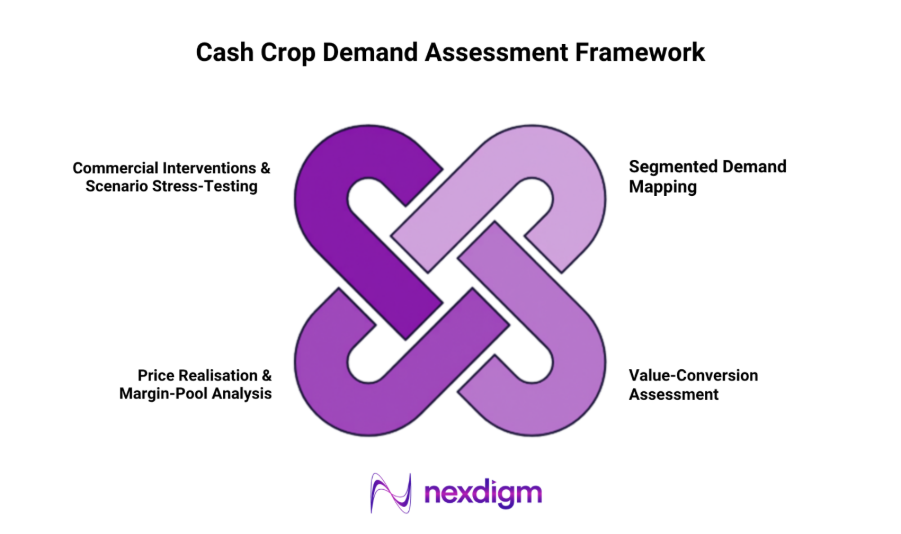
- Segmented Demand Mapping: Constructs a comprehensive demand map separating domestic, industrial, processing, institutional, and export consumption to identify high-growth segments and buyer-specific quality requirements.
- Value-Conversion Assessment: Tracks raw-material flows through grading, processing, primary outputs, secondary outputs, post-harvest losses, and recoverable byproducts to uncover value-addition opportunities and material leakages.
- Price Realisation & Margin-Pool Analysis: Benchmarks farm-gate prices against intermediary margins, processing conversion costs, freight economics, and quality premiums to determine whether target markets leave sufficient margin for investment.
- Commercial Interventions & Scenario Stress-Testing: Tests operational interventions across procurement, aggregation, processing, logistics, and downstream diversification, using scenario modelling to evaluate sensitivity to commodity price swings, yields, export demand, and plant utilisation.
Nexdigm Case Study: Restructuring Agricultural Procurement
Nexdigm’s commodity advisory work has included value-creation and commodity-optimisation programmes across agro-processing and commercial distribution operations. The source case reference reports procurement restructuring that bypassed intermediate commission tiers and generated a 12% to 16% improvement in net margins.
The example demonstrates the importance of examining procurement architecture alongside market demand. Knowing where a commodity is consumed identifies the market opportunity; understanding how the commodity reaches that market determines how much of the resulting value a business can actually capture.
To take the next step, simply visit our Request a Consultation page and share your requirements with us.
Harsh Mittal
+91-8422857704