

Cash crops can appear attractive because they connect agricultural production with organised domestic and international demand. But a high-value crop is not automatically a strong market-entry opportunity. Production economics, export demand, processing requirements, supply concentration and price realisation can produce very different commercial outcomes across crops.
India’s export performance shows the scale of the opportunity. The country exported 17.99 million tonnes of spices and spice products worth ₹39,994.48 crore in FY2024–25, an all-time high for the sector. Coffee exports reached 388,925 tonnes in 2024–25, including re-exports, with an export value of ₹15,422 crore. Coffee from India reached 126 countries during the year.
These figures establish demand. They do not establish which cash crop a new entrant should prioritise.
Different Crops Create Different Commercial Equations
A useful comparison begins with the economics behind the crop rather than its headline market value.
Coffee, for example, combines a substantial export market with a highly fragmented production base. The Coffee Board estimates that India had around 4.43 lakh coffee holdings in 2024–25, of which approximately 4.40 lakh were below 10 hectares. This makes aggregation, quality control and sourcing relationships important parts of the commercial model.
Spices present a different proposition. India’s spice exports more than doubled in volume between FY2014–15 and FY2024–25, while export value in rupee terms increased by 168%. This creates a sizeable international market, but individual spices still differ in cultivation conditions, processing requirements, quality specifications and buyer concentration.
Cotton demonstrates another type of market dynamic. USDA’s 2025 assessment forecast Indian cotton production at 25 million 480-lb bales for MY2025/26, while mill consumption was estimated at 25.7 million bales. The report also noted that domestic supply constraints were supporting imports.
The commercial question is therefore crop-specific: where is demand growing, and can a new entrant build a production or sourcing model that serves it competitively?
Three Filters Can Separate Market Size from Market Opportunity
- Demand depth
A crop may have strong domestic consumption, export demand, or both. The relevant assessment should examine buyer volumes, destination markets, historical demand and the stability of that demand rather than relying on a single annual export figure. - Margin potential
Revenue needs to be considered alongside yield, input costs, labour, land, processing and logistics. A high-value crop can carry high production or compliance costs that narrow its actual margin. - Export readiness
International demand creates an opportunity only where the crop can meet buyer specifications consistently. Quality standards, traceability, processing, certification and logistics can determine whether export demand is genuinely addressable.
These filters can produce very different conclusions from a simple ranking of crop prices.
Export Potential Depends on What Happens After Harvest
The strongest export opportunity may not sit at the farm level. Processing, grading, packaging and value addition can determine how much of the final export value reaches producers and intermediaries.
Coffee illustrates this clearly. India’s 2024–25 coffee exports included 146,644 tonnes of instant coffee, alongside green and roasted products. The Coffee Board also recorded 2,547 registered exporters during the year.
For an entrant, this means assessing the wider ecosystem rather than simply identifying a crop with international demand. Processing capacity, exporters, collection networks and quality infrastructure can all influence the cost and speed of market entry.
Where Cash-Crop Expansion Becomes Commercially Interesting
This is where cash crop market entry strategy consulting can support a more disciplined comparison. Instead of asking which crop has the largest market, companies can assess where demand, production economics, exportability and ecosystem readiness overlap.
Nexdigm’s Cash-Crop Opportunity Lens
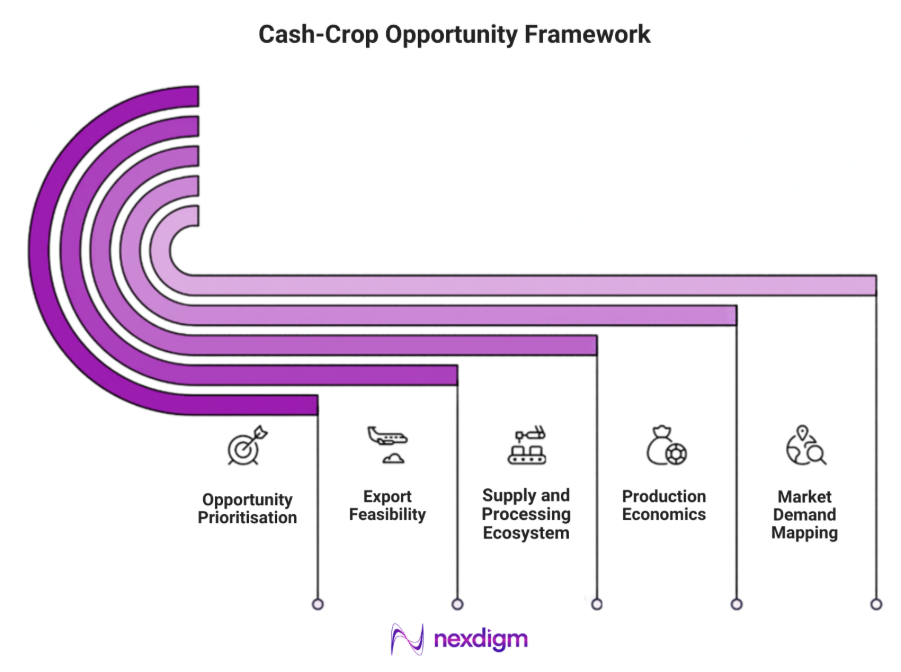
- Market Demand Mapping
Assess domestic consumption, export demand, buyer segments and demand growth by crop and destination market. - Production Economics
Model yields, input costs, labour, land, irrigation and post-harvest requirements to establish crop-level profitability. - Supply and Processing Ecosystem
Map production concentration, aggregators, processors, exporters and existing sourcing networks. - Export Feasibility
Assess destination markets, quality specifications, certification, processing and logistics requirements. - Opportunity Prioritisation
Compare crops and markets using demand, margins, scalability and market-access conditions to identify opportunities for deeper evaluation.
Nexdigm’s Case Study: Comparing Export-Led Crop Opportunities
An agribusiness screened four cash crops across domestic demand, production economics and export potential. The assessment found that the crop with the highest export value did not offer the strongest entry economics after processing and logistics costs were included, while two smaller export categories showed stronger projected margins.
Cash-crop market entry therefore requires more than identifying products with strong demand. The opportunity depends on whether that demand can be served profitably, consistently and at the required quality.
Nexdigm can help companies assess cash-crop opportunities through demand analysis, crop economics, competitive research, export-market assessment and market-entry strategy development.
To take the next step, simply visit our Request a Consultation page and share your requirements with us.
Harsh Mittal
+91-8422857704