

Procurement decisions increasingly depend on understanding what is happening beyond the immediate supplier base. CIPS’ 2026 Global State of Procurement & Supply found that 47% of procurement professionals identified risk management and new technology skills as their top development priorities, while 42% prioritized negotiation skills.
Procurement’s strategic influence is also increasing: 33% of respondents now report directly to a CEO, managing director, or owner, more than double the previous year. Meanwhile, CIPS’ Q2 2026 Pulse Survey found 35% of procurement professionals ranked geopolitical and political uncertainty as a major supply-chain risk, while 28% highlighted inflation and input-price increases. These developments make category intelligence reports increasingly valuable for turning market, supplier, pricing, and risk signals into sourcing decisions.
Why Category Context Matters Before Sourcing
Sourcing decisions can be weakened when procurement teams focus only on supplier quotations without understanding the wider category environment. Commodity prices, demand cycles, production capacity, supplier concentration, trade flows, regulations, and regional cost differences can all influence sourcing outcomes. A broader category view helps procurement teams understand market conditions before evaluating suppliers, negotiating prices, or selecting sourcing locations.
Understanding the Decision-Ready Category Intelligence
Useful category intelligence connects multiple market signals rather than presenting isolated data points. It can reveal how demand is evolving, where supply capacity is concentrated, how supplier competition is changing, and which cost or regulatory factors could affect future sourcing. This gives procurement teams a clearer basis for comparing options and anticipating conditions that may influence sourcing performance.
The Need for Category Intelligence
Procurement teams often make sourcing decisions in markets where prices, suppliers, demand, and competitive conditions are constantly changing. Without a structured category view, important signals can remain fragmented across multiple sources. Category intelligence reports bring these signals together, helping businesses understand market direction, anticipate changes, evaluate opportunities, and enter sourcing or investment discussions with a more informed perspective.
What Nexdigm Adds to Category Intelligence
Nexdigm adds a commercial and market-oriented perspective to category intelligence, helping procurement teams understand:
- Market Context: Nexdigm connects demand, capacity, pricing, trade flows, and industry developments to explain the broader forces shaping category conditions.
- Supplier Perspective: Supplier landscapes, competitive positioning, production capabilities, and sourcing-market developments are assessed to identify opportunities and potential dependencies.
- Decision Relevance: Market signals are translated into practical implications, helping procurement teams identify cost pressures, sourcing opportunities, emerging risks, and areas requiring closer monitoring.
This approach helps transform category information into focused intelligence that procurement teams can use before entering sourcing or supplier decisions.
Nexdigm’s Role in Making Category Intelligence Decision-Ready
Nexdigm organizes category findings around the decisions procurement teams need by assessing category intelligence reports , this helps them move from broad market information to clearly defined sourcing considerations by conducting:
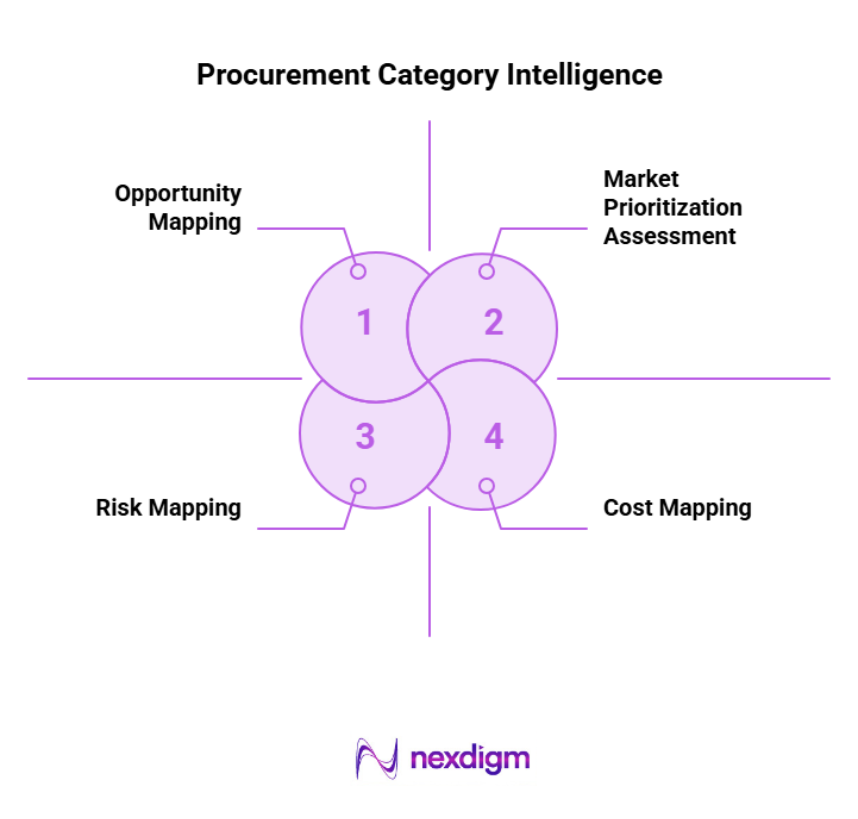
- Opportunity Mapping: Identifying categories where favorable supply conditions, new suppliers, capacity expansion, or changing competition could create sourcing opportunities.
- Risk Mapping: Highlighting supplier concentration, capacity constraints, trade dependencies, regulatory developments, and other factors that could affect sourcing continuity.
- Cost Mapping: Connecting category pricing with raw materials, freight, energy, tariffs, currency, and demand conditions to explain potential cost movements.
- Market Prioritization: Assessing categories according to market attractiveness, sourcing potential, competitive dynamics, and strategic relevance to determine where deeper analysis is warranted.
This creates a decision-ready category view, enabling procurement teams to enter sourcing discussions with clearer market context and stronger evidence.
How Nexdigm’s Category Intelligence Supports Investment Decisions
Category intelligence can extend beyond procurement by giving strategy and investment teams a structured view of the commercial forces shaping an industry. Nexdigm can use category-level evidence to support investment decisions through:
- Investment Thesis Validation: Test whether demand growth, industry structure, customer requirements, and category economics support the underlying rationale for a potential investment.
- Revenue Potential Assessment: Examine addressable demand, end-use industries, customer segments, and purchasing trends to assess the revenue opportunity associated with an investment.
- Competitive Positioning: Evaluate competitor strategies, market shares, product portfolios, partnerships, and differentiation to understand how an investment could compete within the category.
- Scenario Assessment: Examine alternative market, demand, pricing, and competitive scenarios to understand how changing category conditions could influence investment outcomes.
This gives decision-makers a broader commercial perspective on category dynamics, supporting investment evaluations with evidence beyond traditional financial or market-size assessments.
Nexdigm’s Case
Nexdigm assessed a target category across 12 markets and 30+ market indicators, helping identify three high-potential growth segments, five priority customer groups, and a 16% addressable revenue opportunity. The analysis supported investment evaluation by providing a clearer view of demand potential, competitive positioning, and category-level growth prospects.
To take the next step, simply visit our Request a Consultation page and share your requirements with us.
Harsh Mittal
+91-8422857704