

Cell therapy has moved from experimental medicine toward a growing commercial market, led by CAR-T therapies and newer approaches such as tumor-infiltrating lymphocyte (TIL) therapy. The FDA’s approved cellular and gene therapy portfolio now includes multiple CAR-T products, AMTAGVI for TIL therapy, and, in 2026, Tregzi, an allogeneic regulatory T-cell therapy. The expanding product base points to a broader commercialization opportunity, but approval alone does not determine how much of that opportunity can be captured.
For cell therapy developers, the more consequential question is how many eligible patients can progress through referral, treatment-centre qualification, manufacturing, reimbursement and infusion. A large epidemiological population can therefore translate into a much smaller commercially reachable market.
The Addressable Population Is Smaller Than the Patient Population
Cell therapies are generally targeted at narrowly defined patient populations, often involving specific disease stages, previous treatment histories and clinical eligibility criteria. CAR-T, for example, remains heavily concentrated in hematologic malignancies, while the approval of TIL therapy has expanded the cellular-therapy landscape into solid tumors.
Recent regulatory activity is also widening the potential patient pool. In December 2025, the FDA approved Breyanzi for adults with marginal zone lymphoma after two or more prior lines of therapy, adding another indication to the commercial CAR-T landscape.
But patient incidence is only the starting point. A commercial assessment needs to progressively narrow the population by asking:
- How many patients meet the approved indication?
- How many are medically suitable for treatment?
- How many are referred to an appropriate cellular-therapy center?
- How many can complete apheresis and manufacturing within the required clinical window?
- How many have coverage that supports treatment?
This conversion funnel provides a more realistic measure of market demand than incidence alone.
Treatment Capacity Can Define Where Demand Becomes Revenue
Unlike conventional oncology, CAR-T cell therapy demands specialized infrastructure to manage severe complications like cytokine release syndrome (CRS) and ICANS. While outpatient administration makes decentralization possible, it still requires trained multidisciplinary teams, dedicated monitoring, and rapid emergency access.
This reliance on specialized capability drives stark geographic disparities: regions with large eligible patient populations often lack the apheresis capacity, accredited centres, or ICU support needed for treatment. Consequently, cell therapy companies face a critical market-entry choice: concentrate resources in established cellular-therapy hubs, or invest in expanding capacity within underserved regions?
Manufacturing and Logistics Add Another Layer of Commercial Risk
Autologous cell therapies introduce a supply chain that runs from the patient’s cells to a manufactured product and back to the patient. Delays at referral, financial clearance, apheresis, manufacturing or transportation can affect whether a clinically eligible patient ultimately receives treatment.
Evidence from a community cellular-therapy network identified referral delays, financial clearance, apheresis scheduling, patient fitness and manufacturing time among the barriers affecting access to CAR-T therapy.
The emergence of allogeneic approaches could eventually change some of these constraints by enabling more standardized, potentially off-the-shelf products. The commercial implications are significant: improvements in manufacturing flexibility and delivery could expand the number of patients and treatment centres a therapy can realistically serve.
Reimbursement Determines Whether Capacity Can Be Sustained
The economics of cell therapy extend well beyond the acquisition price of the product. Providers must account for administration, hospitalization or monitoring, toxicity management, staffing, infrastructure and follow-up care.
Payment policy is evolving in response. For 2026, CMS continued its bundled payment policy for CAR-T and extended the approach to certain autologous cell-based immunotherapies and gene therapies, including preparatory procedures required for patient-specific manufacturing.
Payer innovation is also becoming part of the access equation. The CMS Cell and Gene Therapy Access Model uses outcomes-based arrangements for participating Medicaid programs, with 32 states plus Washington, D.C., and Puerto Rico participating and representing 84% of Medicaid beneficiaries with sickle cell disease.
For developers, these developments make reimbursement analysis inseparable from market sizing. A patient who is clinically eligible but financially inaccessible should not be treated as equivalent to an immediately reachable commercial patient.
Nexdigm’s Cell Therapy Market Prioritisation Framework
A robust Cell therapy market assessment should therefore connect 4 dimensions: the size and characteristics of the eligible patient pool, the geographic distribution of treatment capacity, the feasibility of the manufacturing and delivery pathway, and the economics governing reimbursement and provider participation.
Nexdigm can translate these dimensions into a market-prioritization exercise covering:
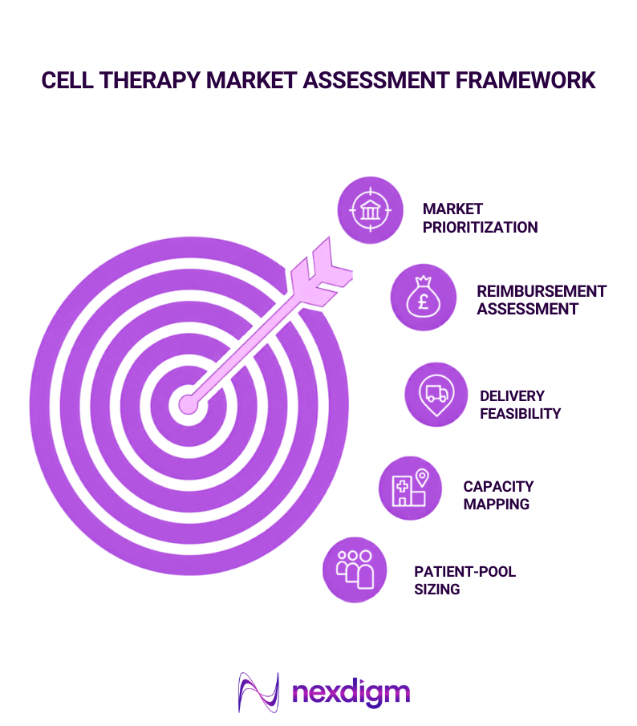
- Patient-pool sizing: Quantifying the clinically and commercially addressable population by indication and geography.
- Capacity mapping: Assessing treatment centers, specialist availability, referral networks, apheresis and supporting infrastructure.
- Delivery feasibility: Evaluating manufacturing timelines, logistics, treatment pathways and potential capacity constraints.
- Reimbursement assessment: Mapping payer coverage, payment mechanisms and provider economics.
- Market prioritization: Identifying the geographies, indications and customer segments with the strongest combination of demand and delivery feasibility.
The result is a more defensible view of where commercialization is viable, where additional infrastructure or partnerships may be required, and where apparent patient demand is unlikely to translate into near-term treatment volume.
Nexdigm’s Case: From Patient Potential to Commercial Reach
A cell-therapy developer benchmarked its launch opportunity against a market where only 2 in 10 eligible patients were receiving cell therapy and CAR-T remained available in fewer than 4% of U.S. healthcare centres. Mapping treatment capacity and referral networks identified priority regions for expansion before nationwide rollout.
To take the next step, simply visit our Request a Consultation page and share your requirements with us.
Harsh Mittal
+91-8422857704