

Certified seed procurement requires more than identifying a producer with an established reputation. Agribusinesses sourcing across multiple crops and regions must account for varietal suitability, certification status, production capacity, quality documentation and delivery schedules. A supplier that performs reliably in one season may not have sufficient inventory or the appropriate varieties to meet requirements in another. These differences become particularly important when procurement covers several agricultural zones, each with distinct planting calendars and crop preferences.
A reliable sourcing strategy connects seed quality with supply planning. It establishes where seed originates, how it is produced and tested, whether it meets applicable standards, and how consistently suppliers can deliver the required quantities.
Certification Is the First Procurement Filter
Certification provides an important basis for assessing seed quality and varietal identity. In India, the Seeds Act, 1966 establishes requirements concerning the identification, germination and physical purity of notified seed varieties. Certification agencies assess seed lots against prescribed standards before issuing certification.
However, procurement teams should understand the distinction between certified seed and other categories of quality seed. Truthfully labelled seed, for example, is subject to applicable quality and labelling requirements but is not necessarily certified through the same process. The sourcing specification should clearly state the required seed category rather than use these terms interchangeably.
Documentation should be checked at the seed-lot level. Buyers should verify:
- Certification tags and applicable lot identification.
- Crop and variety details.
- Germination and physical purity results.
- Testing dates and validity of quality information.
- Producer details and traceability records.
- Packaging, labelling and applicable regulatory documentation.
The assessment should also establish whether the supplier can provide supporting documentation for the quantity being offered, rather than relying on general certificates covering its broader product portfolio.
Match Seed Requirements to Regional Conditions
A certified variety is not automatically suitable for every growing environment. Soil characteristics, rainfall patterns, irrigation access, temperature conditions and local pest pressure can influence crop performance. Procurement specifications should therefore reflect the agricultural conditions of the destination market.
For organisations sourcing across states, this requires a crop-wise and region-wise demand assessment. A seed variety intended for a rainfed area may need different maturity and stress-tolerance characteristics from one intended for irrigated cultivation. Similarly, a supplier with strong maize capabilities may not offer the required pulse or oilseed varieties.
Regional agricultural universities, ICAR institutions, state agriculture departments and field trial results can help validate varietal suitability. Buyers should also examine whether suppliers have experience serving the intended agricultural markets.
Building a Reliable certified seed sourcing research Programme
Structured certified seed sourcing research should identify potential suppliers before the procurement season begins. This gives buyers sufficient time to compare production capacity, verify documentation and negotiate supply arrangements rather than relying on whichever stock is available close to the planting date.
The research should cover three interconnected dimensions.
First, supplier mapping should identify public-sector organisations, private seed companies, regional producers and specialist providers across the required crop categories. Second, quality assessment should establish whether each supplier has appropriate testing, processing, storage and traceability arrangements. Third, commercial evaluation should examine prices, minimum order quantities, delivery coverage, payment terms and replacement provisions.
The supplier shortlist should reflect the actual procurement requirement. A business sourcing certified paddy seed across several districts may need a different supplier mix from one purchasing certified vegetable seeds for commercial cultivation.
Planning Procurement Around Production Cycles
Seed availability is closely connected to agricultural seasons. Suppliers need sufficient time to produce, process, test and distribute seed before the planting window. Procurement teams that engage suppliers too late may face limited varietal choice, higher logistics costs or delayed deliveries.
India’s seed-sector infrastructure has expanded considerably. Government reporting indicates that certified and quality seed availability reached 531.51 lakh quintals in 2024–25, compared with 508.60 lakh quintals in 2023–24. However, national availability does not establish whether a particular variety is available in the right quantity and location.
A practical procurement calendar should include demand forecasting, supplier confirmation, production planning, quality verification, dispatch scheduling and receipt inspection. Organisations should also account for contingencies such as delayed rainfall, changes in sowing patterns or unexpected demand for particular varieties.
Managing Supplier and Quality Risks
A certified seed supplier should be assessed beyond the documents submitted during onboarding. Buyers need to understand how seed lots are stored, transported and handled before delivery. Poor warehouse conditions, damaged packaging or extended exposure to unsuitable temperatures and moisture can affect seed quality.
Contracts should define the specifications that each consignment must meet. They should also establish procedures for sample testing, non-conformance reporting, replacement, delivery delays and dispute resolution.
For critical crop requirements, maintaining more than one qualified supplier can reduce the risk of seasonal shortages. However, alternative suppliers should be assessed against the same quality and traceability standards.
How Nexdigm Supports Certified Seed Procurement Research
Nexdigm supports agribusinesses through supplier identification, market intelligence, procurement research and commercial benchmarking. Its research can help organisations map certified seed producers, assess regional sourcing options, compare supplier capabilities and evaluate commercial arrangements across crop categories. This provides a stronger foundation for developing a reliable and diversified sourcing network.
Certified Seed Sourcing Framework
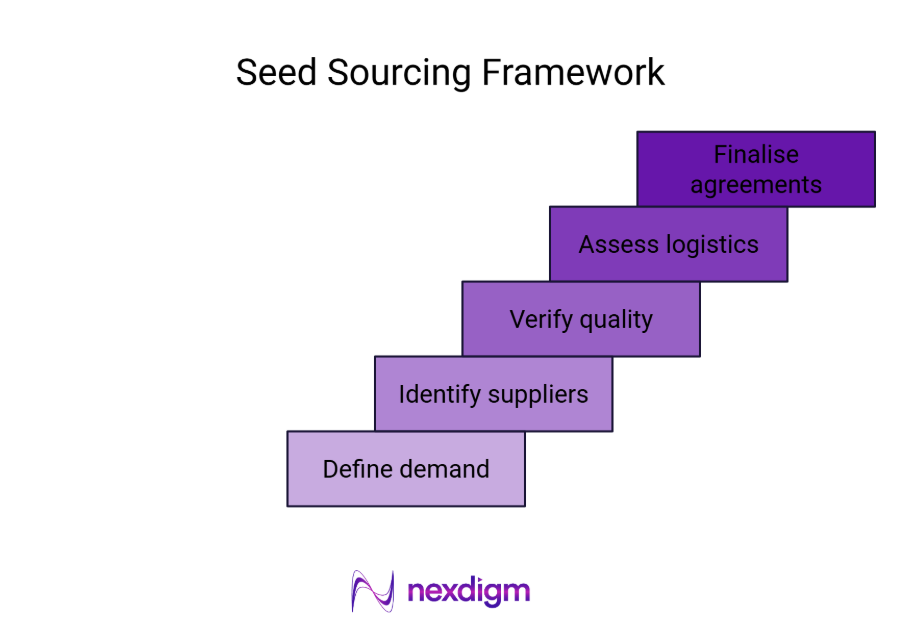
- Define crop and regional demand: Establish varieties, quantities, quality specifications and planting schedules.
- Identify qualified suppliers: Map public-sector, private, regional and specialist seed producers.
- Verify certification and quality: Examine lot-level documentation, testing results, traceability and storage practices.
- Assess supply and logistics: Evaluate production capacity, seasonal availability, delivery coverage and contingency arrangements.
- Finalise commercial agreements: Compare pricing, payment terms, replacement policies and supplier performance commitments.
Nexdigm’s Case Study: Mapping Certified Seed Suppliers
Nexdigm assessed 16 seed suppliers across seven crop categories, verified 35 quality and certification parameters and mapped availability across 9 agricultural markets. The research shortlisted five suppliers for procurement evaluation.
To take the next step, simply visit our Request a Consultation page and share your requirements with us.
Harsh Mittal
+91-8422857704