

Chemical market opportunities depend on more than identifying products with rising demand. A product may have strong import volumes but limited margins, entrenched suppliers, demanding technical specifications, or regulatory barriers that make market entry difficult. Businesses need to understand where demand originates, what buyers value, how competitors serve those needs, and whether the opportunity is commercially viable.
A structured market assessment connects these factors to help chemical manufacturers, distributors, and exporters make better-informed decisions about product portfolios, target markets, pricing, and expansion.
Identify Demand Beyond Headline Market Growth
Aggregate industry growth can conceal differences between chemical categories and end-use applications. Demand for an industrial solvent, specialty coating ingredient, or polymer additive may be driven by entirely different purchasing cycles and customer requirements.
Start by identifying the specific product and its applications. Examine consumption patterns across sectors such as pharmaceuticals, agriculture, construction, automotive, packaging, and personal care. Then distinguish recurring industrial consumption from demand linked to temporary projects, inventory replenishment, or price movements.
Trade statistics can help establish an initial picture. UN Comtrade provides import and export data by product, trading partner, and reporting period, while the World Trade Organization offers broader merchandise-trade statistics and analytical tools. However, trade flows indicate cross-border transactions, not total domestic consumption or unmet demand.
Understand What Buyers Actually Evaluate
Demand alone does not explain why a buyer chooses one chemical supplier over another. Procurement decisions can depend on purity, concentration, consistency between batches, technical documentation, packaging, delivery reliability, and the supplier’s ability to meet regulatory requirements.
For specialty chemicals, application performance and technical support may carry considerable weight. For bulk chemicals, delivered cost, supply continuity, logistics capacity, and contract terms can be more influential.
Customer interviews, distributor discussions, tender records, product specifications, and competitor documentation can help identify these priorities. The objective is to establish which attributes influence supplier selection and which represent minimum requirements for entering the market.
Measure Competitive Pressure at Product Level
Competitor analysis should distinguish direct substitutes from products that serve different applications. Two chemicals may fall within a broad category while differing in performance, compatibility, handling requirements, or customer approval processes.
Assess the number and concentration of suppliers, the origins of imported products, price ranges where reliable data are available, and the presence of established domestic manufacturers. Compare product specifications and commercial terms rather than relying on list prices alone.
Regulatory access also affects competition. For example, the European Union’s REACH framework places registration and risk-management responsibilities on manufacturers and importers for substances within its scope. Market-entry assessments therefore need to account for applicable registration, safety information, and restriction requirements, not just customer demand.
A Framework for Chemical Market Analysis
A decision-ready chemical analysis should connect market evidence with a clear commercial choice. Use the following framework to assess a product or target geography.
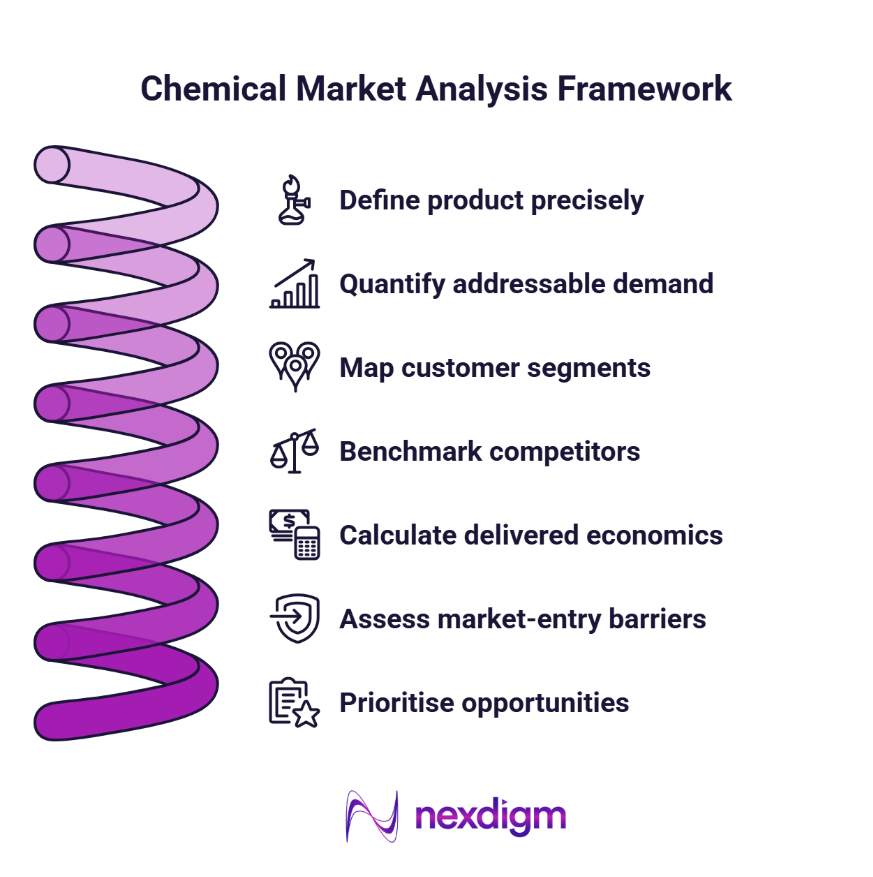
- Define the product precisely. Confirm its chemical identity, grade, concentration, application, relevant HS code, and any product-specific classification requirements before collecting market data.
- Quantify addressable demand. Estimate the relevant market using production, consumption, import, and customer-level evidence, keeping total market size separate from realistically accessible demand.
- Map customer segments. Identify the industries and buyer types most likely to purchase the product, then compare their volumes, qualification processes, technical needs, and purchasing cycles.
- Benchmark competitors. Compare major suppliers by product quality, origin, estimated market presence, service capability, delivery reliability, and pricing where comparable evidence is available.
- Calculate delivered economics. Include manufacturing or sourcing costs, freight, insurance, duties, warehousing, compliance expenses, distributor margins, and working-capital requirements to estimate contribution margins.
- Assess market-entry barriers. Review applicable chemical regulations, registration obligations, safety documentation, product standards, customer approvals, and restrictions that could delay commercialisation or increase costs.
- Prioritise opportunities. Rank product-market combinations by addressable demand, competitive intensity, achievable margin, entry costs, and supply risk, then define the evidence required before committing resources.
Turn Market Findings Into a Commercial Strategy
A market assessment is useful only when it changes a decision. A product with high demand may be unattractive if competition compresses margins or regulatory requirements create substantial entry costs. A smaller market may offer better returns when buyers value technical differentiation, reliable supply, or specialised formulations.
Businesses should translate their findings into specific actions: prioritise selected customer segments, refine product specifications, adjust pricing, evaluate distribution partnerships, or test demand before expanding capacity. Assumptions should be documented and tested against customer feedback and updated market data.
This helps businesses distinguish promising markets from those that appear attractive only at headline level. With a product-specific view of commercial potential, companies can allocate resources more effectively and build positioning around defensible customer value.
Nexdigm’s Case Study
A specialty chemical manufacturer assesses entry into a market with estimated annual demand of 6,000 tonnes. Import data and customer interviews suggest that approximately 2,000 tonnes could be addressable within the manufacturer’s target applications. At an assumed selling price of ₹1.8 lakh per tonne, that segment represents potential annual revenue of ₹36 crore. Rather than assuming immediate market capture, the company models a first-year target of 5% of addressable volume, equivalent to 100 tonnes and ₹1.8 crore in revenue.
Its initial assessment estimates a contribution margin of 18%, or ₹32.4 lakh, before fixed costs and market-entry expenditure. The company then evaluates customer qualification costs, regulatory requirements, competitor pricing, and distributor margins to determine whether the opportunity merits a controlled market-entry pilot.
To take the next step, simply visit our Request a Consultation page and share your requirements with us.
Harsh Mittal
+91-8422857704