

Chemical procurement is often described as a price-driven process. That description works reasonably well for standardized commodities but becomes less useful as product differentiation and application criticality increase.
A chemical that represents $1,000 of input cost can still be commercially insignificant if its failure can disrupt a production line worth million. Conversely, when several suppliers provide an interchangeable commodity to the same specification, even a small difference in delivered price can influence the purchasing decision.
The real question is therefore what customers prioritize at each level of the chemical value chain.
The supplied buyer research divides procurement into three broad tiers: commodities, specialty formulations and regulated chemistries. Delivered cost dominates commodity purchases, in-use performance becomes more important for specialties, while regulatory and safety requirements take precedence in highly regulated applications.
The buyer’s decision changes with the consequence of failure
The more expensive the consequence of chemical failure, the less useful invoice price becomes as the sole purchasing criterion.
A semiconductor manufacturer buying ultra-high-purity chemicals may be far more concerned about contamination risk than a small difference in unit cost. An automotive coatings manufacturer may pay a premium for an additive that reduces curing time or improves corrosion performance if the chemical represents only a small portion of total component cost.
This is the foundation of cost-in-use purchasing.
The relevant equation becomes:
Customer value = product performance + operational savings + risk reduction − switching friction.
That changes the sales proposition from “our chemical costs less” to “our chemical changes the economics of your process.”
Reliability became a commercial variable
The disruptions of recent years exposed the cost of depending on a single distant supplier, particularly when chemical shortages can interrupt continuous production. European energy disruption, shipping bottlenecks and geopolitical restrictions demonstrated that a low purchase price can become economically irrelevant when supply fails.
The supplied research identifies dual sourcing, regional manufacturing, vendor-managed inventory and supplier business-continuity planning as increasingly important procurement requirements.
For chemical suppliers, reliability can therefore become part of the value proposition.
A customer may accept a modest premium for local inventory, shorter lead times or a second qualified source if the alternative is production downtime.
What buyers prioritize by chemical segment
Instead of ranking purchasing criteria universally, Nexdigm’s customer-demand methodology can segment buyers according to the economics of their application.
- Commodity chemicals:
The decision is typically dominated by delivered cost, followed by reliability and specification compliance. - Specialty chemicals:
Performance and technical support become more important because the product is embedded within a formulation or manufacturing process. - Regulated chemicals:
Traceability, consistency, regulatory compliance and supply security can outweigh unit cost.
This segmentation prevents a common research error: asking all chemical buyers the same question and treating the resulting average as representative.
Nexdigm’s chemical buyer assessment model
A structured chemical customer demand assessment services engagement can map buyer priorities through four diagnostic layers.
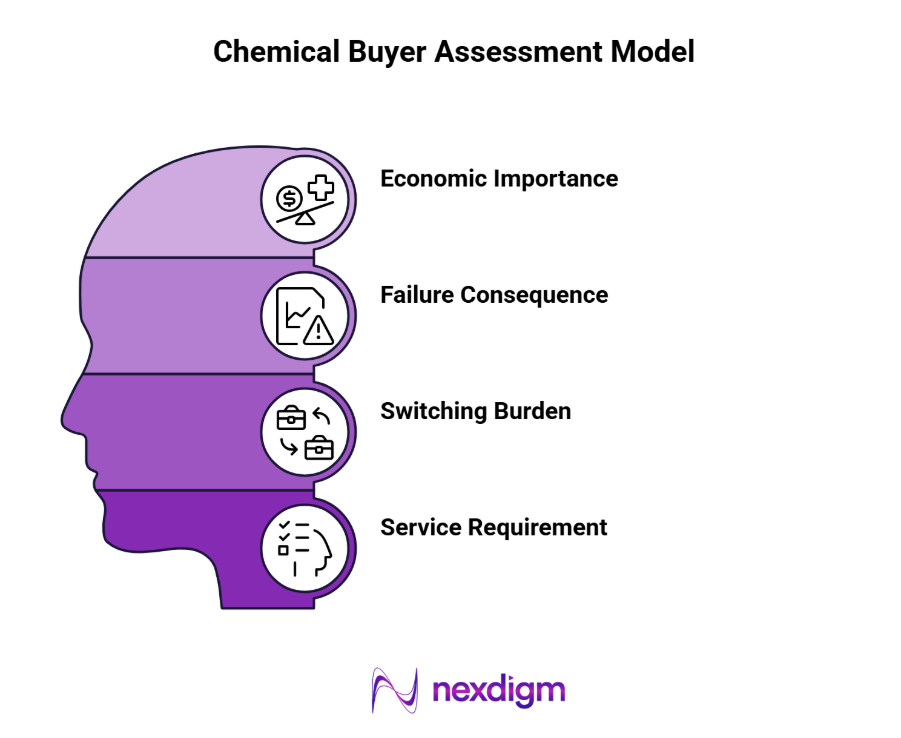
- Economic importance
Determine how much the chemical contributes to the customer’s total product or manufacturing cost. - Failure consequence
Measure what happens when the chemical fails, arrives late or performs below specification. This establishes the customer’s true risk sensitivity. - Switching burden
Assess qualification time, regulatory approval, formulation changes, equipment modification and supplier onboarding requirements. - Service requirement
Determine whether customers need laboratory support, formulation advice, troubleshooting, inventory management, regulatory documentation or on-site technical assistance.
The output is a buyer segmentation model showing which customers are price-sensitive, which are performance-led and which value supply security or technical partnership.
Technical support can become part of the product
In specialty chemicals, technical service is often inseparable from the commercial proposition.
A formulation change can alter viscosity, wetting, foam generation, curing, adhesion or shelf life. Customers may therefore require technical teams to conduct trials, troubleshoot production issues and provide validated formulation guidance.
The supplied research describes technical support as an operational prerequisite in such applications, particularly when customers are transitioning toward lower-VOC or otherwise modified formulations.
That creates an important strategic distinction.
Two suppliers may sell chemically similar products but have very different customer value propositions if one provides application engineering and the other only supplies material.
Measuring willingness to pay properly
Customer interviews alone can overstate price sensitivity because buyers often say they want lower prices even when other factors determine the actual purchasing decision.
A more robust assessment can combine:
- Conjoint analysis
- Customer segmentation
- Win-loss analysis
- Supplier switching studies
- Willingness-to-pay testing
- Procurement interviews
- Purchase-volume analysis
- Service-level evaluation
The objective is to establish which attributes actually influence supplier selection.
The purchasing hierarchy is ultimately application-specific
Chemical suppliers should therefore avoid designing a universal value proposition.
A commodity supplier needs cost and logistics discipline. A specialty producer needs application performance and technical support. A regulated-chemistry supplier needs consistency, documentation and supply assurance.
Understanding that hierarchy is what allows customer research to inform pricing, product development, channel strategy and sales positioning rather than simply producing another customer-satisfaction score.
Nexdigm Case: Chemical Buyer Segmentation
A specialty chemical producer with 310 industrial accounts faced 14% customer churn. Nexdigm interviewed 420 buyers across 6 segments, finding performance drove 47% of specialty purchases while reliability influenced 61% of renewal decisions.
To take the next step, simply visit our Request a Consultation page and share your requirements with us.
Harsh Mittal
+91-8422857704