

A chemical business can have a competitive product and still struggle to expand into new markets. Customers may be geographically dispersed, technical support may need to be available locally, and delivery reliability can matter as much as price. Building a company-owned network offers control, but it also requires capital, management capacity and time.
Franchising or a structured partner-led model can offer another route to expansion. Its success, however, depends on more than signing partners. Territories must support sufficient demand, partners must be technically capable, and the commercial arrangement must reward both parties without weakening service quality.
Why Chemical Businesses Consider Partner-Led Expansion
Chemical distribution and service models vary by product. Some businesses primarily need local inventory and reliable delivery. Others require application advice, equipment installation, customer training or support with product handling. A franchise-like model is more viable when activities, service expectations and operating processes can be defined and monitored consistently.
Before choosing this route, a business should establish what it is actually replicating. It may be a distribution operation, a technical service centre, a branded application model or a combination of these. Each requires different investment, partner skills and levels of oversight.
Territory Selection and Local Market Potential
Territory design determines whether partners can build viable businesses without unnecessary overlap. A large geographic area does not automatically represent a strong territory. Demand may be concentrated around industrial clusters, construction corridors, agricultural markets or a limited number of large buyers.
A territory assessment should consider:
- Addressable customer density: Number and type of relevant industrial customers within an economically serviceable area.
- Industry concentration: Presence of end-use sectors that consume the target chemical products.
- Competitive coverage: Existing distributors, direct sales teams, competing brands and established customer relationships.
- Logistics and service costs: Travel distances, warehousing, delivery frequency and the need for specialised handling.
- Growth potential: Planned industrial investment, infrastructure development or expansion among existing customers.
Territories should be sized around achievable sales and service capacity rather than administrative boundaries alone.
Partner Capability, Training and Service Standards
The partner’s ability to represent the business is central to customer retention. A low-cost distributor may not be suitable for products requiring application troubleshooting, documentation or careful handling. Similarly, a technically strong partner may lack the working capital needed to maintain inventory and provide credit to customers.
Partner evaluation should cover commercial credibility, financial strength, technical staffing, local relationships and willingness to follow operating standards.
Service expectations must also be explicit. These may include order fulfilment times, inventory availability, complaint resolution, customer visit frequency, technical escalation procedures and reporting requirements. Training should cover product knowledge, safety, handling and customer communication. Certification and periodic reassessment can help maintain consistency as the network grows.
Building a Viable Franchise Economics Model
The economics must work for both the brand owner and the local partner. A model that leaves the partner with insufficient returns may encourage discounting, underinvestment or competing product sales. Excessive fees and inventory requirements can also make otherwise attractive territories commercially unviable.
A useful model should estimate:
- Initial investment in premises, equipment, inventory and training.
- Expected sales volumes by customer segment and product category.
- Gross margin after discounts, logistics and product handling.
- Recurring operating expenses, including staffing and technical service.
- Working capital needs, payment cycles and inventory risk.
- The brand owner’s revenue from product supply, fees or other agreed arrangements.
Sensitivity analysis should test slower customer acquisition, delayed collections and lower-than-expected order frequency. Chemical franchising entry consulting services can support these decisions by linking territory demand, partner readiness and unit economics before the network is scaled.
Common Risks When Expanding Through Chemical Partners
Partner-led models can fail when commercial incentives conflict with service expectations. Typical warning signs include territories that overlap, inconsistent customer pricing, weak safety practices, poor inventory visibility and dependence on a single high-performing partner.
A staged rollout reduces exposure. Begin with a limited group of territories, define performance thresholds and review results before expanding further. Contracts should clarify territory rights, training obligations, audit access, customer ownership, confidentiality, termination and post-termination responsibilities.
Nexdigm’s Chemical Franchise Readiness Framework
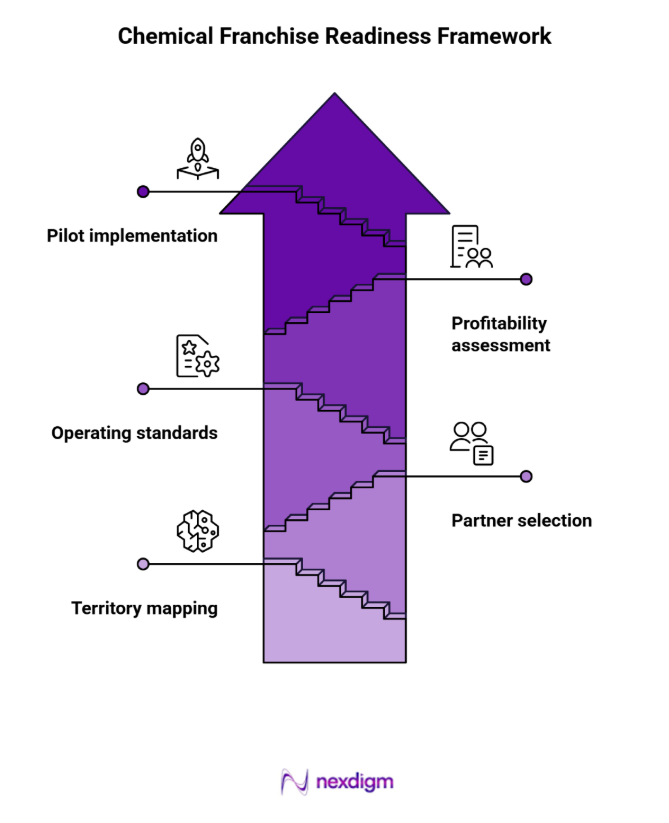
- Territory mapping: Identify markets with strong customer density and demand potential relative to service costs.
- Partner selection: Set minimum financial, technical and market-access criteria for prospective partners.
- Operating standards: Define procedures, training requirements and service-level expectations.
- Profitability assessment: Evaluate partner profitability alongside the brand owner’s contribution margin.
- Pilot implementation: Test partner performance and commercial viability in selected territories before expansion.
Nexdigm Case Study
A specialty chemical supplier evaluated 8 potential territories for a partner-led distribution model. Demand mapping identified five territories with sufficient customer density, while financial screening showed that only 3 could support the required inventory and technical staffing. A phased launch in those 3 territories reduced initial capital exposure and established measurable partner performance thresholds.
To take the next step, simply visit our Request a Consultation page and share your requirements with us.
Harsh Mittal
+91-8422857704