

A chemical product can pass laboratory testing and still fail commercially.
This is particularly important in performance and specialty chemicals, where customers may need to validate compatibility with existing formulations, production equipment, regulatory requirements, and quality systems before switching suppliers. A technical failure can disrupt production, affect warranties, or create regulatory exposure, making supplier changes materially more difficult than a conventional procurement decision.
The consequence is a familiar commercial problem: companies invest heavily in developing a technically differentiated product, generate qualified prospects, complete trials, and then discover that conversion remains slow.
The gap is usually somewhere between product qualification and organizational willingness to switch.
The Qualification Funnel Has Five Commercial Stages
A chemical go-to-market model should treat qualification as a progression rather than a single technical approval.
- Technical prospecting identifies customers whose formulations are already under pressure from cost changes, regulation, supply risks, or performance requirements.
- Lab-scale screening establishes technical equivalence or performance improvement against the incumbent.
- Pilot and line trials introduce the product into the customer’s actual production environment. This stage matters because laboratory behavior can differ significantly at industrial scale. Viscosity, foaming, shear, curing behavior, and filtration can become practical obstacles.
- Regulatory and specification approval then determines whether the material can formally enter the customer’s formulation, bill of materials, or certified production system.
Only after these barriers are addressed does commercial conversion become realistic.
The Processing Gap Can Destroy an Otherwise Strong Proposition
One of the most important GTM risks is the transition from laboratory performance to plant performance.
A formulation tested successfully in a small laboratory batch may behave differently in a 5,000-liter reactor or industrial coating line. Changes in viscosity, pump shear, foaming, curing exotherms, or filter behavior can create operational problems that are invisible during early qualification.
That means application engineering is part of commercial strategy.
Field Application Engineers can help customers resolve processing problems during trials, reduce the burden on internal technical teams, and increase the probability that qualification translates into routine production.
Incumbent Formulations Create Another Barrier
Chemical customers rarely buy molecules in isolation. They buy inputs that interact with existing recipes.
Replacing an additive or resin can alter phase stability, shelf life, cure rates, processing conditions, or final product performance. Consequently, even a technically superior alternative may be rejected if switching requires extensive reformulation.
A stronger GTM strategy therefore reduces the customer’s workload. Starting-point formulations, drop-in performance packages, accelerated stability data, freeze-thaw testing, UV exposure results, and other supporting evidence can shorten the technical evaluation process.
Regulatory Readiness Is Part of the Sales Proposition
In regulated sectors, qualification can become a documentation exercise as much as a technical one.
Automotive, medical, aerospace, food-contact, and cosmetics applications may require extensive regulatory and safety documentation. Missing registrations, declarations, toxicology information, or material approvals can delay adoption for months.
This means the GTM plan should assess documentation readiness before commercial launch. Regulatory dossiers are not simply compliance materials stored after product development. They can determine whether a sales opportunity progresses at all.
Nexdigm’s GTM Conversion Architecture
A chemical go-to-market assessment consulting engagement can connect commercial targeting with qualification economics through four decision layers.
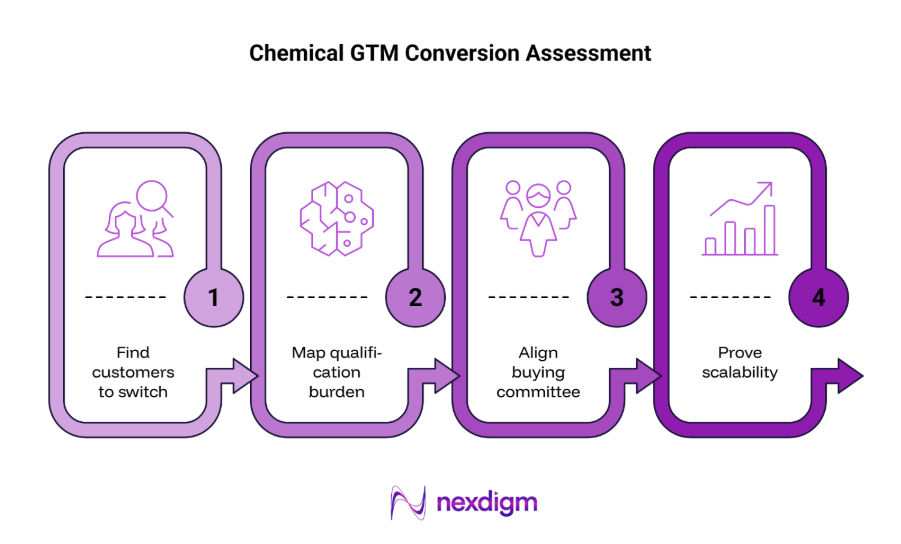
- Find customers with a reason to switch
Prioritize accounts experiencing regulatory deadlines, single-source supply risks, production constraints, or significant formulation costs. These conditions create urgency that ordinary price competition cannot manufacture. - Map the qualification burden
For each target account, determine the laboratory, plant, regulatory, and specification requirements needed for adoption. This establishes the actual sales-cycle complexity. - Align the buying committee
R&D teams need technical evidence. Plant managers need process assurance. Procurement needs delivered-cost economics and supply reliability. A GTM strategy must address each stakeholder without reducing the proposition to a single generic message. - Prove scalability before the contract
Large customers need confidence that a supplier can maintain quality across plants and production volumes. Manufacturing redundancy, ISO systems, statistical process control, and batch consistency become part of commercial credibility.
This approach shifts GTM planning from lead generation toward conversion architecture. The relevant question becomes how many technical prospects can realistically progress through qualification, approval, and repeat purchasing.
Nexdigm Case: Specialty Chemical Conversion Funnel
A specialty chemical producer had 380 qualification paths across 19 formulations. Nexdigm identified 72 priority accounts, mapped 4 approval barriers, and redesigned trial sequencing, reducing projected qualification time from 14 months to 9 months.
To take the next step, simply visit our Request a Consultation page and share your requirements with us.
Harsh Mittal
+91-8422857704