

The chemical industry is undergoing structural changes as feedstock economics, production capacity, trade patterns, and downstream demand evolve at different speeds. In 2024, global chemical production reached approximately 2.5 billion tonnes. The US remains a major producer, supported by comparatively competitive natural-gas-based feedstocks, while Europe continues to face higher energy costs.
Meanwhile, global demand for chemicals is increasingly linked to construction, automotive, electronics, agriculture, packaging, and consumer products. These differences are changing where companies invest, source raw materials, build capacity, and serve customers.
A robust Chemical Industry Analysis therefore needs to examine the complete chain from feedstocks and production assets to trade flows and end-use demand to understand where competitive advantages and future opportunities are developing.
Feedstock Economics Are Influencing Production Decisions
Feedstock availability and cost remain important determinants of chemical competitiveness. Countries with access to competitively priced natural gas, crude derivatives, or locally available raw materials can support different production economics from markets dependent on imports. Changes in energy prices, refinery capacity, and feedstock supply can therefore influence plant utilization, investment decisions, and the location of future chemical capacity.
End-Use Demand Is Shaping Where Capacity Goes
Chemical demand increasingly follows the growth of downstream industries rather than broad economic expansion alone. Automotive, construction, electronics, agriculture, packaging, pharmaceuticals, and consumer goods each create different requirements across chemical categories.
- Industry-Led Demand: Growth in downstream manufacturing can increase demand for polymers, coatings, solvents, specialty chemicals, and other industrial inputs.
- Product-Specific Shifts: Changes in EVs, renewable energy, electronics, and advanced manufacturing can create new demand for specialized chemical materials.
Together, these trends show why chemical markets need to be assessed through both supply-side competitiveness and the industries generating future demand.
Where Nexdigm Brings Chemical Market Signals Together
The forces reshaping chemicals rarely move independently. A feedstock advantage can encourage new capacity, capacity can alter trade flows, and changing downstream demand can shift the attractiveness of entire markets. Nexdigm brings these interconnected signals together through its chemical industry expertise and competitive assessment.
This enables businesses to see how changes across the chemical value chain connect, where industry dynamics are shifting, and which developments could create implications for sourcing, investment, production, or market expansion.
Nexdigm’s Role in Examining Chemical Value Chain
Nexdigm evaluates the chemical industry through interconnected supply- and demand-side signals to identify what is changing, where pressure is building, and which developments could influence future opportunities through:
- Feedstock Dynamics: Assessing raw-material availability, energy costs, refinery linkages, and feedstock advantages that influence production economics.
- Capacity and Investment: Tracking existing capacity, utilization, new plants, expansions, and investment activity to identify emerging production hubs.
- Trade and Supply Networks: Analyzing imports, exports, trade corridors, supplier concentration, and sourcing shifts to understand changing supply relationships.
- End-Use Demand: Examining downstream sectors, product applications, consumption trends, and industry growth to identify where future chemical demand may develop.
- Competitive Landscape: Mapping producers, market positions, capacity additions, and strategic moves to understand changing competitive intensity.
Together, these dimensions provide a connected view of how supply economics, production capacity, trade relationships, and downstream demand are reshaping chemical markets.
Nexdigm’s Chemical Industry Analysis Framework
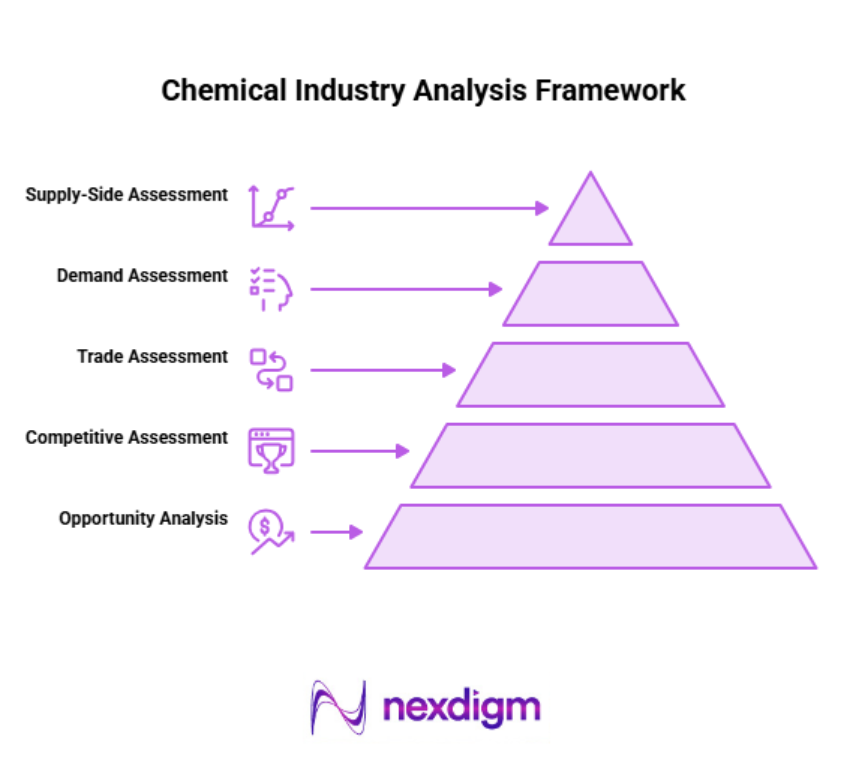
Nexdigm brings these industry signals together through a structured Chemical Industry Analysis framework designed to assess both current market conditions and future shifts through:
- Supply-Side Assessment: Evaluation of feedstock availability, production capacity, plant utilization, new investments, and manufacturing economics to identify changes in supply strength.
- Demand-Side Assessment: Examination of end-use industries, consumption patterns, product applications, and market growth to determine where future chemical requirements could increase.
- Trade Assessment: Analysis of imports, exports, trade balances, sourcing dependencies, and major trade corridors to identify changing market relationships.
- Competitive Assessment: Mapping of producers, market shares, capacity additions, product portfolios, and strategic developments to understand competitive movements.
- Opportunity Assessment: Bringing supply, demand, trade, and competition findings together to identify attractive markets, investment opportunities, sourcing alternatives, and potential risks.
This framework enables businesses to understand not only what is changing across the chemical industry, but which changes could have the greatest strategic and commercial relevance.
Benefits of Nexdigm’s Chemical Industry Analysis Framework
By connecting supply, demand, trade, and competitive signals, Nexdigm’s framework helps businesses:
- Understand Supply Risks: Highlight feedstock dependencies, capacity constraints, supplier concentration, and trade exposure that could affect production or sourcing decisions.
- Improve Market Prioritization: Compare countries and chemical segments using multiple indicators rather than relying on market size or individual growth statistics.
- Support Investment Decisions: Evaluate production economics, capacity additions, downstream demand, and competitive conditions before considering new facilities or market expansion.
The framework therefore helps businesses move from monitoring industry developments to understanding their implications for growth, sourcing, investment, and competitive strategy.
Nexdigm’s Case
Nexdigm assessed 15 chemical categories across markets, evaluating feedstock conditions, production capacity, trade flows, downstream demand, and competitive activity. The analysis identified four markets with more than 12% demand growth and five emerging capacity hubs, helping the client prioritize market expansion, sourcing, and investment opportunities.
To take the next step, simply visit our Request a Consultation page and share your requirements with us.
Harsh Mittal
+91-8422857704