

A chemical market can show strong demand growth and still be difficult for a new manufacturer to enter. Attractive selling prices may be offset by volatile feedstock costs, established competitors, demanding customer qualification processes or substantial environmental compliance requirements. The product may be commercially promising, but the proposed plant could remain uncompetitive if its scale, location or process technology is wrong.
For investors and manufacturers, the decision is not simply whether a chemical is in demand. It is whether a new entrant can secure customers, source inputs reliably, meet regulatory requirements and operate at a cost that supports acceptable returns.
India’s Chemical Industry: Growth Does Not Guarantee Easy Entry
The Department of Chemicals and Petrochemicals’ Annual Report 2025–26 reports that the production of major chemicals and petrochemicals reached approximately 58.62 million tonnes in 2024–25, compared with 45.64 million tonnes in 2015–16. The report also states that the output of chemical and chemical products increased at a compound annual growth rate of 11.6% over the preceding five years at current prices.
These figures indicate a substantial industrial base, but they combine different product categories and production conditions. A growth rate for the wider sector cannot be applied directly to a particular intermediate, specialty chemical or polymer. Each product has its own demand drivers, production economics and competitive structure.
The Department’s Chemical and Petrochemical Statistics at a Glance 2025 provides product-level information on production, installed capacity, imports and exports. This is a useful starting point for identifying categories where domestic demand exceeds local supply or where imports are significant. The data must then be examined alongside customer requirements, competing capacity and the technical characteristics of the proposed product.
Import dependence can signal an opportunity, but it can also reflect structural disadvantages in domestic production. A new plant needs to establish which explanation applies before committing capital.
Five Factors That Determine Chemical Market Entry Feasibility
- Demand and customer concentration: Examine market size, demand growth, end-use industries, import trends and customer purchasing patterns. A product serving a few large buyers may offer stable volumes but create significant customer concentration risk. Customer interviews and purchase commitments can help validate whether demand is accessible to a new supplier.
- Capacity and competition: Review existing plants, announced expansions, utilisation, product grades and supplier market shares. Nominal installed capacity does not necessarily equal saleable output, while a new entrant may face aggressive pricing from producers with established scale and customer relationships.
- Feedstock and utilities: Raw materials, energy, water, logistics and waste treatment can determine the cost position of a chemical plant. Feedstock availability, price volatility, supply contracts and distance from suppliers should be modelled under different scenarios. Access to an industrial cluster or integrated petrochemical complex may materially affect feasibility.
- Technology and product quality: Process selection, yield, energy consumption, consistency, intellectual property and customer qualification all influence competitiveness. Specialty chemicals may require application testing and lengthy approval processes before buyers accept a new supplier.
- Regulation and environmental obligations: Chemical manufacturing can involve environmental clearances, pollution-control approvals, hazardous-material handling, waste management, worker safety and product-specific quality requirements. The exact obligations depend on the chemical, process, location and scale. Compliance costs and approval timelines need to be included in the project model from the outset.
Chemical Industry Market Feasibility Study Consulting: Turning Market Data Into an Investment Decision
A chemical industry market feasibility study consulting engagement should integrate market evidence with plant economics and implementation risk. Trade data can identify import opportunities, but product-level analysis must establish whether domestic production can compete on delivered cost, quality and reliability.
The assessment should compare the proposed plant with existing producers and imported alternatives. It should also test whether the intended location provides dependable feedstock, utilities, transport and access to customers. A technically viable process may still be commercially unattractive if the minimum economic scale exceeds realistic demand or if customer qualification takes longer than the business can finance.
Scenario modelling is essential. Feedstock prices, exchange rates, utilisation, selling prices and commissioning delays can change the project’s economics substantially. A base-case forecast should therefore be accompanied by downside scenarios that show how much financial resilience the project requires.
Chemical Market Entry Feasibility Framework
The Chemical Manufacturing Market Entry Framework helps determine whether a proposed project is ready for investment.
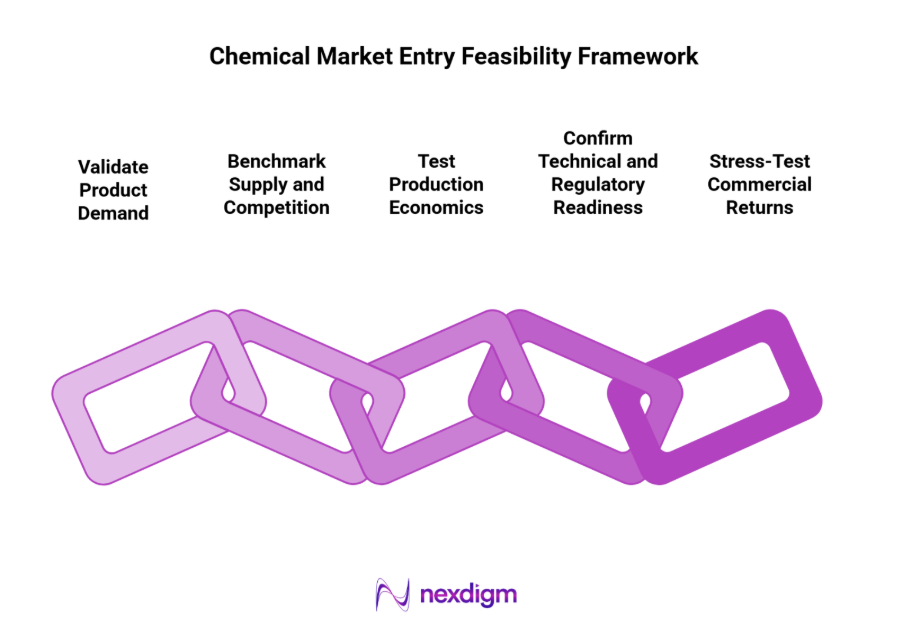
- Validate Product Demand: Analyse consumption, end-use sectors, import and export trends, customer requirements and realistic sales volumes.
- Benchmark Supply and Competition: Compare domestic producers, imported products, installed capacity, utilisation and planned expansions.
- Test Production Economics: Model feedstock, utilities, process yield, labour, logistics, capital expenditure and break-even utilisation.
- Confirm Technical and Regulatory Readiness: Assess process technology, quality requirements, environmental approvals, safety systems and waste management.
- Stress-Test Commercial Returns: Evaluate price volatility, input disruptions, commissioning delays, customer concentration and financing needs.
The outcome should be a clear entry decision: proceed, modify the product or location, secure a technology or supply partnership, or defer investment until the commercial conditions improve.
Nexdigm Case Study: Screening a Chemical Manufacturing Project
Nexdigm assessed a proposed chemical manufacturing project across four dimensions: domestic demand, import competition, feedstock access and plant economics. Product-level analysis narrowed the initial shortlist of 12 candidates to four for detailed feasibility testing. The preferred option advanced to customer validation and location assessment, with investment conditional on feedstock security and achievable capacity utilisation.
To take the next step, simply visit our Request a Consultation page and share your requirements with us.
Harsh Mittal
+91-8422857704