

Entering a chemical market can require more than capital and a competitive product. Local customer relationships, manufacturing capabilities, regulatory knowledge, distribution access, technical expertise, and supply-chain infrastructure can materially influence the success of expansion. India remains a significant chemical market, with the sector contributing approximately ₹15.14 lakh crore in manufacturing output in FY2023–24, while chemicals and petrochemicals excluding pharmaceuticals and fertilizers recorded imports of about ₹6.32 lakh crore in FY2024–25.
These dynamics create opportunities for international chemical companies, but also make entry-mode selection important. A joint venture can provide access to local capabilities and relationships while sharing investment and operational responsibilities. However, governance complexity, partner alignment, technology sharing, and capital commitments must be evaluated before proceeding.
When Can a JV Create an Advantage?
A joint venture can be attractive when a local partner provides capabilities that would take significant time or investment to develop independently. These may include manufacturing assets, distribution networks, customer relationships, regulatory knowledge, technology, or established supplier connections.
The value of a JV therefore depends on the strategic complementarity of both partners and whether their combined capabilities create a stronger market position than a wholly owned or distribution-led entry.
What Should Companies Evaluate Before Committing?
A promising market does not automatically make a JV the right entry route. Companies need to compare joint ventures with acquisitions, greenfield investments, strategic partnerships, licensing, and distribution arrangements.
Factors such as investment requirements, control, speed to market, regulatory complexity, partner capability, customer access, expected returns, and exit flexibility can determine which structure offers the best risk-adjusted opportunity.
Nexdigm’s Role in Evaluating Joint Venture Opportunities for Chemical Market Entry
Selecting the right joint venture partner requires a careful assessment of strategic fit, market access, operational capabilities, and long-term business objectives. Nexdigm helps chemical companies evaluate whether a JV can create a stronger and more sustainable market-entry platform through:
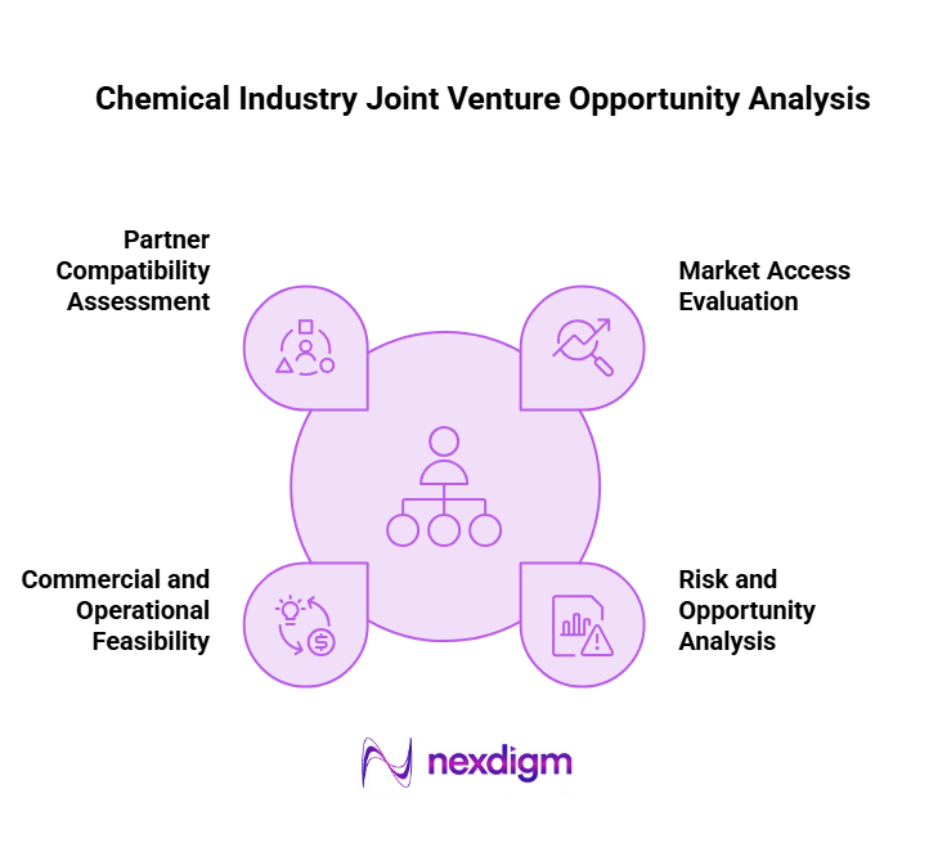
- Partner Compatibility Assessment: Evaluation of capabilities, strategic objectives, operational strengths, and market presence to determine whether potential partners can create complementary value.
- Market Access Evaluation: Assessing how a joint venture can accelerate customer acquisition, strengthen distribution reach, and improve access to local industry networks.
- Commercial and Operational Feasibility: Analyzing investment requirements, governance structures, manufacturing capabilities, supply-chain assets, and expected business outcomes.
- Risk and Opportunity Analysis: Identifying potential challenges related to control, technology sharing, partner alignment, regulatory compliance, and future expansion plans.
A structured joint venture assessment helps businesses determine whether a partnership can enhance market-entry success while supporting long-term growth, competitiveness, and operational sustainability.
Nexdigm in Supporting Chemical JV Market Entry Strategy Development
A successful joint venture requires more than identifying the right partner. Businesses must determine whether the proposed structure can support market-entry objectives, operational efficiency, regulatory compliance, and long-term value creation. Through chemical JV market entry strategy consulting capabilities, Nexdigm helps companies evaluate partnership opportunities through:
- Entry Model Evaluation: Assessing whether a joint venture offers advantages over acquisitions, greenfield investments, licensing arrangements, or distributor-led market entry.
- Partner Selection and Assessment: Evaluating potential partners based on market position, manufacturing capabilities, customer relationships, financial strength, and strategic alignment.
- Governance and Operating Structure Review: Analyzing decision-making frameworks, ownership structures, investment responsibilities, and operational roles to support effective collaboration.
- Growth and Value-Creation Planning: Identifying opportunities to leverage combined capabilities, accelerate market access, strengthen competitiveness, and support long-term expansion.
By combining market intelligence, commercial analysis, and partnership evaluation, Nexdigm helps businesses develop joint venture strategies that balance opportunity, risk, and sustainable growth objectives.
Benefits of Nexdigm’s Chemical JV Market Entry Strategy Consulting
A strategically designed joint venture can accelerate market entry while reducing the challenges associated with building capabilities independently. Nexdigm’s assessment helps businesses with:
- Faster Market Access: Leverage established customer relationships, distribution networks, manufacturing assets, and local market knowledge to accelerate commercialization.
- Shared Investment and Risk: Distribute capital requirements, operational responsibilities, and market-entry risks across partners while improving resource efficiency.
- Enhanced Competitive Positioning: Combine complementary capabilities in production, technology, supply chains, and customer access to strengthen market presence.
- Improved Operational Scalability: Build platforms that support future expansion, capacity growth, product diversification, and geographic reach.
- Stronger Strategic Decision-Making: Evaluate partnership opportunities using commercial, operational, financial, and market-entry considerations to improve long-term outcomes.
With the following benefits offered by Nexdigm’s chemical JV market entry strategy consulting, businesses can develop partnership models that support sustainable growth, competitive advantage, and successful market expansion.
Nexdigm’s Case
Nexdigm supported a global company evaluating entry into India where local partnerships could accelerate market access. The assessment covered 3 business segments, engaged 50+ industry experts and distributors, and evaluated market size, regulations, distribution structures, and partnership feasibility. The analysis identified a JV-led entry model supported by pan-India distributors, offering a lower-investment route to market penetration than a direct acquisition.
To take the next step, simply visit our Request a Consultation page and share your requirements with us.
Harsh Mittal
+91-8422857704