

The global chemical industry is entering a period in which volume growth and commercial attractiveness are increasingly separating from one another. Demand is still expanding across major end markets, but the location, product mix and economics of that demand are changing. For chemical producers, the question is no longer simply where consumption is rising. It is where demand can support attractive utilization, pricing and returns after accounting for new capacity and competitive pressure.
The divergence is already visible across regions. Cefic’s latest Q2 2026 Chemical Trends report describes the European chemical industry as facing weak underlying demand, 75% capacity utilization and a widening gas-price disadvantage relative to the United States. European chemical exports fell 6.3% in value during the first half of 2026, while basic organic chemicals and polymers remained among the weakest segments.
Meanwhile, Asia Pacific remains the centre of global chemical consumption and capacity expansion, while North American producers continue to benefit from structurally competitive feedstocks.
Demand is moving toward specific end-use pools
Chemical demand cannot be evaluated as a single growth curve because different end markets are moving in different directions.
Deloitte’s 2026 chemical industry outlook expects chemical demand to remain soft in several major industrial markets, including construction, automotive and consumer goods. Semiconductors stand out as a relative growth opportunity, with global semiconductor sales projected to exceed $760 billion in 2026. Chemicals account for an estimated 9% to 14% of the bill of materials for electronic devices, creating demand for ultra-pure gases, solvents and other electronic-grade materials.
The uploaded sector research similarly identifies energy-transition materials, semiconductor chemicals, performance construction polymers and advanced agricultural formulations as areas where demand is shifting toward higher-value applications.
This creates several distinct demand pools:
- Electronics and semiconductors, where purity, consistency and supply security matter as much as volume.
- Electrification, where batteries, power electronics, lightweight materials and thermal-management systems create new chemical requirements.
- Advanced construction, where performance polymers, adhesives, sealants and protective systems can command greater value than standard materials.
- Agriculture, where formulations designed around nutrient efficiency, biological performance and crop-specific requirements can create differentiated demand.
- Conventional packaging and industrial applications, where volumes remain significant but pricing pressure can be stronger.
The distinction between volume growth and value growth is therefore essential.
Capacity can change the economics of demand
A growing end market does not automatically produce attractive chemical margins.
The industry continues to face structural overcapacity in several basic chemicals. Deloitte notes that new ethylene and polyethylene capacity is expected to come online in the United States and Qatar during 2026, while China continues to add polypropylene capacity as part of its self-sufficiency strategy.
The uploaded research also highlights the effect of large-scale Chinese refinery-to-chemicals investments on ethylene, propylene, paraxylene and PTA capacity.
This changes the competitive equation. A producer operating in a high-cost region can face weak margins even when global consumption is increasing because incremental supply is being added faster than demand.
Europe illustrates the problem particularly clearly. Cefic reported capacity utilization at 75% in H1 2026, substantially below historical norms, while global oversupply continued to weigh on basic chemicals and polymers.
A market assessment needs to connect demand with economics
This is where chemical market assessment consulting becomes more useful than a conventional market-size exercise.
A robust assessment can be built around four linked questions.
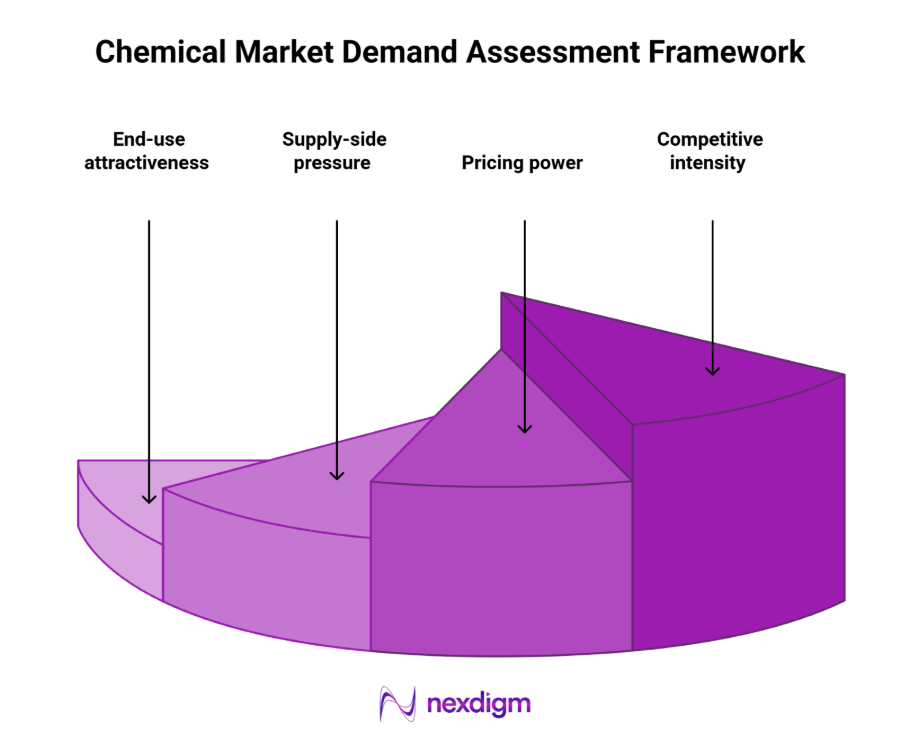
- End-use attractiveness
Map chemical consumption by application, industry and geography. Identify where demand is structurally expanding and distinguish replacement demand from genuinely incremental consumption. - Supply-side pressure
Assess announced capacity, operating rates, plant closures, feedstock access and integration. A market with strong demand but substantial new capacity may offer less pricing opportunity than its headline growth suggests. - Pricing power
Evaluate the extent to which suppliers can pass through changes in feedstock, energy, logistics and regulatory costs. Commodity products tend to track the marginal producer, while differentiated formulations can retain greater value-based pricing. - Competitive intensity
Compare scale, technology, feedstock position, geographic proximity, customer relationships and product differentiation. The relevant competitor is not always the largest producer. It is the supplier capable of serving the target application at the required economics.
Regional divergence creates different strategic choices
Asia remains the major volume centre, but opportunity within the region is uneven. China has expanded domestic production substantially, while India and Southeast Asia continue to benefit from industrialization and manufacturing investment.
North America retains an important cost advantage in feedstock-intensive chemicals because of shale-linked natural gas and ethane availability. The Middle East combines advantaged feedstocks with export-oriented infrastructure.
Europe presents a different proposition. Structural cost pressure and low utilization can make additional commodity capacity difficult to justify, while specialty chemicals and downstream formulations can offer more defensible economics. Deloitte notes that chemical companies are increasingly reassessing portfolios and shifting attention toward higher-margin specialty products.
The strategic implication is that market assessment should identify where a company has a structural reason to compete.
Nexdigm Case: Chemical Portfolio Shift
A chemical producer with $680M revenue assessed 9 product families across 7 regions. Nexdigm identified 3 commodity segments facing persistent overcapacity and 4 specialty applications with 11%–16% projected demand growth, redirecting a $95M investment pipeline.
To take the next step, simply visit our Request a Consultation page and share your requirements with us.
Harsh Mittal
+91-8422857704