

Chemical companies can invest in research and still struggle to bring new products to market. A formulation may perform well in laboratory testing but fail under industrial conditions. A promising material may require manufacturing equipment the company does not own, while customers may be reluctant to qualify an unfamiliar supplier. The gap between technical success and commercial adoption is where many innovation programmes lose momentum.
Partnerships can help bridge this gap by combining capabilities that would be expensive or slow to build independently. Yet collaboration creates value only when the partners have complementary assets, aligned incentives and a clear route from research to customer adoption.
Why Chemical Innovation Often Needs More Than Internal R&D
Chemical innovation spans a wide range of activities, from improving formulations and production processes to developing advanced materials and lower-impact alternatives. Commercialisation may require laboratory research, pilot-scale production, application testing, regulatory review, customer trials and manufacturing scale-up.
These activities depend on different resources. A research institution may provide scientific expertise, a technology company may contribute specialised testing, and an industrial customer may provide application requirements and validation. A manufacturing partner may be needed to establish process reliability at commercial volumes.
The OECD’s work on collaborative innovation in advanced materials highlights the role of shared infrastructure, research coordination and governance in moving emerging technologies towards deployment. For chemical businesses, the lesson is practical: technical expertise alone is insufficient if the surrounding capabilities needed for industrial adoption are missing.
Choosing the Right Chemical R&D Partnership Model
Not every innovation challenge requires the same arrangement. The partnership model should reflect the capability gap, maturity of the technology and level of commercial uncertainty.
- University and research institution collaborations: Suitable for fundamental research, specialised testing, materials science and access to scientific talent.
- Technology licensing: Useful when a company needs access to an existing process, formulation or intellectual property without developing it entirely in-house.
- Joint development agreements: Appropriate when both parties contribute expertise, funding, facilities or customer access to create a new product.
- Customer-led development: Helps align innovation with actual application requirements and can improve the relevance of product testing.
- Manufacturing and scale-up partnerships: Provide pilot facilities, process engineering or production capabilities that are unavailable internally.
- Consortium-based research: Can distribute cost and combine expertise where the challenge is too complex for one organisation.
The choice should be deliberate. A licensing arrangement may accelerate access to mature technology, while a joint development agreement may be more appropriate when the solution is still evolving and both partners need to contribute substantially.
From Technical Validation to Commercial Adoption
A partnership should be assessed against its ability to move an innovation through defined stages. Laboratory performance is an early milestone, not proof of market readiness.
Before entering an agreement, partners should establish the evidence required at each stage:
- Technical feasibility: Define performance targets, testing protocols, reproducibility requirements and failure criteria.
- Application validation: Test the product under relevant operating conditions and against customer specifications.
- Manufacturing readiness: Evaluate yield, input availability, process consistency, equipment requirements and cost at scale.
- Regulatory and safety readiness: Identify applicable registration, handling, environmental and product documentation requirements.
- Commercial validation: Confirm customer willingness to adopt, acceptable pricing, qualification timelines and the cost of switching from existing solutions.
The sequence will vary by product, but milestones should have clear owners and acceptance criteria. Without them, research partnerships can continue absorbing resources even when commercial prospects have weakened.
Managing Intellectual Property, Costs and Partner Incentives
A promising technical relationship can deteriorate when ownership, access rights and commercial responsibilities remain ambiguous. Agreements should distinguish pre-existing intellectual property from jointly developed results and specify who can use, license, modify or commercialise the outcomes.
Other issues require equal attention. Partners should agree on funding commitments, access to facilities and data, publication rights, confidentiality, milestone payments and the consequences of delays or underperformance. They should also establish how disputes will be resolved and whether either party can continue the work if the partnership ends.
The phrase chemical R&D partnership entry strategy consulting captures a broader commercial question: which collaboration model gives a company access to the capabilities it needs while preserving a viable route to market?
Measuring Whether a Partnership Is Creating Value
Research output alone is an incomplete measure of partnership performance. Patents, prototypes and successful laboratory tests can be important milestones, but management also needs to understand whether they are reducing commercial uncertainty.
Useful indicators include time between development milestones, reproducibility of test results, pilot-scale yield, customer trial conversion, estimated cost at scale and progress towards regulatory or customer qualification. Commercial metrics should be introduced as the technology matures, rather than forcing early-stage research to meet immediate revenue targets.
Partnership reviews should also examine whether the original capability gap remains relevant. Changes in customer demand, competing technologies or input costs may require the collaboration’s scope to be revised.
A Chemical Innovation Partnership Framework
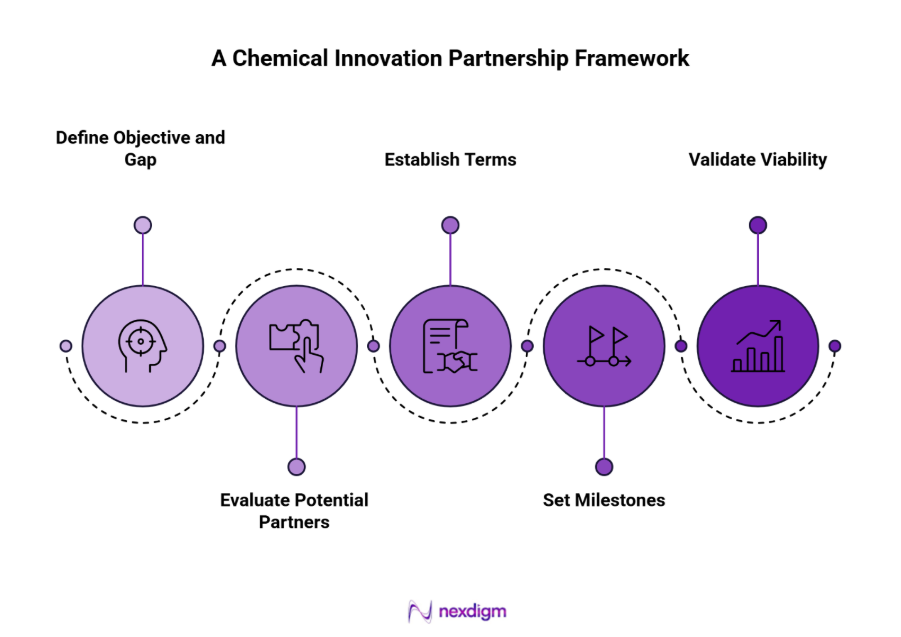
- Define the Innovation Objective and Capability Gap: Establish the specific technical or commercial objective, identify capabilities missing internally, and determine whether external collaboration can accelerate development or reduce execution risks.
- Evaluate Potential Partners and Strategic Fit: Compare prospective partners based on technical expertise, research infrastructure, manufacturing capabilities, customer access and alignment with the company’s long term innovation priorities.
- Establish Intellectual Property and Commercialisation Terms: Define ownership of existing and jointly developed intellectual property, funding responsibilities, confidentiality requirements, licensing arrangements and commercialisation rights before the collaboration begins.
- Set Development Milestones and Accountability: Establish measurable milestones covering technical validation, product development, scale up and customer testing, with clearly assigned responsibilities, timelines and performance criteria for each partner.
- Validate Commercial Viability and Scale Up Readiness: Assess production feasibility, manufacturing costs, regulatory requirements, customer adoption barriers and market demand at each stage to determine whether the innovation can progress towards commercialisation.
Nexdigm Case Study
A specialty materials company evaluated seven potential partners for a new industrial formulation. Technical screening reduced the field to three, and pilot-capability and intellectual property reviews identified one preferred development partner. The proposed collaboration established four stage-gate milestones covering performance, scale-up, customer validation and cost targets before commercial investment.
To take the next step, simply visit our Request a Consultation page and share your requirements with us.
Harsh Mittal
+91-8422857704