

Chemical companies entering a new market face an important commercial decision: should products move through retailers and dealers, be sold directly to industrial customers, or follow a hybrid model? The answer depends on product volumes, customer concentration, technical requirements, order frequency, geographic reach, and the level of control the manufacturer needs.
The Indian chemical and petrochemical industry demonstrates the scale of the opportunity. Chemicals and petrochemicals, excluding pharmaceuticals and fertilizers, recorded imports of approximately ₹6.32 lakh crore in FY2024–25. Domestic petrochemical production reached 42.16 million tonnes in FY2023–24, creating a broad customer base spanning manufacturing, construction, automotive, packaging, agriculture, coatings, and consumer industries.
For businesses entering or expanding within this ecosystem, chemical retail and B2B distribution entry strategy can help determine which channel structure can deliver the right combination of market access, customer coverage, technical support, cost efficiency, and scalability.
Retail and B2B Serve Different Market Realities
Retail-led distribution can provide broad geographic coverage and access to fragmented customers, particularly where products are purchased in smaller quantities or through established dealers. B2B distribution, by contrast, is more relevant when customers purchase in bulk, require customized service, or operate within concentrated industrial clusters.
The distinction is not absolute. Many chemical businesses need both models: direct relationships for strategic accounts and distributors or dealers for smaller customers and less accessible territories.
The Hybrid Model Can Balance Reach and Control
A hybrid route-to-market can allow manufacturers to retain direct relationships with high-value customers while using distributors to expand regional coverage. This can be useful when customer requirements differ substantially across segments.
However, hybrid models also introduce potential channel conflicts. Pricing, territory allocation, account ownership, margins, inventory responsibilities, and customer-service roles need to be clearly defined. The appropriate structure therefore depends on both commercial opportunity and operating complexity.
Nexdigm’s Expertise in Chemical Retail and B2B Distribution Strategy
Selecting the right distribution model requires balancing market reach, customer requirements, channel economics, and operational complexity. Whether a business adopts a retail, B2B, or hybrid approach, the optimal route-to-market depends on how customers buy, the level of technical support required, and the economics of serving different segments.
Leveraging our industry expertise, Nexdigm’s experts combine market intelligence, customer analysis, channel assessment, and distribution-network evaluation to help chemical companies identify the most effective distribution structure for sustainable growth.
Nexdigm’s Framework for Chemical Retail and B2B Distribution Entry Strategy
Selecting the right route-to-market requires understanding how different customer segments buy, where they are located, and the level of support they require. Nexdigm’s chemical retail and B2B distribution entry strategy framework helps businesses evaluate such areas through the following steps:
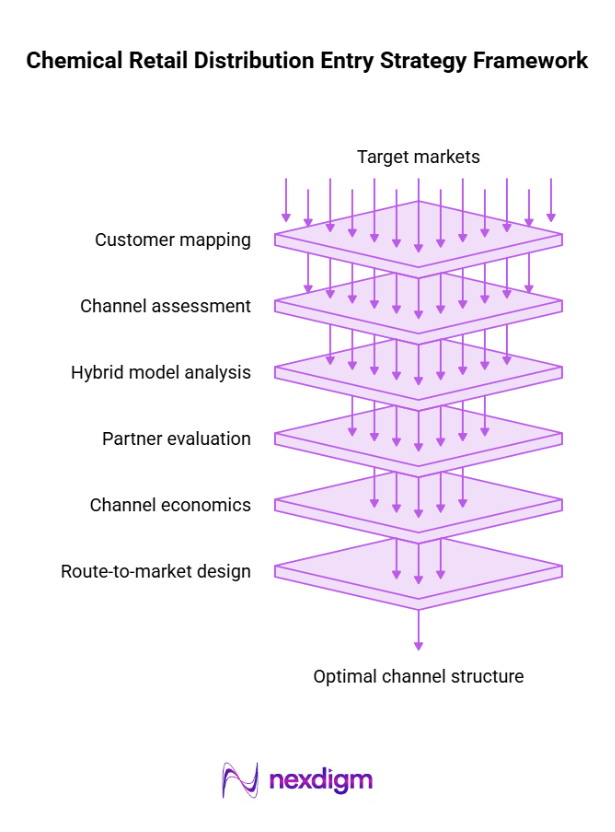
- Customer Mapping and Segmentation: Identifying bulk industrial buyers, fragmented customers, dealers, and regional demand clusters to understand channel requirements across target markets.
- Retail vs. B2B Channel Assessment: Evaluating whether customer volumes, purchasing behavior, technical requirements, and service expectations are better suited to retail or direct B2B models.
- Hybrid Model Feasibility Analysis: Determining where direct management of strategic accounts can be combined with distributor or dealer coverage to maximize market penetration.
- Channel Partner Evaluation: Assessing distributors, dealers, and retail networks based on market reach, infrastructure, customer relationships, inventory capabilities, and commercial strength.
- Channel Economics and Control Assessment: Analyzing margins, pricing structures, customer-acquisition costs, inventory responsibilities, and profitability across alternative channel models.
- Route-to-Market Design: Developing an optimal channel structure that balances customer access, geographic coverage, operational efficiency, and long-term scalability.
This framework helps chemical companies identify whether a retail, B2B, or hybrid model can best support market-entry objectives while improving customer coverage, channel effectiveness, and sustainable growth.
How Nexdigm’s Framework Helps Enhance Channel Effectiveness and Drive Sustainable Growth
Selecting the appropriate retail, B2B, or hybrid model is only the starting point. To generate long-term value, businesses must ensure that distribution channels remain efficient. Nexdigm’s framework helps chemical companies assess channel performance through:
- Channel Performance Optimization: Evaluating how effectively existing distributors, dealers, and direct-sales channels reach target customers, generate sales, and support market expansion.
- Partner Capability Enhancement: Assessing channel partners’ infrastructure, inventory management, technical support capabilities, customer relationships, and sales effectiveness to identify performance-investment opportunities.
- Customer Coverage Expansion: Identifying underserved geographies, customer segments, and industry clusters where additional channel investment can strengthen market penetration.
- Channel Alignment and Governance: Defining clear roles, responsibilities, pricing structures, and account ownership models to minimize channel conflict and improve coordination.
With these insights, Nexdigm helps chemical companies strengthen channel effectiveness, improve market access, and build distribution models that support sustainable long-term growth.
Nexdigm’s Case
Nexdigm supported a consumer-products company seeking to strengthen its route-to-market strategy across four priority regions. The assessment covered 120 distributor locations, identifying territory-level coverage and channel-productivity gaps. Following channel reallocation, the company achieved a 32% improvement in coverage and a 21% increase in channel conversions, demonstrating how data-led channel restructuring can translate into measurable commercial improvements.
To take the next step, simply visit our Request a Consultation page and share your requirements with us.
Harsh Mittal
+91-8422857704