

Chemical trade connects feedstock producers, chemical manufacturers, distributors, and downstream industries across international markets. Changes in import and export patterns can reveal expanding manufacturing activity, shifts in production capacity, or greater dependence on overseas suppliers. However, aggregate trade figures often conceal differences between products with distinct demand drivers, logistics requirements, and regulatory conditions.
Businesses need to understand which products are moving, why trade relationships are changing, and whether those movements create a viable commercial opportunity.
Read Trade Flows At Product Level
Organic chemicals, inorganic chemicals, fertilisers, plastics, and other chemical products serve different industries. Combining them into a single market estimate can obscure where demand is growing and which suppliers are gaining ground.
UN Comtrade provides trade statistics that can be examined by product classification, trading partner and reporting period. Comparing imports and exports over time helps identify destinations with increasing purchases, changes in supplier shares and markets where imported products represent a substantial part of available supply.
Values and quantities should be considered together wherever possible. Higher import expenditure may reflect rising prices rather than increased physical demand. Product classifications also need to remain consistent across periods to avoid interpreting changes in reporting categories as changes in the market itself.
Understand What Is Changing The Supply Network
Chemical trade patterns can shift when feedstock costs, energy prices, plant capacity, or environmental requirements change the economics of production. A producer facing higher input costs may lose competitiveness in one destination while another manufacturing region gains market share.
Trade policy and logistics can also redirect supply. Tariffs, export restrictions, shipping disruptions, and access to ports may affect which origins are commercially attractive. Some products require specialised storage, handling or transport arrangements, making alternative routes more expensive than headline freight rates suggest.
Effective chemical trade flow intelligence therefore connects trade statistics with production capacity, industrial demand, infrastructure and market-access conditions. This wider view helps distinguish a temporary disruption from a more durable change in the geography of chemical supply.
Find Opportunities Beyond Import Growth
A destination with rising imports may appear attractive, but the increase could already be served by established suppliers with strong distribution networks and long-standing customer relationships. A smaller market may offer a better opportunity if local production is limited, buyers need alternative sources, or a specific product grade is difficult to obtain.
The relevant question is not simply where imports are increasing. It is whether a business can meet buyer requirements at a competitive total cost and maintain reliable supply.
Build A Chemical Trade Intelligence Framework
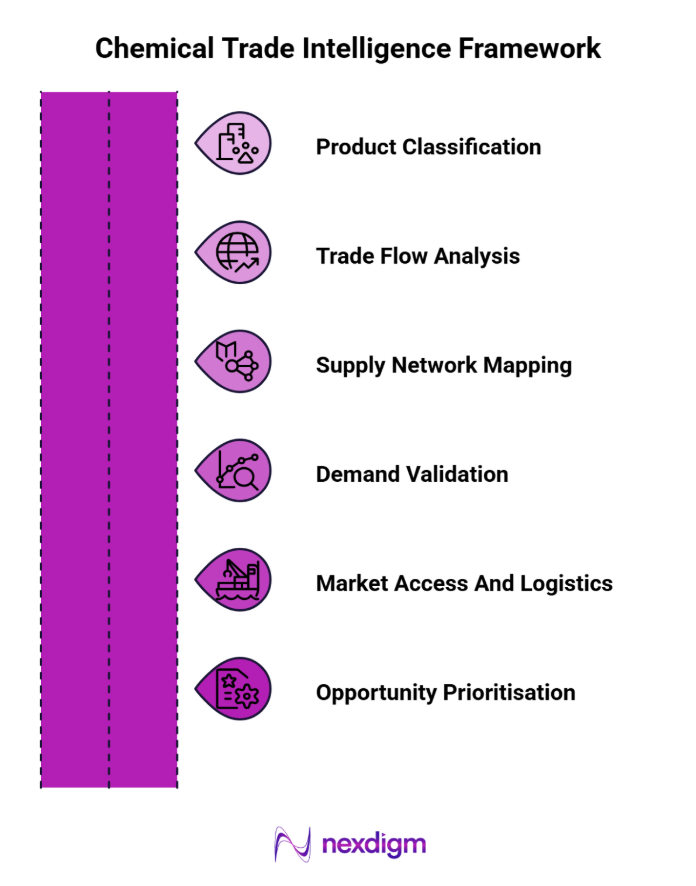
- Product Classification: Define the chemical categories and trade codes precisely, ensuring that comparisons across countries and reporting periods refer to consistent products.
- Trade Flow Analysis: Compare import and export values, available quantities and supplier shares to identify growing destinations, changing origins and shifts in physical demand.
- Supply Network Mapping: Trace major producers, exporting countries, importing markets and distribution routes to identify concentrated relationships and potential alternative sources.
- Demand Validation: Connect import movements with downstream industrial production, customer requirements and domestic capacity to determine whether demand growth is likely to persist.
- Market Access And Logistics: Assess tariffs, product regulations, freight costs, handling requirements and route reliability to estimate the practical cost of serving each market.
- Opportunity Prioritisation: Rank product-market combinations by demand potential, competition, supplier gaps and execution requirements before committing resources to market entry or sourcing changes.
This framework should be used to investigate opportunities, not to assume that every import increase signals unmet demand. Trade data identifies patterns; customer research, supplier validation and cost analysis establish whether those patterns can support a viable business decision.
Where Trade Intelligence Creates Value
A clearer view of chemical flows helps exporters evaluate destinations; importers diversify sourcing, and manufacturers assess changes in regional supply networks. Combining product-level trade data with logistics, production and buyer research makes it easier to distinguish a genuine market opportunity from a temporary movement in reported trade.
Nexdigm’s Case Study
A chemical distributor identifies a destination where imports of a selected product have increased over several reporting periods. Supplier concentration and downstream manufacturing activity are examined to understand the trend. Freight costs, product specifications, and import requirements are then assessed to determine whether an alternative supplier can serve the market competitively.
To take the next step, simply visit our Request a Consultation page and share your requirements with us.
Harsh Mittal
+91-8422857704