

Chemical market dynamics are increasingly diverging by country. In H1 2025, China’s chemical production grew 7.9%, compared with 2.6% in the US and 4.3% in Brazil, while India declined 1.0% and Japan 1.1%. Germany, one of Europe’s major chemical producers, recorded a 2.7% decline during the same period.
The differences extend to trade: during January–August 2025, the US remained the largest destination for EU27 chemical exports at €28.3 billion, followed by the UK at €17.0 billion and China at €11.6 billion. These contrasting production and trade patterns show why chemical trade intelligence needs to go beyond shipment values to understand demand shifts and evolving supply networks.
Trade Growth Alone Is Not Enough
A rise in chemical exports may reflect new production capacity, while increasing imports can indicate either stronger downstream demand or weakening domestic supply. Similarly, changes in trade value can result from pricing rather than volume growth. Businesses therefore need to connect trade movements with production, consumption, competitors, and supplier networks to understand the underlying market shift.
Signals Behind Changing Chemical Markets
A broader intelligence view can reveal what is happening beneath headline trade numbers:
- Demand Shifts: Changes in imports, consumption, and downstream industries can indicate where chemical requirements are strengthening or weakening.
- Competitive and Supply Shifts: Changes in exporter shares, supplier participation, pricing, and production capacity can reveal who is gaining or losing market position.
Together, these signals help businesses understand whether a trade movement represents genuine market growth, changing supply dynamics, or a temporary pricing or sourcing effect.
Nexdigm’s View on Changing Chemical Market Shifts
Chemical trade movements become more meaningful when businesses understand the market forces behind them. Nexdigm brings together trade, demand, supplier, pricing, and competitive intelligence to examine how chemical markets are evolving across products and countries.
By connecting these signals, Nexdigm helps businesses identify where demand is shifting, which suppliers are gaining relevance, how competitive positions are changing, and where supply networks may create new commercial opportunities.
How Nexdigm Maps Chemical Market Dynamics
Nexdigm examines chemical markets across multiple interconnected dimensions to understand the reasons behind changing trade patterns such as:
- Demand and Consumption: Analysis of import growth, downstream industries, applications, and market activity to identify where chemical requirements are strengthening.
- Pricing and Product Trends: Comparison of product-level trade values, volumes, and historical movements to distinguish pricing changes from genuine shifts in market demand.
- Supply Network Development: Mapping of production hubs, capacity additions, investments, and trade corridors to understand how chemical supply structures are evolving.
These dimensions allow Nexdigm to connect what is moving across borders with why it is moving and what those changes could mean for businesses.
Nexdigm’s Chemical Trade Intelligence Framework
Nexdigm structures chemical trade intelligence around a connected assessment of products, markets, suppliers, pricing, and competitive activity. The framework helps businesses move from individual trade observations to a broader understanding of market dynamics through the following steps:
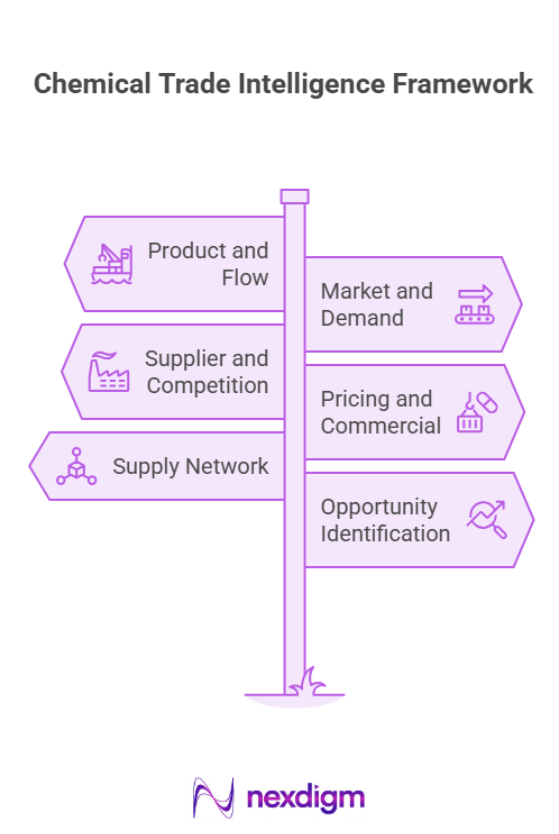
- Product and Flow Assessment: Analyzing HS codes, product categories, trade values, volumes, origins, and destinations to identify where chemical flows are increasing, declining, or changing direction.
- Market and Demand Assessment: Evaluating import growth, downstream industries, consumption patterns, applications, and market development to determine whether changing trade flows reflect sustainable demand.
- Supplier and Competition Assessment: Map exporters, manufacturers, supplier shares, competitors, and production locations to identify concentration, emerging suppliers, and shifts in competitive positioning.
- Pricing and Commercial Assessment: Comparing trade values, volumes, product-level pricing indicators, and market differences to understand whether growth is volume-driven, price-driven, or influenced by product mix.
- Supply Network Assessment: Connect trade movements with production capacity, new investments, capacity additions, logistics corridors, and sourcing dependencies to understand how supply networks are evolving.
- Opportunity Identification: Bringing the findings together to identify growth markets, alternative suppliers, attractive product categories, changing competitive positions, and potential expansion opportunities.
This framework enables Nexdigm to turn fragmented trade information into structured market intelligence that can support sourcing, expansion, competitive, and investment decisions.
Why Businesses Partner with Nexdigm
Chemical markets require more than access to trade statistics. Businesses need the ability to connect fragmented market signals and interpret their commercial significance. Nexdigm combines trade intelligence with chemical-sector knowledge to provide:
- Integrated Intelligence: Connect trade flows with demand, suppliers, pricing, production, and competition rather than analyzing each signal independently.
- Sector Context: Interpret trade movements within the specific dynamics of chemical products, downstream industries, production ecosystems, and market structures.
- Forward-Looking Perspective: Combine historical trade patterns with capacity additions, investments, demand shifts, and supplier developments to identify emerging opportunities.
This combination helps businesses move from accessing chemical trade data to understanding the market forces behind it and making more informed strategic decisions.
Nexdigm’s Case
Nexdigm assessed 19 chemical categories, identifying 15% growth in selected trade flows and four markets with over 14% import growth. The analysis highlighted five emerging suppliers, helping the industry client evaluate sourcing diversification and market expansion opportunities.
To take the next step, simply visit our Request a Consultation page and share your requirements with us.
Harsh Mittal
+91-8422857704