

Chemical imports and exports can reveal where industrial demand is expanding, which countries have competitive production capacity, and where domestic supply may not meet buyer requirements. These patterns matter to chemical manufacturers, distributors, and procurement teams assessing new markets or alternative sourcing options.
However, a trade deficit or rising import bill does not automatically indicate an unmet market need. Businesses must distinguish between products that are unavailable locally, products that offer advantages when imported, and products already supplied by established competitors.
Read Trade Data By Chemical Category
Chemicals encompass organic and inorganic compounds, fertilisers, plastics, industrial inputs, and specialised formulations. Each category has different production economics and end-use requirements. Aggregated trade figures can conceal these differences and make market opportunities difficult to identify.
Researchers should compare imports and exports using consistent product classifications and reporting periods. UN Comtrade provides data that can help identify major trading partners, changes in import values, and shifts in the composition of chemical trade.
Quantity data is useful when available, as changes in trade value may reflect higher prices rather than increased demand. Product-level analysis can also help identify whether a country imports basic inputs for domestic processing or finished products for direct industrial use.
Interpret Supply Gaps Carefully
A market importing substantial volumes of a chemical may have limited domestic production, insufficient capacity, or a preference for particular imported grades. It may also import because overseas producers offer lower costs, more consistent quality, or technical specifications that local suppliers cannot provide.
For chemicals import export analysis, the key is to establish why imports occur and whether the underlying conditions create a viable opportunity. A high import value alone does not prove that buyers are underserved. Existing suppliers may already meet demand effectively, while technical approvals, tariffs, or transport costs may limit entry for new competitors.
Comparing import trends with local production, industrial output, and supplier concentration helps clarify the commercial context.
Assess Export Potential And Competitive Position
Export opportunities depend on whether a producer can meet destination-market requirements at a competitive delivered cost. Manufacturing capacity is only one part of the equation. Product quality, consistency, packaging, regulatory documentation, delivery schedules, and distributor access can influence purchasing decisions.
Exporters should compare destination markets by product rather than assuming that demand for one chemical indicates demand for the wider category. They should also review customs requirements, applicable duties, product restrictions, and documentation obligations before estimating market-entry costs.
For importers, the same research can identify alternative suppliers and assess whether diversification would improve price competitiveness or supply reliability.
Build A Chemical Trade Opportunity Framework
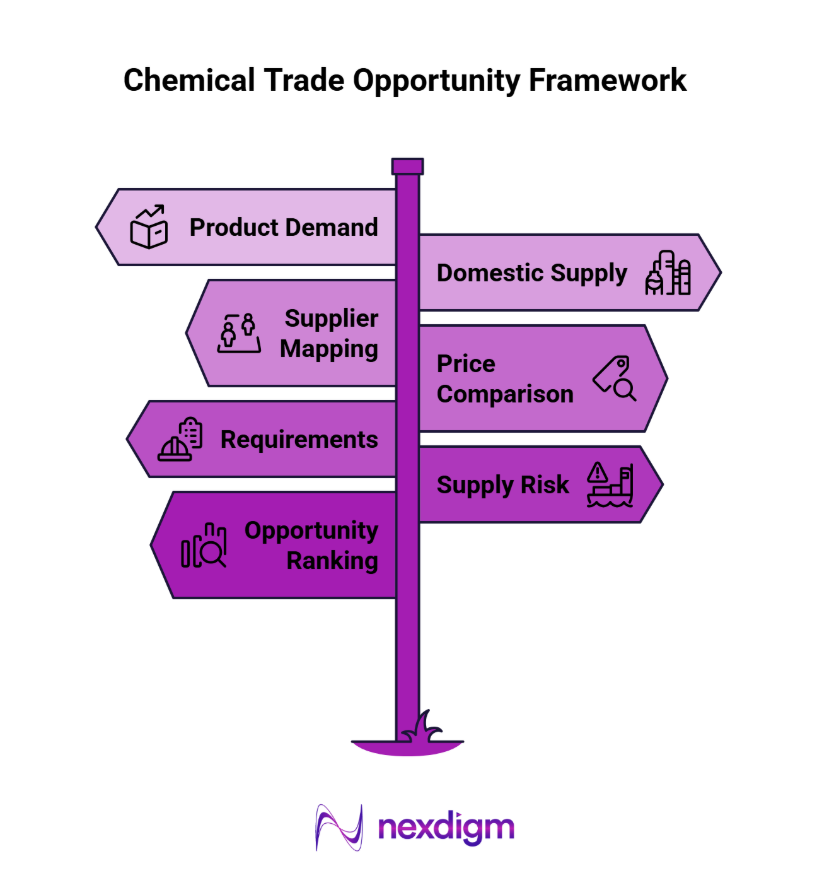
- Product-Level Demand: Identify specific chemical products and grades, then compare import quantities, trade values, and end-use industries to establish where demand is increasing.
- Domestic Supply Assessment: Compare imports with local production, processing capacity, and industrial consumption to determine whether the market has a structural supply gap or relies on imports for commercial reasons.
- Supplier And Competitor Mapping: Identify major exporting countries and established suppliers, examining market shares, product quality, pricing, and delivery performance to understand competitive conditions.
- Price And Cost Comparison: Assess available price indicators, freight, duties, handling, and currency exposure to estimate the delivered cost of imported products and the competitiveness of potential exports.
- Regulatory And Technical Requirements: Review product classification, applicable chemical regulations, safety documentation, labelling, and customer qualification requirements that could affect access to the destination market.
- Supply Risk Assessment: Examine supplier concentration, transport routes, production constraints, and alternative sources to determine whether import dependence creates an operational vulnerability.
- Market Opportunity Ranking: Prioritise product-market combinations by demand growth, competition, margin potential, regulatory complexity, and the company’s ability to supply customers reliably.
The strongest opportunities emerge when several factors align. A market may have high imports but limited room for new suppliers, while another may offer a more attractive entry point through specialised products, reliable delivery, or a demonstrable gap in local supply.
From Trade Patterns To Commercial Decisions
Chemical import-export research helps businesses identify promising destinations, assess sourcing alternatives, and understand how local production compares with international supply. Combining trade statistics with industry demand, supplier research, and market-access requirements provides a more reliable basis for decisions than using import growth as a standalone indicator.
Nexdigm’s Case Study
A chemical manufacturer evaluates a market importing 8,000 tonnes of a selected product annually, with an estimated average import value of ₹1.5 lakh per tonne. The implied import market is approximately ₹120 crore. Rather than assuming it can capture the entire market, the manufacturer assesses a 5% share as an initial commercial target, equivalent to 400 tonnes and ₹6 crore in annual sales at the same average value. Freight, duties, compliance costs, and buyer qualification requirements must then be assessed to establish whether that target is profitable.
To take the next step, simply visit our Request a Consultation page and share your requirements with us.
Harsh Mittal
+91-8422857704