

Chemical trade is showing a mixed but increasingly regional pattern. According to UNCTAD, global trade in chemicals grew 20% quarter-on-quarter in Q1 2025 and was 7% higher year-on-year, making chemicals one of the stronger-performing manufacturing sectors during the period. More recent industry data shows how uneven this growth can be.
In the first half of 2025, chemical production increased 7.9% in China, 4.3% in Brazil, and 2.6% in the US, while India declined 1.0% and the EU27 declined 2.4%. By Q3 2026, EU27 chemical exports had fallen 4.2% and imports 3.1% year-on-year. These differences make chemicals trade analysis increasingly important for identifying growing product flows, changing demand centers, supplier shifts, and emerging market opportunities.
Chemical Trade Is Becoming More Regional
Chemical products move through complex networks shaped by feedstock availability, production capacity, energy costs, downstream demand, trade policies, and logistics. A country may be a major producer of one chemical category while depending heavily on imports for another. This creates different trade opportunities across basic chemicals, petrochemicals, polymers, specialties, and consumer chemicals. Understanding these product-level differences is essential when evaluating where trade is actually expanding.
Product Flows Can Reveal Where Demand Is Moving
Trade movements can provide early clues about changing industrial requirements and supplier positions.
- Growing Product Flows: Rising exports or imports of specific chemical categories can indicate stronger downstream demand, new production capacity, or changes in sourcing patterns.
- Changing Supplier Markets: Shifts in countries of origin can reveal emerging suppliers, production advantages, capacity additions, or efforts to diversify existing sourcing networks.
These signals help businesses understand which chemical products are gaining traction, where demand is developing, and how supplier relationships are changing.
Nexdigm’s Role in Interpreting Chemical Trade Movements
Chemical trade data becomes commercially useful when individual product movements are connected with demand, suppliers, production capabilities, pricing, and competitive conditions.
Nexdigm combines trade intelligence with market research, company intelligence, competitive analysis, and sector expertise to interpret these relationships. Our chemicals trade analysis can examine:
- HS Codes and Product Categories: Specific chemical products and segments to understand trade activity, market size, and category-level growth trends.
- Import-Export Values and Volumes: Evaluate market demand, consumption patterns, pricing movements, and the relative importance of different products across regions.
- Origins and Destinations: Track where chemicals are sourced and sold, helping businesses understand key supply markets, demand hubs, and trade dependencies.
- Suppliers and Buyers: Assess major exporters, importers, manufacturers, distributors, and end-users to uncover potential customers, competitors, and partnership opportunities.
This enables businesses to move beyond identifying where chemicals are traded and understand what is driving those flows and what they could mean for market expansion, sourcing, and competitive positioning.
How Nexdigm Connects Chemical Trade Signals
Chemical trade movements can have different implications depending on the product, market, and underlying supply conditions. Nexdigm connects these signals using chemicals trade analysis to provide a more complete view of the forces shaping chemical trade by:
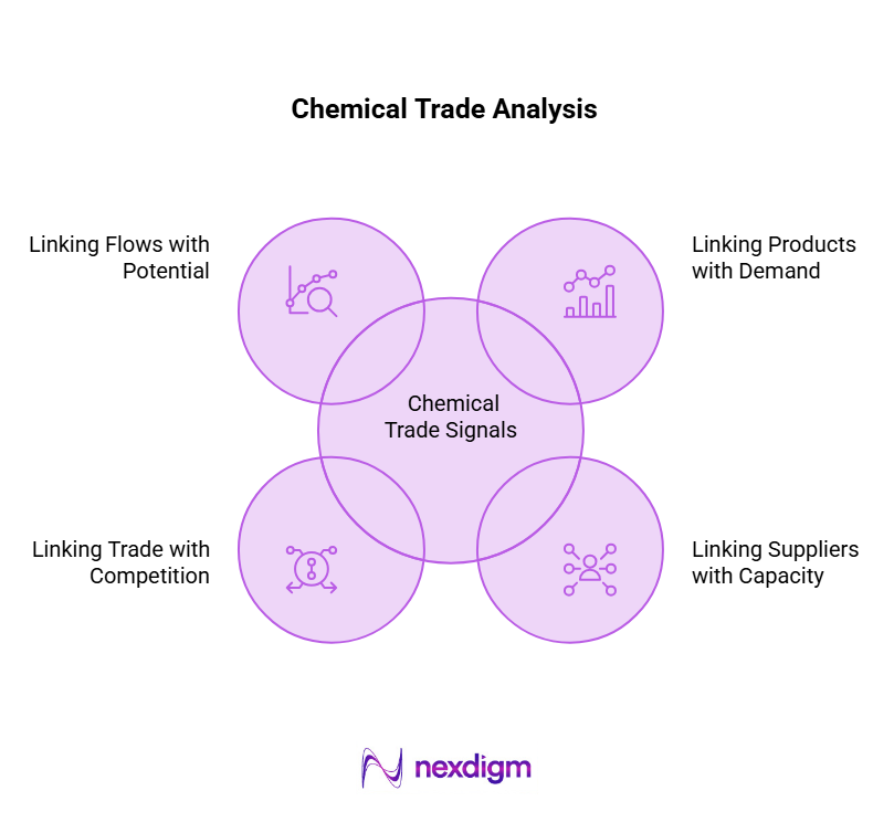
- Linking Products with Demand: Compare product-level trade growth with downstream industries, consumption patterns, and market activity to understand whether rising flows reflect sustainable demand.
- Linking Suppliers with Capacity: Assess exporters alongside production facilities, capacity additions, and investment activity to determine whether supplier growth is supported by expanding supply.
- Linking Trade with Competition: Examine supplier shares, destination markets, and company participation to identify changing competitive positions and emerging market participants.
- Linking Current Flows with Future Potential: Combine historical trade patterns with investment pipelines and market developments to identify where supply and demand relationships could strengthen.
This approach helps businesses interpret why chemical trade is changing, which movements are structurally significant, and where those changes may create commercial opportunities.
How Nexdigm’s Chemical Trade Analysis Approach Helps Businesses
Connecting trade, demand, supplier, and capacity signals gives businesses a clearer understanding of:
- Growth Markets: Recognize countries and product categories where rising trade reflects sustained demand or developing supply gaps.
- Sourcing Opportunities: Identify alternative supplier markets by comparing export activity, production capabilities, capacity, and supplier concentration.
- Competitive Shifts: Track changing exporter shares, destination markets, and company participation to understand evolving competitive positions.
- Expansion Decisions: Combine trade growth with demand and production indicators to evaluate markets for potential entry, partnerships, or investment.
The approach helps businesses move from observing chemical trade movements to interpreting their commercial significance and identifying practical opportunities.
Nexdigm’s Case
Nexdigm assessed chemical trade across 14 markets and 20 product categories, identifying 16% growth in selected trade flows and four destination markets with more than 10% import growth. The analysis also highlighted six emerging supplier markets and five priority product categories, helping the client identify sourcing alternatives and evaluate expansion opportunities.
To take the next step, simply visit our Request a Consultation page and share your requirements with us.
Harsh Mittal
+91-8422857704