
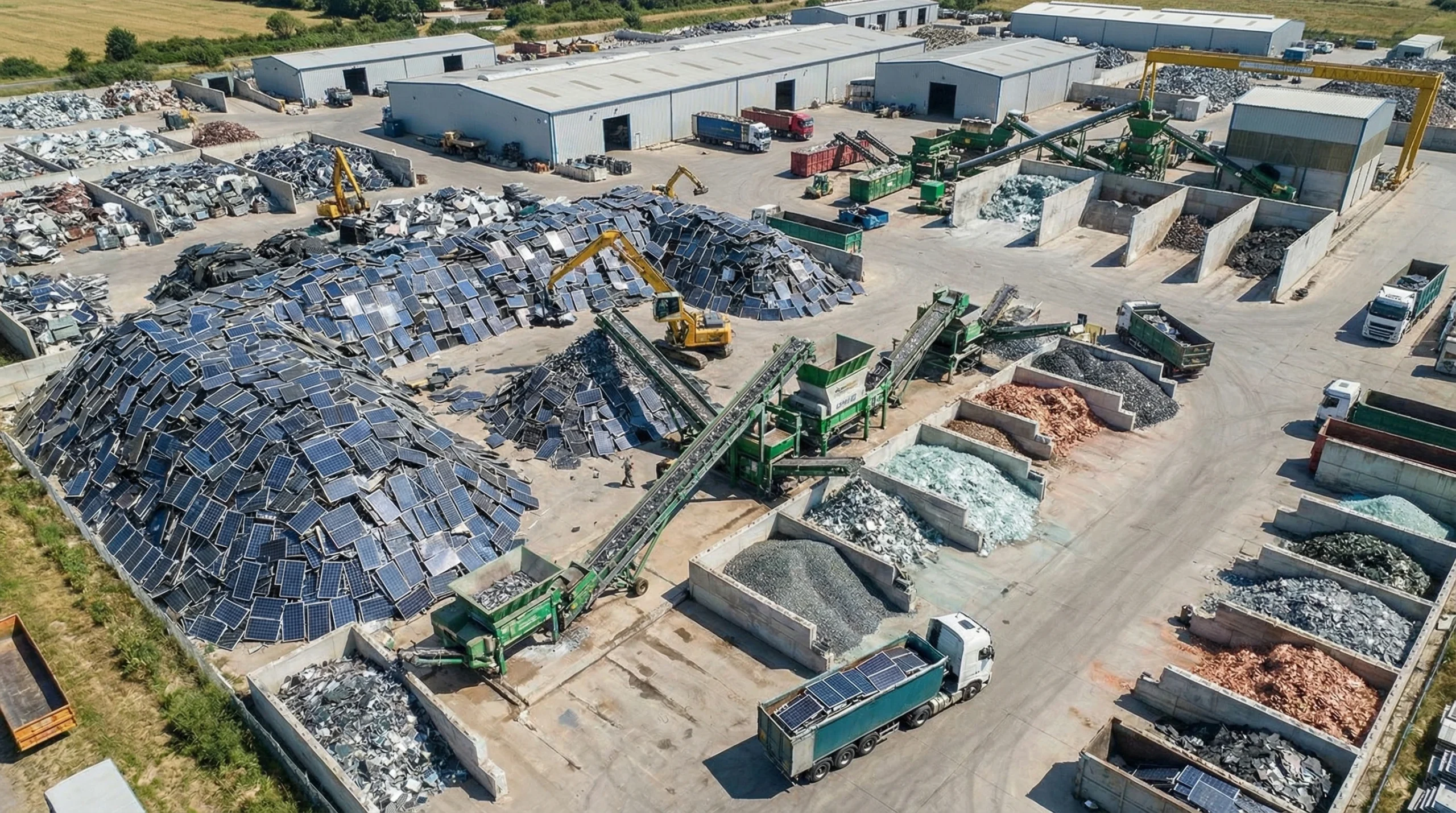
China’s remarkable rise as the world’s solar powerhouse has created a new challenge and opportunity: managing millions of solar panels as they approach the end of their operational life. With the country accounting for over half of global solar installations and adding substantial new capacity each year, the volume of photovoltaic (PV) waste is expected to increase significantly in the coming decades. This shift is transforming solar panel recycling from a niche activity into a critical component of China’s renewable energy ecosystem. Recovering valuable materials while reducing environmental impact is becoming a priority for manufacturers, policymakers, and energy developers alike.
Market Drivers Advancing the China Solar Panel Recycling Industry
Expanding Solar Installations Creating Future Recycling Demand
China’s solar industry has grown at an unprecedented scale, with installed solar capacity exceeding 1 terawatt, making it the largest solar market globally. As many early-generation solar projects move closer to retirement, the volume of decommissioned panels is expected to rise sharply. Every solar panel contains recyclable components such as glass, aluminum, silicon, copper, and silver. As utility-scale solar farms continue to expand across provinces including Inner Mongolia, Xinjiang, and Qinghai, the future stream of recyclable materials is becoming substantial. This growing stock of aging panels is creating long-term demand for specialized recycling facilities and collection networks.
Recovering Valuable Raw Materials Supporting Circular Economy Goals
Solar panels are not merely waste products. They contain materials that can be reintroduced into manufacturing supply chains. Glass often accounts for more than 70% of a panel’s weight, while aluminum frames and silicon cells offer additional recovery value. As global industries seek greater resource security and lower raw material dependence, recycled materials are gaining importance. Many Chinese companies are investing in advanced recycling technologies capable of extracting high-purity silicon and precious metals, helping improve economic returns while reducing environmental burdens.
Strong Sustainability Commitments Encouraging Recycling Investments
China’s broader environmental agenda is accelerating interest in solar panel recycling. Businesses are increasingly under pressure to demonstrate responsible end-of-life waste management practices. At the same time, renewable energy stakeholders recognize that the long-term sustainability of solar power depends on effectively handling retired equipment. This growing focus on circular economy principles is encouraging investments in recycling infrastructure, research programs, and innovative material recovery techniques throughout the country.
Government Initiatives Supporting the China Solar Panel Recycling Industry
Chinese authorities have been promoting resource efficiency and circular economy initiatives that support photovoltaic waste management. Industry stakeholders are working alongside research institutions to develop more efficient recycling processes and establish best practices for end-of-life panel treatment. Government-backed sustainability programs and clean energy policies are also encouraging investment in recycling facilities, helping create the foundation for a more organized and scalable solar panel recycling ecosystem.
Competitive Landscape of China Solar Panel Recycling Sector
The China solar panel recycling industry is becoming increasingly competitive as recycling specialists, waste management firms, and renewable energy companies expand their operations. Market participants are focusing on advanced separation technologies that improve recovery rates for glass, metals, and silicon. Strategic partnerships between solar manufacturers, recyclers, and research organizations are helping accelerate innovation. Companies that can achieve higher material recovery efficiency and lower processing costs are expected to gain a stronger market position.
Challenges Impacting the China Solar Panel Recycling Industry
High Processing Costs Impact Commercial Viability
Despite growing demand, recycling solar panels remains a relatively expensive process. Collection, transportation, dismantling, and material separation require specialized equipment and investment. In some cases, recovered material values may not fully offset operational expenses, creating profitability challenges for recyclers.
Recycling Infrastructure Still Developing Across Regions
China’s recycling ecosystem for photovoltaic panels is evolving but remains fragmented in some areas. Differences in solar panel designs, material compositions, and regional collection capabilities can make large-scale recycling more complex. Expanding nationwide collection systems and standardizing recycling procedures will be essential for long-term industry growth.
Future Outlook
The future of China’s solar panel recycling market appears highly promising as larger volumes of photovoltaic modules gradually reach end-of-life. Improvements in recycling technologies are expected to increase recovery rates and reduce operational costs, making recycling more commercially attractive. Growing environmental awareness, stronger circular economy initiatives, and continued renewable energy expansion will further strengthen market demand. As China continues to lead global solar deployment, the recycling sector is set to become an integral part of the country’s clean energy value chain, opening new opportunities for investment, innovation, and sustainable resource management.
Consultants at Nexdigm, in their latest publication “China Solar Panel Recycling Market Outlook to 2035” analyze the sector By Panel Technology Type (Cadmium Telluride Panels, Amorphous Silicon Cells and Perovskite Tandem Cells), By End User Profile (Utility-Scale Project Developers, Residential Rooftop Operators and PV Module Manufacturing Facilities) and By Geographic Region (North China, South China and East China).
Nexdigm suggests that businesses in “China Solar Panel Recycling Industry” focusses on oilfield, desalination, construction, and industrial applications, strengthen local warehousing, develop application-specific grades, improve technical support, and build resilient sourcing networks to serve expanding energy, water, and manufacturing demand.
To take the next step, simply visit our Request a Consultation page and share your requirements with us.
Harsh Mittal
+91-8422857704