

Waste is increasingly being viewed not simply as a disposal challenge, but as a potential source of secondary materials for manufacturing. The opportunity is substantial: the World Bank estimates global municipal solid waste generation could reach 3.4 billion tonnes annually by 2050, while the OECD reports that only around 9% of global plastic waste is successfully recycled.
At the same time, demand for recycled metals, plastics, construction materials, industrial by-products, and recovered resources is creating new commercial opportunities across manufacturing value chains. Circular production models can help businesses reduce dependence on virgin materials, manage input costs, strengthen supply security, and respond to customer sustainability requirements.
The challenge is identifying waste streams with sufficient volume, quality, consistency, recoverability, and economic value to become viable manufacturing inputs. A structured market assessment can help businesses map these opportunities and evaluate their commercial potential.
Where Waste Streams Can Create Manufacturing Value
Manufacturers are increasingly exploring waste streams as alternative sources of raw materials, particularly where virgin material costs or supply risks are rising. Metals, plastics, textiles, packaging waste, construction materials, and industrial by-products can potentially re-enter production cycles. The opportunity depends on reliable collection, processing capabilities, material quality, and consistent availability across relevant supply chains.
Factors Shaping Circular Manufacturing Potential
Not every waste stream represents a commercially attractive manufacturing input. Businesses must consider recovery costs, processing technology, transportation, quality standards, regulatory requirements, and customer acceptance alongside material availability. Markets become more promising when recovered materials can compete economically with virgin alternatives while meeting production specifications. Understanding these factors helps identify circular opportunities with stronger potential for scalable manufacturing applications.
Understanding Circular Manufacturing Opportunities with Nexdigm
Understanding whether recovered materials can become viable manufacturing inputs requires connecting material availability with market demand, processing economics, supply-chain conditions, and end-user requirements.
Nexdigm brings together industry knowledge, market intelligence, and strategic analysis to help businesses evaluate these interconnected factors. Its approach can assess waste streams, recycling and recovery ecosystems, technology requirements and cost structures to identify opportunities with stronger commercial potential.
This helps businesses move from identifying available waste resources to understanding where circular production models can support new products, cost efficiencies, supply security, and sustainable growth.
Nexdigm’s Circular Manufacturing Market Opportunity Analysis
Nexdigm’s Circular Manufacturing Market Opportunity Analysis helps businesses identify where waste-derived materials can create commercially viable opportunities. The assessment focuses on:
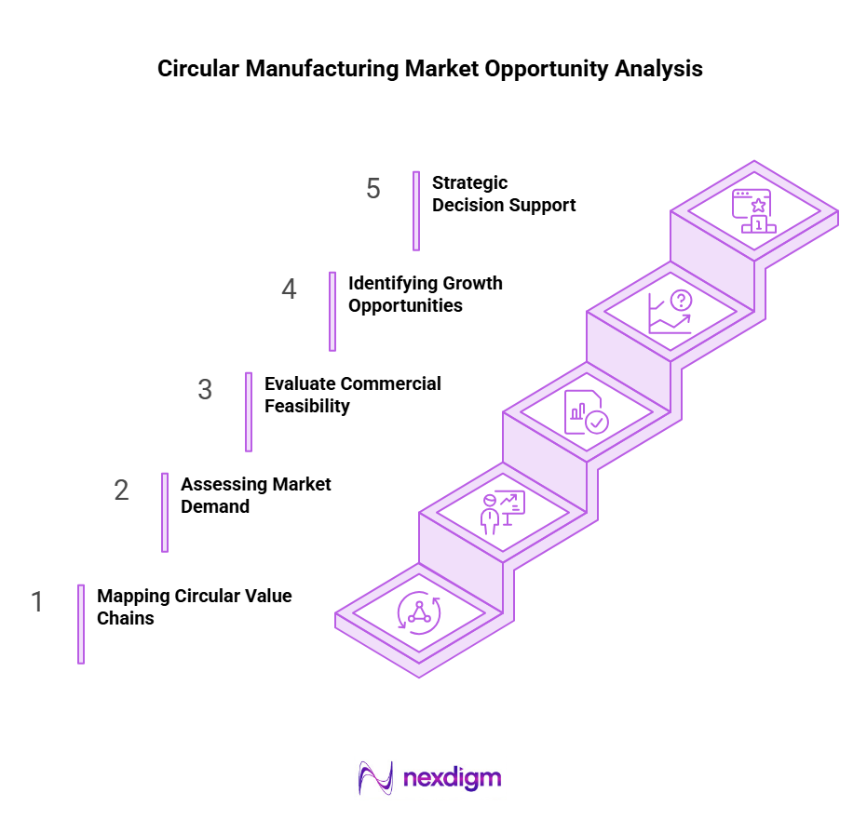
- Mapping Circular Value Chains: Identifying and analyzing the complete circular ecosystem, including waste generators, collection networks, recyclers, processors, manufacturers, distributors, and end users, to understand material flows and value creation opportunities.
- Assessing Market Demand: Evaluating customer preferences, sustainability commitments, procurement requirements, adoption patterns, and market demand to determine the commercial attractiveness of recovered materials and circular products.
- Evaluate Commercial Feasibility: Assessing processing technologies, material quality standards, logistics requirements, operating costs, pricing dynamics, and profitability potential to determine the viability of circular manufacturing solutions.
- Identifying Growth Opportunities: Pinpoint high-potential applications, underserved customer segments, strategic partnerships, and emerging markets where circular manufacturing solutions can drive long-term business growth.
- Strategic Decision Support: Translating market insights into actionable recommendations that support investment planning, product development, partnership strategies, capacity expansion, and market entry decisions.
By combining market intelligence, value-chain analysis, and commercial evaluation, Nexdigm helps organizations identify scalable circular manufacturing opportunities and develop strategies that drive sustainable growth and long-term value creation.
Nexdigm’s Analysis Converting Circular Manufacturing Opportunities into Growth Strategies
Identifying market opportunities is only the first step in building a successful circular manufacturing business. Nexdigm helps organizations translate market insights into actionable strategies by conducting:
- Opportunity Prioritization: Evaluating identified opportunities based on market attractiveness, commercial feasibility, scalability, and strategic fit to help businesses focus on high-impact initiatives.
- Business Model Assessment: Analyzing potential operating models, partnership structures, revenue mechanisms, and value-creation approaches to support sustainable market participation.
- Investment and Expansion Roadmapping: Developing structured roadmaps that align capacity planning, technology adoption, market development, and investment priorities with long-term business objectives.
- Risk and Market Readiness Evaluation: Assessing operational, supply-chain, regulatory, and market risks to support informed decision-making and improve implementation success.
By transforming market opportunity insights into practical growth strategies, Nexdigm helps organizations accelerate circular manufacturing initiatives, strengthen competitiveness, and capture long-term value from the transition to more sustainable industrial systems.
Nexdigm’s Case
Nexdigm supported an industrial client evaluating circular manufacturing opportunities across recovered materials and downstream applications. The assessment screened 14 material streams, evaluated 30+ commercial factors, and identified 5 priority opportunities, helping reduce the initial opportunity pool by 36% and focus investment discussions on scalable circular applications.
To take the next step, simply visit our Request a Consultation page and share your requirements with us.
Harsh Mittal
+91-8422857704